Ever wonder why bubbles shimmer or how sunnies kill the glare?
Prompted by A NerdSip Learner
Master the physics of light waves and see the world in high definition.
Imagine tossing a stone into a neon-lit lake. Instantly, you see ripples pulsing outward across the surface. This is Wave Optics—viewing light not as a rigid, boring beam, but as a dynamic, flowing wave.
For centuries, scientists thought light was just a stream of tiny billiard balls flying through space. But those "particles" couldn't explain every mystery. Everything changed when we realized light flows exactly like a wave.
These invisible light waves vibrate through the universe at incredible speeds. Just like water, they can overlap, boost each other, or even bend around obstacles in their path.
Next time you flip a switch, imagine the room flooding with microscopic, pulsing energy. This concept is the ultimate key to understanding why our world is so visually electric and complex.
Key Takeaway
Light doesn't just travel in straight lines; it behaves like ripples on a digital pond.
Test Your Knowledge
How do we describe light's behavior in wave optics?
Why is a stop sign a deep red while the summer sky glows electric blue? The answer is hidden in the wavelength. Think of it as the "stride length" of a light wave as it races through space.
The light our eyes can detect is a mix of different wavelengths. Our brain acts like a high-tech translator, turning these specific lengths into the colors we see every day.
Red light takes long, sweeping strides. It has the longest wavelength in our visible spectrum. Blue and violet light, however, move in tiny, frantic short steps with a much higher frequency.
When all these wavelengths hit your eye at once, you see pure white light. A rainbow only appears when raindrops split that white light back into its individual "strides." It’s physics converted into pure beauty!
Key Takeaway
The colors we perceive are determined by the distance between wave peaks, known as wavelength.
Test Your Knowledge
Which color has the longest wavelength in the visible spectrum?
How does a clear soap bubble turn into a swirling rainbow? The secret is interference—the moment where waves collide and dance. When two light waves meet at the same spot, they interact in wild ways.
If two wave peaks hit each other perfectly, they join forces. This "constructive interference" creates a boosted, brighter wave. The light becomes more intense right at that point.
But if a peak meets a valley, they fight and cancel each other out. This is "destructive interference," the same logic used in noise-canceling headphones to kill background sound.
In a soap bubble, light bounces off both the inner and outer layers of the thin film. These returning waves mix, canceling some colors and boosting others. The result? A magical light show without a drop of ink!
Key Takeaway
When light waves overlap, they can either amplify each other or cancel each other out completely.
Test Your Knowledge
What happens during destructive interference?
If you’re in a room and someone shouts in the hallway, you can hear them even if you can't see them. Sound waves bend around corners effortlessly. But did you know light can pull the same trick?
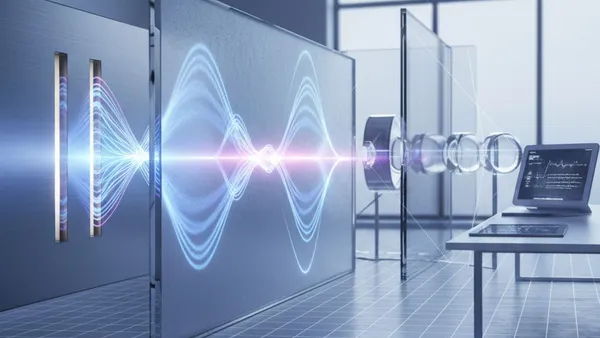
This phenomenon is called diffraction. When a wave hits an obstacle or a narrow slit, it doesn't just stop. It fans out in all directions on the other side, sneaking past the edge.
Because light wavelengths are microscopic—thinner than a single human hair—we rarely notice this bending in daily life. We usually see sharp shadows and assume light only travels in straight lines.
However, when scientists pass light through an ultra-fine slit, it spreads out like a deck of cards. This effect is the definitive proof that light is a wave: it literally weaves around obstacles!
Key Takeaway
Diffraction allows light to bend around edges and spread through narrow gaps, proving its wave nature.
Test Your Knowledge
Why do we rarely notice light diffraction in our daily lives?
Natural light is total chaos. Waves from the sun or a bulb vibrate in every direction at once—up, down, sideways, and diagonally. It's a messy jumble of energy.
Polarization is the ultimate filter. Imagine shaking a rope through a vertical fence. Only the vertical waves get through; the horizontal ones are blocked. This is exactly how polarized sunglasses work.
These glasses have a microscopic grid that only lets light vibrating in one specific direction pass through to your eyes. It’s like a VIP gate for light waves.
Blinding glare from wet roads or water usually vibrates horizontally. Your polarized lenses simply delete that horizontal light. The result? Crystal-clear vision and zero squinting. That's high-performance optics for your everyday life!
Key Takeaway
Polarization acts like a directional filter, sorting chaotic light into organized vibrations.
Test Your Knowledge
How do polarized sunglasses reduce annoying glare from wet surfaces?
Track your progress, earn XP, and compete on leaderboards. Download NerdSip to start learning.