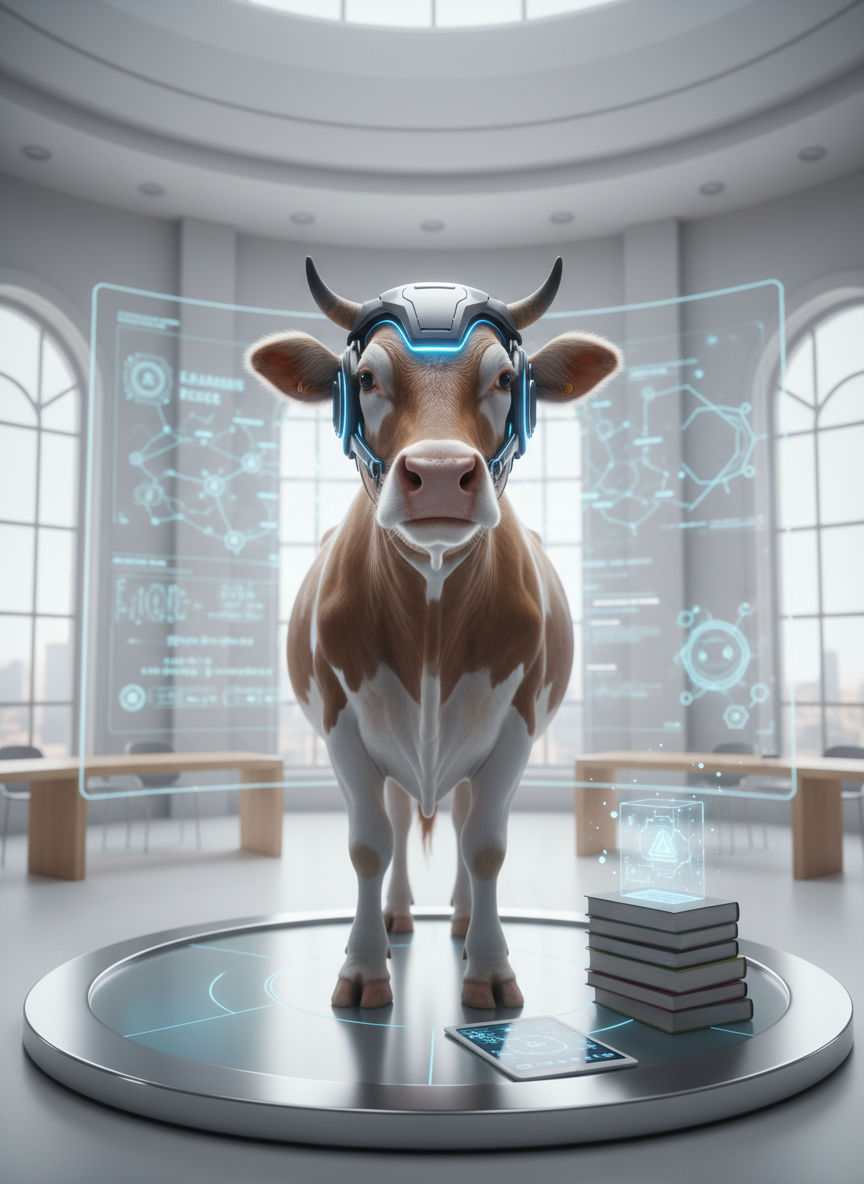
Can a cow use tools like a chimpanzee? Meet the bovine that shocked science.
Prompted by A NerdSip Learner
Discover how one cow redefined animal intelligence.
Meet Veronika, a 13-year-old Swiss Brown cow living a beautifully charmed life in the picturesque mountain villages of Austria. Unlike the vast majority of cattle globally, Veronika isn't raised for food production. Instead, she’s a beloved companion animal living peacefully on an organic farm.
For years, her owner noticed Veronika doing something highly unusual. When she got an annoying itch, she didn't just wait for a human to help or rub up against a fence post like a typical cow. Instead, she actively sought out objects—like fallen branches or sturdy sticks—to deliberately scratch herself with.
This casual, everyday observation eventually caught the attention of professional cognitive biologists. When they traveled to Austria to study her behavior in controlled trials, they quickly realized Veronika was doing something extraordinary.
She wasn't just playing; she was deliberately using tools. This single Austrian cow was about to turn our entire scientific understanding of livestock intelligence completely upside down.
Key Takeaway
Veronika is an Austrian pet cow whose unique scratching habit caught the attention of cognitive scientists.
Test Your Knowledge
Why did scientists initially travel to Austria to study Veronika?
To truly test Veronika’s cognitive abilities, scientists presented her with a common household item during their observations: a simple deck brush. What she did next was nothing short of astonishing to the researchers watching.
Veronika didn't just awkwardly rub against the brush on the ground. She actively picked it up in her mouth, positioned it carefully, and used it as a highly targeted back-scratcher. But the true scientific breakthrough was *how* she used the tool.
Scientists observed that Veronika purposefully chose entirely different parts of the brush for different jobs. When she needed to aggressively scratch her thick-skinned back, she specifically opted to use the rough bristle end.
However, when she needed to soothe an itch on her much more sensitive underbelly, she flipped the tool around and used the smooth wooden handle. This wasn't random trial and error; it was deliberate, calculated problem-solving in action.
Key Takeaway
Veronika demonstrated deliberate problem-solving by selecting different parts of a single brush for different types of scratches.
Test Your Knowledge
How did Veronika adapt her use of the deck brush?
Why is a domestic cow using a brush such a massive deal in the global scientific community? It all comes down to a specialized concept called flexible, multi-purpose tool use.
For decades, using the exact same tool in multiple ways for entirely different functions was considered an elite cognitive skill. It was a biological trait almost exclusively associated with highly intelligent, dexterous animals, like chimpanzees carefully fishing for termites.
Livestock animals, particularly cattle, were widely assumed to lack the advanced mental hardware for this level of problem-solving. In fact, cattle are rarely studied by cognitive scientists because they are historically dismissed as cognitively simple and passive.
By deliberately choosing which end of the brush to use for specific needs, Veronika crashed a very exclusive biological club. She successfully proved that the cognitive gap between a farm animal and a wild primate might be much narrower than we ever imagined.
Key Takeaway
Veronika's multi-purpose tool use is a complex cognitive skill previously associated almost exclusively with primates.
Test Your Knowledge
What makes Veronika's tool use scientifically significant?
When a chimpanzee or a human uses a stick, they have the immense biological benefit of hands and opposable thumbs. Veronika, however, has to perform all of her complex tool manipulation using only her mouth and tongue.
This physical reality makes her cognitive achievements even more impressive. Scientists carefully noted that Veronika displays remarkable dexterity and fine motor control. She has to perfectly position the heavy brush in her mouth, adapt her grip, and anticipate how her movements will affect her body.
This specific type of behavior is known in biology as egocentric tool use—meaning the tool is being used directly on the animal's own body, rather than being applied to an external object in the environment.
Despite the severe physical limitation of lacking hands, Veronika maneuvers the brush with stunning precision. It requires not just physical coordination, but the advanced mental ability to map an external object to her own physical body.
Key Takeaway
Veronika achieves precise, egocentric tool use relying entirely on her mouth and tongue.
Test Your Knowledge
What does the term 'egocentric tool use' mean in this context?
Is Veronika the solitary Einstein of the bovine world, or are all cows secretly this smart? The researchers who studied her lean heavily toward the latter. They believe Veronika isn't a genetic anomaly; she’s just incredibly lucky.
Most cows raised for traditional agriculture live relatively short lives in barren, confined, and highly regulated environments. They simply do not have the time, physical space, or interesting objects available to safely explore and innovate.
Veronika, however, lived to be 13 years old in an enriching, complex environment with daily human interaction. She had the absolute freedom and the raw environmental materials needed to let her natural intelligence shine through.
Her story serves as a powerful scientific reminder that when we assume an animal isn't smart, it might just be because we haven't given them the chance to prove us wrong. Veronika invites us to completely rethink the hidden inner lives of livestock.
Key Takeaway
Veronika's intelligence was likely unlocked by her enriched environment, suggesting other cows could be equally capable.
Test Your Knowledge
Why do researchers believe other cows haven't shown Veronika's level of tool use?
Track your progress, earn XP, and compete on leaderboards. Download NerdSip to start learning.