What makes NVIDIA's new super-rack 10x more efficient than Blackwell?
Prompted by A NerdSip Learner
Understand the hardware driving the Agentic AI revolution.
When you think of a computer chip, you probably imagine a small square of silicon sitting on a motherboard. For years, that's exactly how the tech industry bought and sold AI hardware. But with the introduction of the Vera Rubin architecture, NVIDIA is officially changing the game.
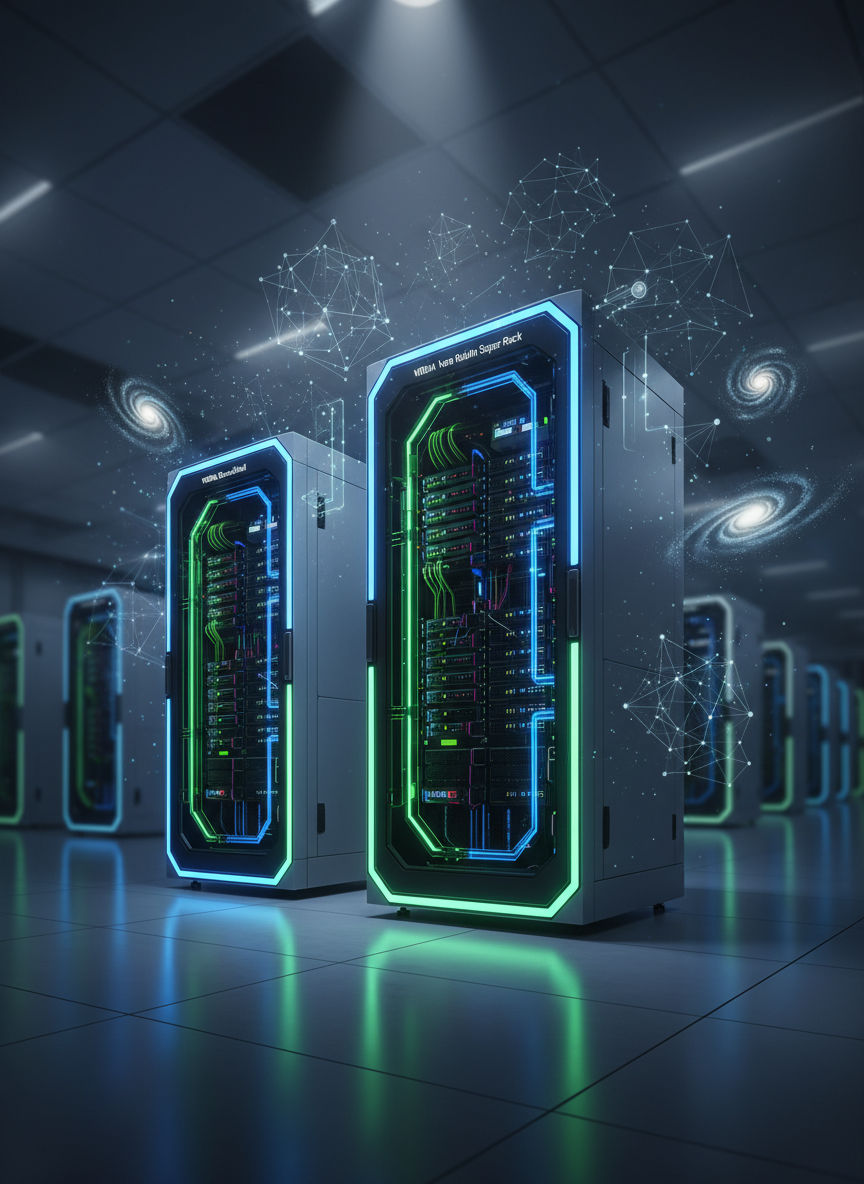
Instead of just selling individual graphics cards, NVIDIA is now focusing on the rack as the product. The flagship Vera Rubin NVL72 isn't a single chip—it's a towering, fully integrated supercomputer rack. It packs 72 GPUs and 36 CPUs functioning seamlessly as one giant, unified brain.
Why make this massive shift? As artificial intelligence models grow to trillions of parameters, connecting individual servers together creates lag. By engineering the entire rack from the ground up—including the processors, networking cables, and cooling systems—NVIDIA ensures data moves at lightning speed without bottlenecks.
For the tech world, this means buying AI infrastructure is no longer about plugging and playing single components. It's about deploying entire "AI factories" that are pre-built to handle the most demanding computational tasks in history.
Key Takeaway
NVIDIA's Vera Rubin platform shifts the focus from selling individual chips to fully integrated, rack-scale AI supercomputers.
Test Your Knowledge
What is the primary physical structure of the NVIDIA Vera Rubin NVL72?
To understand this new supercomputer, we have to look at the powerful duo inside: the Vera CPU and the Rubin GPU. NVIDIA has a tradition of naming its computing architectures after groundbreaking scientists, and this generation honors the pioneering astronomer Vera Florence Cooper Rubin.
In the previous generation, known as Grace Blackwell, the system used the Grace CPU paired with the Blackwell GPU. The Vera Rubin platform completely replaces both components with next-generation silicon. The Vera CPU is a custom-designed processor featuring 88 highly efficient cores, built specifically to manage the complex data traffic of modern AI.
Meanwhile, the Rubin GPU is the heavy lifter. Built on an incredibly advanced 3-nanometer manufacturing process, it is packed with billions of microscopic transistors. While the Blackwell GPU was a massive leap forward, Rubin is designed to process AI queries at radically higher speeds.
Together, these two processors are tightly coupled in the server rack. The Vera CPU acts as the ultimate traffic director, ensuring the Rubin GPUs never have to wait for the data they need to perform their massive calculations.
Key Takeaway
The platform pairs the new Vera CPU (the traffic director) with the incredibly powerful Rubin GPU (the heavy lifter).
Test Your Knowledge
In the Vera Rubin platform, what specific role does the Vera processor play?
One of the biggest challenges in computing isn't just doing math quickly—it's getting the numbers to the calculator fast enough. This is known as the "memory bottleneck." To beat the older Blackwell architecture, Rubin introduces two massive highway upgrades: HBM4 and NVLink 6.
Blackwell relied on HBM3e memory, which was incredibly fast for its time. However, Rubin jumps to HBM4 (High Bandwidth Memory), giving the GPU up to 288 gigabytes of memory with vastly wider data pipelines. Imagine upgrading a four-lane highway to a massive twelve-lane expressway; the data can flow into the GPU's processing cores significantly faster.
Once the data is inside, the GPUs need to talk to each other. That's where NVLink 6 comes in. It is NVIDIA's custom networking technology that allows all 72 GPUs in a rack to communicate instantly.
NVLink 6 doubles the bandwidth of Blackwell's previous NVLink 5. It delivers speeds so fast that it can move the equivalent of the entire internet's traffic in a fraction of a second, ensuring the rack truly operates as a single mind.
Key Takeaway
Upgrades to HBM4 memory and NVLink 6 networking provide wider, faster pathways for data, eliminating processing bottlenecks.
Test Your Knowledge
How does HBM4 memory improve the Rubin GPU's performance compared to Blackwell?
Speed is impressive, but the real secret weapon of the Vera Rubin platform is its incredible energy efficiency. Data centers are currently consuming massive amounts of global electricity, making power consumption the biggest roadblock for scaling AI.
NVIDIA notes that the Rubin architecture delivers up to 10x more inference throughput per watt compared to the previous Blackwell systems. This means it can generate AI responses and process massive amounts of data ten times faster while using the exact same amount of electricity!
How is this massive leap possible? Beyond the new highly efficient 3-nanometer chip design, the NVL72 rack relies heavily on direct liquid cooling. Instead of using giant, power-hungry fans to blow air over the servers, warm water is circulated directly over the components to absorb the heat.
By drastically reducing cooling energy and optimizing how the silicon processes data, Rubin allows tech companies to scale up their operations without needing to build their own dedicated power plants. It represents a transformational leap in operational economics.
Key Takeaway
Through advanced chip design and liquid cooling, Vera Rubin achieves up to 10x better energy efficiency for AI inference than Blackwell.
Test Your Knowledge
What cooling technology does the Vera Rubin NVL72 rack use to help achieve its massive energy efficiency?
You might be wondering: why do we need all this new hardware when Blackwell is already so powerful? The answer lies in the shift from basic AI chatbots to the era of Agentic AI.
Earlier AI models were mostly reactive—you ask a question, and it gives you a single answer. But Agentic AI involves autonomous "agents" that reason, plan, write code, and continuously interact with other AI agents to solve complex, multi-step problems without human intervention.
While Blackwell was an absolute powerhouse for *training* these massive AI models from scratch, Rubin is hyper-optimized for inference—the process of the AI actually running, reasoning, and generating responses in real-time.
Because Agentic AI requires continuous, non-stop processing and massive amounts of working memory, it demands a highly specialized architecture. The Vera Rubin platform, with its lightning-fast HBM4 memory and hyper-efficient Vera CPUs, provides the exact environment these AI agents need to operate seamlessly. It marks the transition from AI as a tool you prompt, to AI as an independent digital workforce.
Key Takeaway
While Blackwell excelled at model training, Vera Rubin is specifically optimized for running complex, autonomous Agentic AI in real-time.
Test Your Knowledge
What is "Agentic AI", which the Vera Rubin platform is specifically optimized to run?
Track your progress, earn XP, and compete on leaderboards. Download NerdSip to start learning.