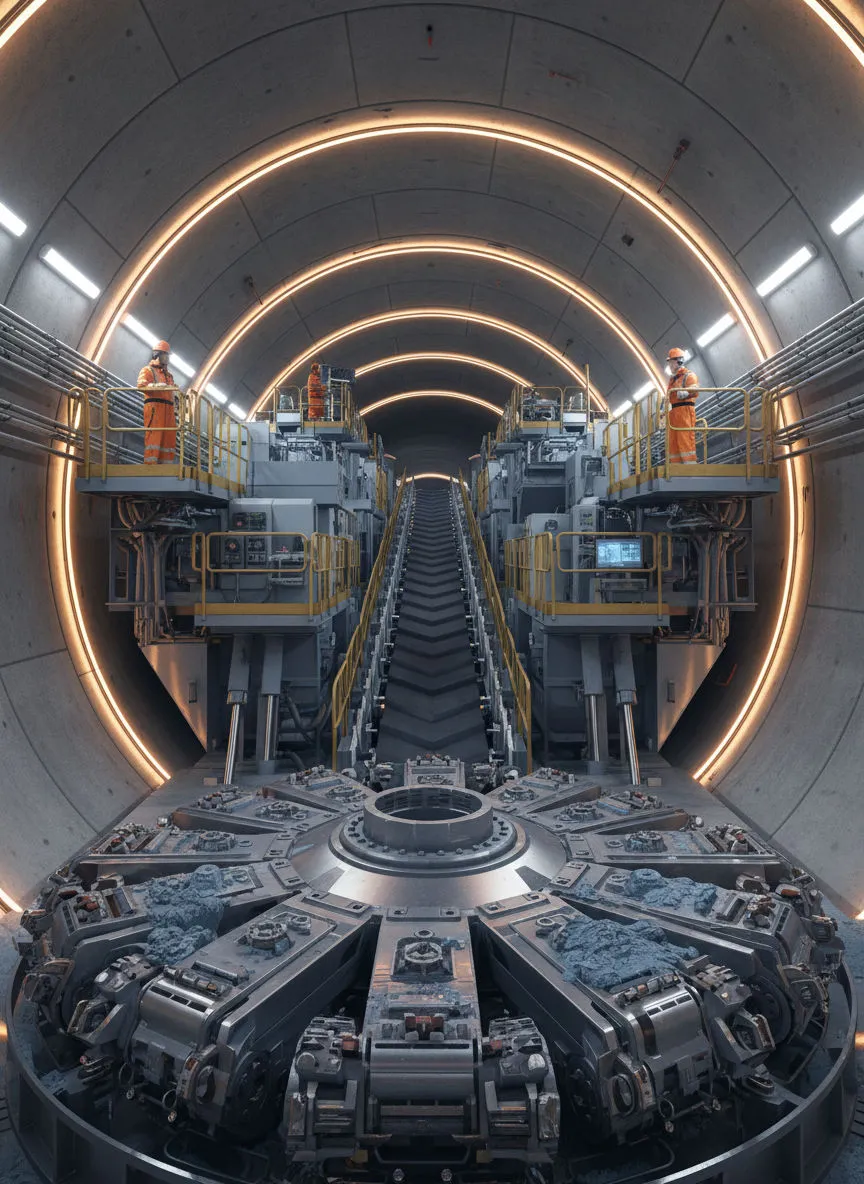
How do you drill massive tunnels without the mountain collapsing?
Prompted by A NerdSip Learner
Master the complex engineering behind modern mechanized tunneling.
A Tunnel Boring Machine (TBM) is more than just a giant drill. It’s a mobile underground factory that eats through earth and rock while simultaneously leaving a finished tunnel in its wake.
Unlike traditional blasting, which happens in slow cycles, a TBM operates continuously. While rock is excavated at the front, the middle and rear sections handle debris removal and wall installation at the same time.
The real mastery lies in tailoring the machine to the specific geology. Tunneling through solid Alpine granite requires entirely different tools than boring through soft, water-bearing sand beneath a metropolis.
TBMs must overcome two massive challenges: generating enough force to push forward while resisting the ground pressure that wants to collapse the fresh cavity immediately.
Key Takeaway
TBMs combine excavation, debris removal, and tunnel construction into one continuous process.
Test Your Knowledge
What is a key advantage of a TBM over conventional drill-and-blast methods?
The most visible part of a TBM is the rotating boring head, or cutterhead. It spans the entire tunnel diameter and is fitted with specialized tools designed specifically for the expected rock type.
In extremely hard rock, disc cutters are used. These massive steel discs are pressed against the rock with up to 30 tons of force each. They don’t shave the rock; they roll over it, creating high-tension chips that snap off the wall.
In soft ground like clay or sand, pressure isn't enough. Instead, cutting knives act like giant planes, shaving the soft material from the excavation face layer by layer.
The cutterhead also features openings. These allow the loosened material to fall into the machine's excavation chamber to be transported to the rear.
Key Takeaway
The cutterhead breaks rock using either rolling disc pressure or shaving knives, depending on the geology.
Test Your Knowledge
How do 'disc cutters' break through hard solid rock?
If the cutterhead does the work, the main bearing is the indispensable heart of the machine. It acts as the mechanical interface between the rotating head and the stationary machine shield.
This giant rolling-element bearing must withstand multiple extremes. It transmits the massive torque from the electric motors to the cutterhead while absorbing the enormous axial thrust from the hydraulic jacks.
Engineers consider the main bearing a TBM's Achilles' heel. If this component fails deep inside a mountain, repair is incredibly difficult because it cannot be replaced from the outside.
To prevent failure, it features sophisticated multi-stage sealing systems. These monitored seals ensure that abrasive rock dust or high-pressure mud cannot penetrate the bearing's inner workings.
Key Takeaway
The main bearing transmits torque and thrust to the cutterhead and is hermetically sealed to prevent failure.
Test Your Knowledge
Why is the main bearing considered one of the most critical TBM components?
How does a machine weighing thousands of tons move forward? The answer lies in the massive hydraulic thrust jacks built into the machine.
Dozens of these cylinders are arranged in a ring. Together, they exert an unimaginable force—often several thousand tons—to press the cutterhead into the excavation face.
According to physics, every action needs a reaction. In soft ground, the jacks push against the front of the most recently installed concrete ring (lining segment). Essentially, the TBM pushes itself away from the finished tunnel.
Once the cylinders reach their full extension, progress stops. The jacks retract, creating space to install the next ring. It’s a rhythmic "caterpillar" motion: push, build, repeat.
Key Takeaway
Hydraulic jacks propel the TBM forward by pushing against the already completed tunnel walls.
Test Your Knowledge
What do the thrust jacks push against in a soft-ground TBM?
When tunneling through stable rock, a TBM can often run "open." However, in soft, unstable ground, the unlined hole would collapse instantly. This is where a shield machine is required.
The namesake of this machine is the shield skin. This is a giant, cylindrical steel tube that encloses the front of the machine and the crew like a massive tank.
The shield absorbs external earth and water pressure, protecting the cavity from the cutterhead to the rear of the machine. The steel's thickness is calculated precisely for the expected ground conditions.
Only in the very back of this steel shell, the shield tail, are the permanent concrete walls installed under safe protection. Workers never leave this protected zone during construction.
Key Takeaway
The shield is a steel cylinder that protects the machine and prevents collapse in soft ground.
Test Your Knowledge
What is the primary function of the shield in soft-ground machines?
In wet, cohesive soil like clay, the excavation face—the wall right in front of the drill—risks collapsing under pressure. Engineers solved this with the Earth Pressure Balance (EPB) shield.
Instead of using external fluids, the EPB machine uses the excavated soil itself to balance the pressure. The cutterhead shaves material into a closed chamber where it is pressurized.
To create the perfect support pressure, the soil is conditioned. Special nozzles inject water and foam, turning crumbly soil into a smooth, flowing paste that actively supports the face.
The operator's skill involves using a screw conveyor to remove exactly as much material as is being excavated. This maintains a perfect balance, preventing surface sinkholes above.
Key Takeaway
An EPB shield uses foam-conditioned soil to balance the earth pressure at the excavation face.
Test Your Knowledge
How does an EPB shield actively support the excavation face?
When geology is grainy and under high water pressure—like when tunneling under rivers—the EPB system fails. This is where the Slurry Shield (Mixshield) takes over.
Instead of using soil, the excavation chamber is filled with a bentonite suspension. Bentonite is a clay mineral that swells in water. This fluid penetrates the porous ground to form an impermeable membrane: the filter cake.
This filter cake seals the face. The fluid in the chamber can then be pressurized with compressed air to counteract the external water and earth pressure with millimeter precision.
The loosened rock falls into this liquid. Massive pipes pump the mixture to the surface, where the rock is separated and the bentonite is recycled back into the tunnel.
Key Takeaway
Slurry shields support porous ground by pumping in bentonite, which creates a sealing 'filter cake' at the face.
Test Your Knowledge
What is the primary job of the bentonite suspension in a Slurry Shield?
Every centimeter of progress produces massive amounts of debris, known as muck. This must be efficiently moved to the surface without breaking the pressure balance at the face.
In Hard Rock TBMs, this is straightforward: dry rock falls through the cutterhead onto a conveyor belt system. These belts often run for kilometers along the tunnel ceiling to the exit.
In EPB Shields, removal also controls pressure. A massive screw conveyor is used. By adjusting its speed, the operator controls how fast the soil paste leaves the pressurized chamber.
In Slurry Shields, the material isn't moved dry. It is pumped to the surface as a liquid mixture through heavy-duty pipelines via a hydraulic slurry circuit.
Key Takeaway
Material removal happens via conveyor belts (rock), screw conveyors (EPB), or pipelines (Slurry).
Test Your Knowledge
Which component regulates material discharge and pressure in an EPB shield?
As the TBM bores, the raw cavity must be secured immediately. In shield machines, this happens at the rear via mechanized segmental lining.
Segments are precision-made reinforced concrete pieces weighing several tons. Inside the protected shield tail, a robotic arm called an erector uses a vacuum to place them with millimeter accuracy.
A complete ring typically consists of 5 to 8 standard segments and one smaller, wedge-shaped key stone. This key stone is pushed in last, locking the entire concrete ring into place.
Each segment features heavy-duty elastomer gaskets on its edges. Once bolted and pressed together, these gaskets create a high-strength, waterproof tunnel shell piece by piece.
Key Takeaway
Protected by the shield tail, an erector builds the permanent waterproof tunnel wall from precast segments.
Test Your Knowledge
How is the newly built tunnel ring made waterproof?
Technically, a TBM always digs a hole slightly larger than the finished concrete tube. This remaining gap between the ground and the segments is called the annular gap.
If left empty, the ground could shift, causing damage at the surface. Therefore, the gap is permanently grouted with a special cement mortar under high pressure as the machine advances.
To protect the junction between the moving steel shield and the stationary concrete ring, engineers use a tail skin seal.
Several rows of massive wire brushes, injected with grease, seal this transition. They prevent groundwater or mortar from flowing back into the TBM—a literal lifesaver for the crew.
Key Takeaway
The gap behind the segments is filled with mortar (grouting), while tail seals protect the machine from incoming material.
Test Your Knowledge
What is the main purpose of annular gap grouting?
Track your progress, earn XP, and compete on leaderboards. Download NerdSip to start learning.