Did you know a volcano in Indonesia once caused snow to fall in July in the United States?
Prompted by A NerdSip Learner
How a volcanic eruption in 1815 changed global climate and inspired Mary Shelley's Frankenstein.
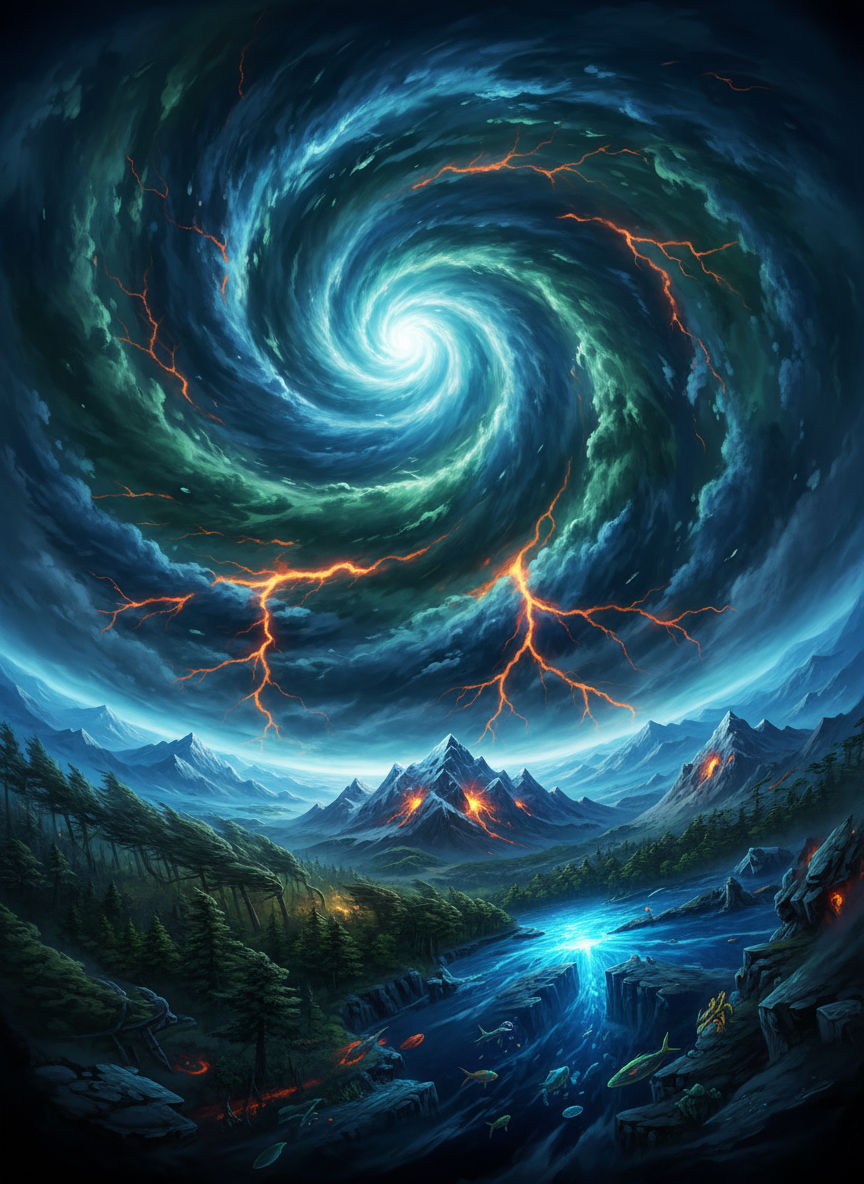
Welcome to a fascinating journey where geology meets literature! Our story begins not with a book, but with a massive explosion. In April 1815, Mount Tambora, a towering volcano located in present-day Indonesia, erupted with unimaginable force.
To this day, the Tambora eruption is considered the most powerful volcanic event in recorded human history. It registered a 7 out of 8 on the Volcanic Explosivity Index (VEI), making it far more powerful than the famous modern eruptions of Mount Vesuvius or Mount St. Helens. The explosion was so incredibly loud that it was reported to be heard hundreds of miles away!
The immediate devastation was immense, drastically reshaping the island and tragically claiming tens of thousands of lives in the surrounding region. However, the effects of this massive geological event were not limited to the local area. As we will see, Mount Tambora was about to change the weather—and the course of history—for the entire planet.
Key Takeaway
In April 1815, Indonesia's Mount Tambora produced the most powerful volcanic eruption in recorded human history.
Test Your Knowledge
Where is Mount Tambora located?
How can an eruption in Indonesia affect the whole world? The answer lies in what Mount Tambora blasted into the sky. During the eruption, an estimated 100 cubic kilometers of ash, rock, and toxic gases were violently ejected into the atmosphere.
While the heavier volcanic ash fell back to Earth relatively quickly, massive amounts of sulfur dioxide gas reached the stratosphere. High above the clouds, this gas reacted with water vapor to form a persistent, global veil of sulfate aerosols. This thick, hazy layer effectively acted like a giant planetary sunshade, reflecting a significant portion of the Sun's incoming rays back into space.
Because less sunlight was reaching the Earth's surface, global temperatures began to drop. Scientists estimate that the planet cooled by roughly 1 degree Celsius (or about 1 to 2 degrees Fahrenheit) in the months that followed. This phenomenon is known as a "volcanic winter," and it set the stage for one of the most bizarre weather years in human history.
Key Takeaway
Sulfur gases from the eruption formed a high-altitude haze that reflected sunlight, causing global temperatures to drop.
Test Your Knowledge
What term is used to describe the global cooling effect caused by a massive volcanic eruption?
By 1816, the atmospheric veil from Mount Tambora had spread across the globe. The result was a period of extreme and bizarre weather abnormalities, earning 1816 the chilling nickname: "The Year Without a Summer."
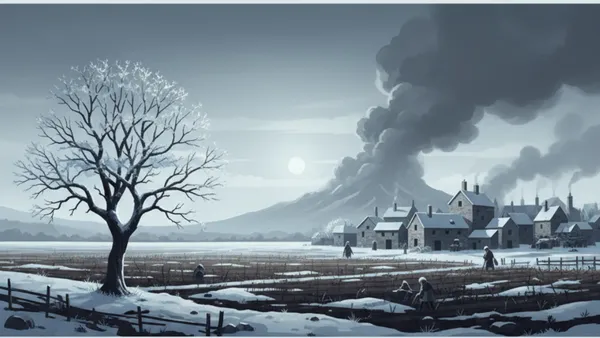
In regions accustomed to warm, sunny summers, the weather turned unseasonably cold and gloomy. The eastern United States was hit particularly hard. In June of 1816, when people normally expect warm sunshine, a major snowstorm struck New England! States like New York, Massachusetts, and Maine experienced heavy frosts and accumulating snow right in the middle of summer.
Residents were completely caught off guard. Diarists from the time reported wearing heavy winter coats and mittens in July, and witnessing small birds freezing in the streets. Rivers and lakes even formed ice during the summer months. It was a bizarre and terrifying experience for those living through it, completely unaware that a distant volcano was to blame.
Key Takeaway
In 1816, the volcanic winter caused bizarre extreme weather, including June snowstorms and summer frosts in North America.
Test Your Knowledge
What bizarre weather event occurred in New England during June of 1816?
While snow in July might sound like a quirky historical anomaly, the reality of the "Year Without a Summer" was incredibly grim. The severe and prolonged cold snaps devastated agriculture across the Northern Hemisphere.
In North America, repeated summer frosts killed off crops before they could be harvested. Corn and wheat fields were ruined, leaving little to no food for the upcoming winter. Across the Atlantic, Europe experienced relentless, freezing rains that flooded farms and destroyed harvests. The lack of sunshine and warmth meant that whatever crops didn't freeze ended up rotting in the muddy fields.
This widespread agricultural failure led to skyrocketing food prices, severe shortages, and outright famine in many parts of the world. In desperation, people foraged for wild roots and nettles just to survive. The crisis also triggered mass migrations, as thousands of New England farmers, ruined by the cold, abandoned their homes to seek better land in the American Midwest.
Key Takeaway
The extreme cold of 1816 destroyed crops across the Northern Hemisphere, leading to widespread famine and migration.
Test Your Knowledge
How did the "Year Without a Summer" primarily affect farmers in 1816?
Amidst this global climate crisis, a group of famous writers planned what was supposed to be a pleasant summer vacation. In the summer of 1816, the brilliant English poet Lord Byron rented the grand Villa Diodati, a beautiful mansion located near Lake Geneva in Switzerland.
He was soon joined by his personal physician, John Polidori, as well as the poet Percy Bysshe Shelley, his 18-year-old lover Mary Godwin (who would soon become Mary Shelley), and her stepsister Claire Clairmont. They had hoped for a season of leisurely sailing, hiking, and enjoying the beautiful vistas of the Swiss Alps.
Instead, Mount Tambora's volcanic winter ruined their plans. The group was greeted by violent thunderstorms, plunging temperatures, and dark, perpetual rain that kept them trapped indoors for days on end. Mary Godwin later described it as a "wet, ungenial summer" with "incessant rain." Confined to the gloomy, candle-lit villa, the bored and restless writers needed a way to entertain themselves.
Key Takeaway
In the summer of 1816, severe volcanic weather trapped a group of famous English writers indoors at a Swiss villa.
Test Your Knowledge
Why were Lord Byron and his guests stuck indoors during their 1816 vacation in Switzerland?
Trapped by the torrential rains, the atmosphere inside the Villa Diodati grew increasingly spooky. To pass the time, the group began reading aloud from a French translation of a German book called *Fantasmagoriana*, a collection of chilling tales about ghosts, the occult, and the supernatural.
The dark, stormy weather outside and the creepy stories inside sparked an idea in Lord Byron. On June 16, 1816, he issued a famous challenge to his guests: "We will each write a ghost story."
Everyone eagerly accepted the challenge, but coming up with a truly terrifying tale proved difficult. For several days, Mary Godwin struggled to find an idea. Every morning she was asked if she had thought of a story, and every morning she had to say no. She desperately wanted to write something that would speak to "the mysterious fears of our nature" and curdle the blood of the reader.
Key Takeaway
Inspired by the gloomy weather and a book of spooky tales, Lord Byron challenged his guests to write their own ghost stories.
Test Your Knowledge
What challenge did Lord Byron issue to his guests to pass the time?
The stormy nights at the Villa Diodati eventually yielded legendary results. After days of writer's block, Mary Godwin had a vivid "waking dream" about a pale student of unhallowed arts kneeling beside a terrifying creature he had just brought to life.
This terrifying vision became the seed for her masterpiece, *Frankenstein; or, The Modern Prometheus*, published in 1818. Mary's monster wasn't the only iconic creature born from that stormy summer, though. Lord Byron's physician, John Polidori, wrote a tale called *The Vampyre*, which became the first modern vampire story in English literature and heavily influenced Bram Stoker's *Dracula* decades later.
It is fascinating to think about how deeply interconnected our world is. An unimaginable volcanic eruption in Indonesia altered the Earth's climate, causing snow to fall in the summer and trapping a group of brilliant minds in a Swiss villa. Out of that darkness, two of the greatest monsters in literary history were brought to life!
Key Takeaway
The stormy summer of 1816 directly inspired Mary Shelley to write Frankenstein and John Polidori to write The Vampyre.
Test Your Knowledge
Alongside Frankenstein, what other famous literary monster was born from the 1816 ghost story contest?
Track your progress, earn XP, and compete on leaderboards. Download NerdSip to start learning.