Can a plant's weird shape be a survival tactic against extinct giant birds?
Prompted by A NerdSip Learner
Understand the evolution and secrets of the wire-netting bush.
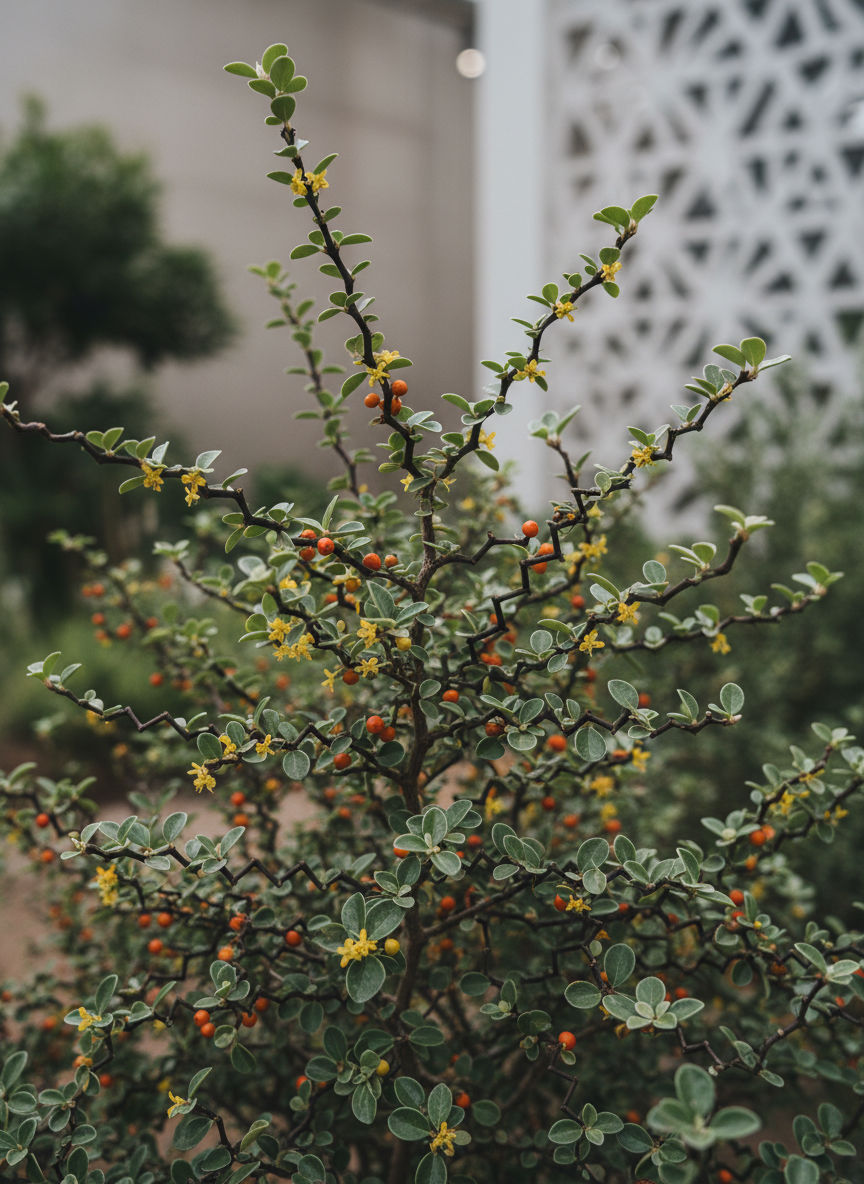
Meet the Corokia cotoneaster, a New Zealand native often called the wire-netting bush. At first glance, it looks like a chaotic tangle of dark, wiry twigs. But look closer, and you’ll see a masterclass in geometry. This plant grows in a divaricating pattern, meaning its branches zig-zag at wide angles (often exactly 45 degrees) to form a dense, protective cage.
Its leaves are tiny, almost like an afterthought, but they have a secret: the undersides are coated in a silvery-white down. When the wind blows, the whole shrub can take on a ghostly, shimmering appearance. This is why some people in New Zealand call it the 'ghost plant.'
Beyond its looks, this structural design is incredibly tough. The plant is built to withstand salt spray, high winds, and drought, making it a rugged survivor in rocky, coastal, or sub-alpine environments. It’s not just a plant; it’s a living piece of architectural art.
Key Takeaway
The Corokia cotoneaster uses a 'divaricating' zig-zag growth habit to create a tough, cage-like structure.
Test Your Knowledge
What does the term 'divaricating' refer to in this plant?
Why would a plant evolve to look like a pile of wire? One of the coolest theories in botany is the Moa Browsing Hypothesis. Scientists believe the Corokia co-evolved with the Moa, a group of giant, flightless birds that once ruled New Zealand but are now extinct.
The Moa didn't have teeth; they used their beaks to pluck and pull. The Corokia’s tangled, tough outer branches acted like a shield. By hiding its leaves deep inside a cage of stems, the plant made it almost impossible for the birds to get a full meal without snapping a twig.
Another theory suggests the zig-zag habit is an adaptation to harsh climates. The outer branches might act as a sunshade for the inner leaves, preventing 'photoinhibition' (light damage) during cold, bright winters. Whether it was fighting off giant birds or the freezing sun, this plant is a tactical genius.
Key Takeaway
The plant's cage-like structure likely evolved as a defense against the now-extinct giant Moa birds.
Test Your Knowledge
According to the browsing hypothesis, why did Corokia develop its tangled branches?
The Corokia isn't just a wild survivor; it’s a superstar in modern landscaping. Because it’s so hardy and slow-growing, it is a favorite for bonsai artists and gardeners looking for low-maintenance minimalist hedges. It can be pruned into tight, geometric shapes or left to grow naturally as a 'statement piece.'
In the spring, the bush transforms. Thousands of tiny, bright yellow star-shaped flowers appear, filling the air with a subtle, sweet fragrance. These are followed in autumn by colorful drupes (small berries) that range from bright red to orange and yellow.
These berries aren't just for show; they are a vital food source for native birds, which help spread the seeds. For a 16-year-old interested in nature or design, the Corokia is a perfect example of how function defines form in the natural world.
Key Takeaway
Corokia cotoneaster is valued in gardening for its hardiness, starry spring flowers, and bird-attracting autumn berries.
Test Your Knowledge
What type of fruit does the Corokia cotoneaster produce in the autumn?
Track your progress, earn XP, and compete on leaderboards. Download NerdSip to start learning.