What flattened 80 million trees instantly without ever hitting the ground?
Prompted by A NerdSip Learner
Master the physics of the largest impact event in recorded history.
Imagine waking up on a quiet morning in Siberia, June 30, 1908. Suddenly, the sky splits in two. A blinding blue-white light outshines the sun, followed by a shockwave so powerful it knocks people off their feet 40 miles away.
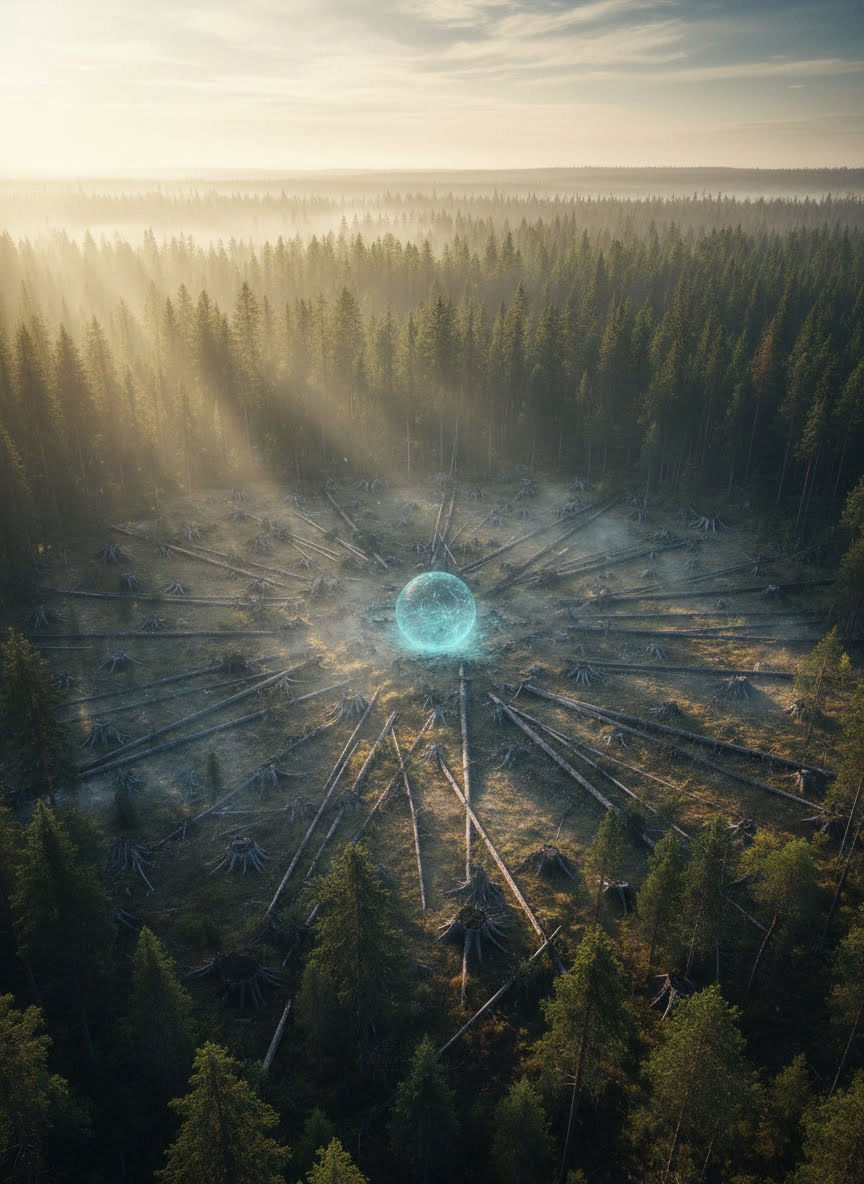
This wasn't a nuclear bomb—it was nature. The explosion flattened 80 million trees over an area the size of a major city. The shockwave circled the Earth twice! Scientists rushed to the scene expecting to find a massive hole in the ground and a giant space rock.
But here is the twist that baffled researchers for decades: there was no crater. At the epicenter, the trees were still standing upright, stripped of their branches like telephone poles, while everything around them was flattened in a radial 'butterfly' pattern. If a rock fell from space, where did it go?
Key Takeaway
The Tunguska event was a massive 1908 explosion in Siberia that flattened a forest but mysteriously left no impact crater.
Test Your Knowledge
What was the most puzzling missing piece of evidence at the Tunguska site?
So, how do you destroy a forest without touching the ground? The answer lies in a phenomenon called an airburst.
The culprit—likely a stony asteroid about the size of a 25-story building—slammed into Earth's atmosphere at roughly 33,500 miles per hour. When something moves that fast, the air in front of it can't move out of the way fast enough. The air gets compressed, creating intense heat and pressure.
The rock couldn't handle the stress. At an altitude of about 3 to 6 miles up, the pressure exceeded the strength of the rock, causing it to detonate. It released the energy of 185 Hiroshima bombs instantly. The shockwave slammed downward, stripping the trees directly below (the epicenter) and flattening everything else outward. It turned the atmosphere into a giant hammer.
Key Takeaway
An airburst happens when a meteor explodes due to atmospheric pressure before hitting the ground, causing widespread damage via shockwaves.
Test Your Knowledge
Why did the space rock explode before hitting the ground?
For a long time, Tunguska felt like a freak accident. But in 2013, it happened again—on a smaller scale. A meteor exploded over Chelyabinsk, Russia, blowing out windows in thousands of buildings and injuring over 1,000 people with flying glass.
Events like Tunguska happen roughly once every few centuries. While that sounds rare, it’s frequent enough that scientists take Planetary Defense seriously. We now have telescopes constantly scanning the skies for Near-Earth Objects (NEOs).
The goal isn't just to watch, but to act. Missions like NASA's DART spacecraft have already proven we can crash into an asteroid to change its course. We are no longer just looking up and hoping for the best; we are learning how to nudge the cosmos back!
Key Takeaway
Tunguska-class events are rare but real threats, driving modern science to develop planetary defense systems like asteroid deflection.
Test Your Knowledge
Which 2013 event proved that airbursts are still a modern threat?
Track your progress, earn XP, and compete on leaderboards. Download NerdSip to start learning.