Did a single volcano almost delete the human race 74,000 years ago?
Prompted by A NerdSip Learner
Discover how 5,000 survivors saved the human species.
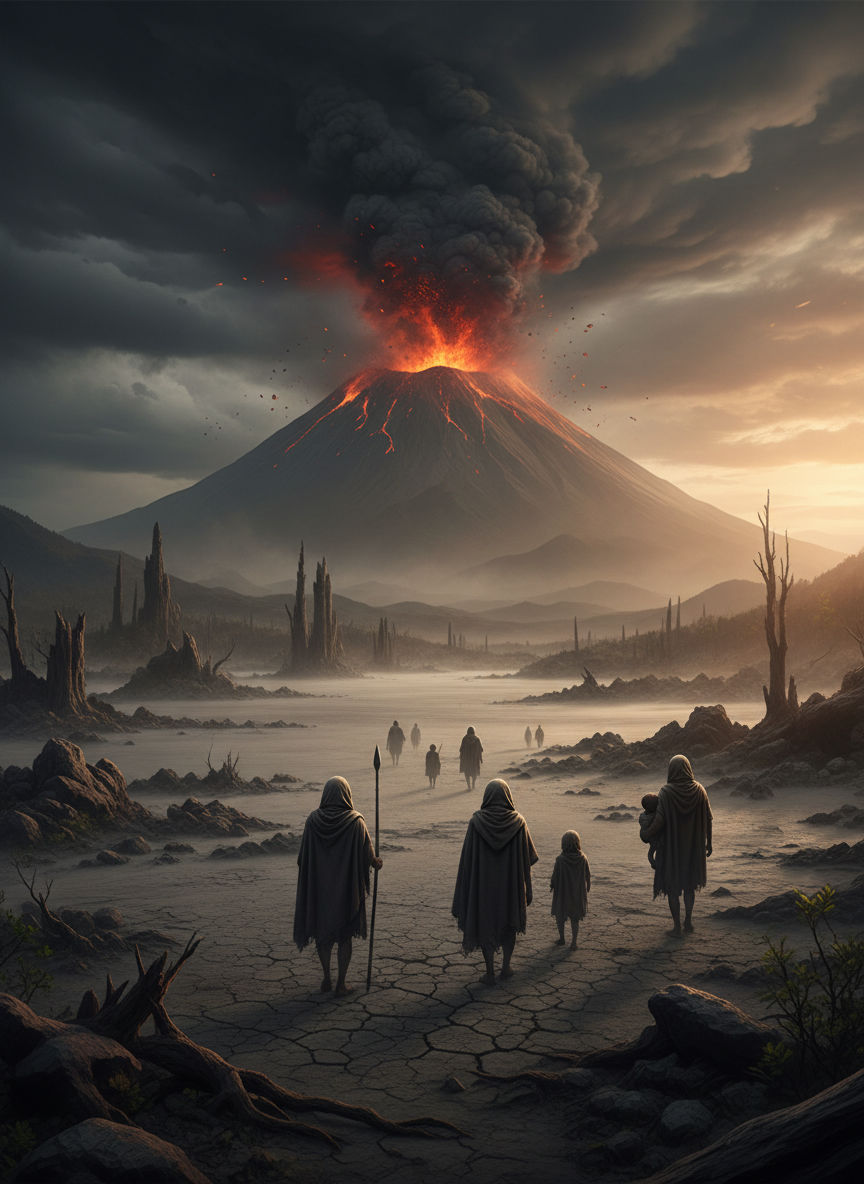
Roughly 74,000 years ago, a supervolcano known as Mount Toba in Sumatra, Indonesia, produced the largest volcanic eruption in the last 2 million years. To put it in perspective, this explosion was roughly 1,000 times more powerful than the 1980 eruption of Mount St. Helens.
The blast ejected a staggering 2,800 cubic kilometers of ash and rock into the atmosphere. This wasn't just a local disaster; the resulting ash cloud blanketed the Indian subcontinent in layers several centimeters thick and sent a massive plume of sulfur dioxide circling the globe.
Imagine a world where the sun was literally blotted out for weeks. This event, categorized as a VEI-8 super-eruption, didn't just change the landscape; it altered the very chemistry of our atmosphere, setting the stage for a global crisis that would test the survival of every living thing on Earth.
Key Takeaway
The Mount Toba eruption was a 'super-event' that released enough ash to bury large parts of Asia and darken the global sky.
Test Your Knowledge
How does the Toba eruption compare to the 1980 Mount St. Helens eruption?
The immediate blast was only the beginning. The sulfur ejected into the stratosphere combined with water vapor to create a shimmering haze that reflected sunlight back into space. This triggered what scientists call a volcanic winter.
Global temperatures are estimated to have dropped by 3 to 5 degrees Celsius (and some models suggest even more), potentially plunging the Earth into a decade of freezing conditions. This sudden cooling caused a massive die-off of vegetation, leading to the collapse of food chains.
For early *Homo sapiens*, this meant their familiar hunting grounds became frozen wastelands. With plants dying and animals migrating or perishing, our ancestors faced a choice: adapt or vanish. This environmental pressure is believed by many scientists to have been the primary driver behind a massive drop in the human population.
Key Takeaway
The eruption triggered a decade-long 'volcanic winter' that decimated food sources and global temperatures.
Test Your Knowledge
What caused the 'volcanic winter' after the Toba eruption?
Why do humans today have so little genetic diversity? Compared to a single troop of chimpanzees, 8 billion humans are remarkably similar. The Toba Catastrophe Theory suggests that during this crisis, the human population crashed to as few as 3,000 to 10,000 individuals.
This 'bottleneck' meant that only a tiny fraction of the human gene pool survived. We are all descendants of that small group of survivors who likely found 'refugia'—safe havens with stable water and food, possibly along the coasts of Africa or India.
While some modern archaeologists debate if Toba was the *only* cause, our DNA clearly shows a period where humanity nearly flickered out. This shared history means every person on Earth today is essentially a distant cousin, carrying the genetic legacy of those few thousand brave ancestors who endured the world's darkest decade.
Key Takeaway
Modern humans have low genetic diversity because we are all descended from a tiny group of survivors who made it through a prehistoric population crash.
Test Your Knowledge
What does a 'genetic bottleneck' refer to in human history?
Track your progress, earn XP, and compete on leaderboards. Download NerdSip to start learning.