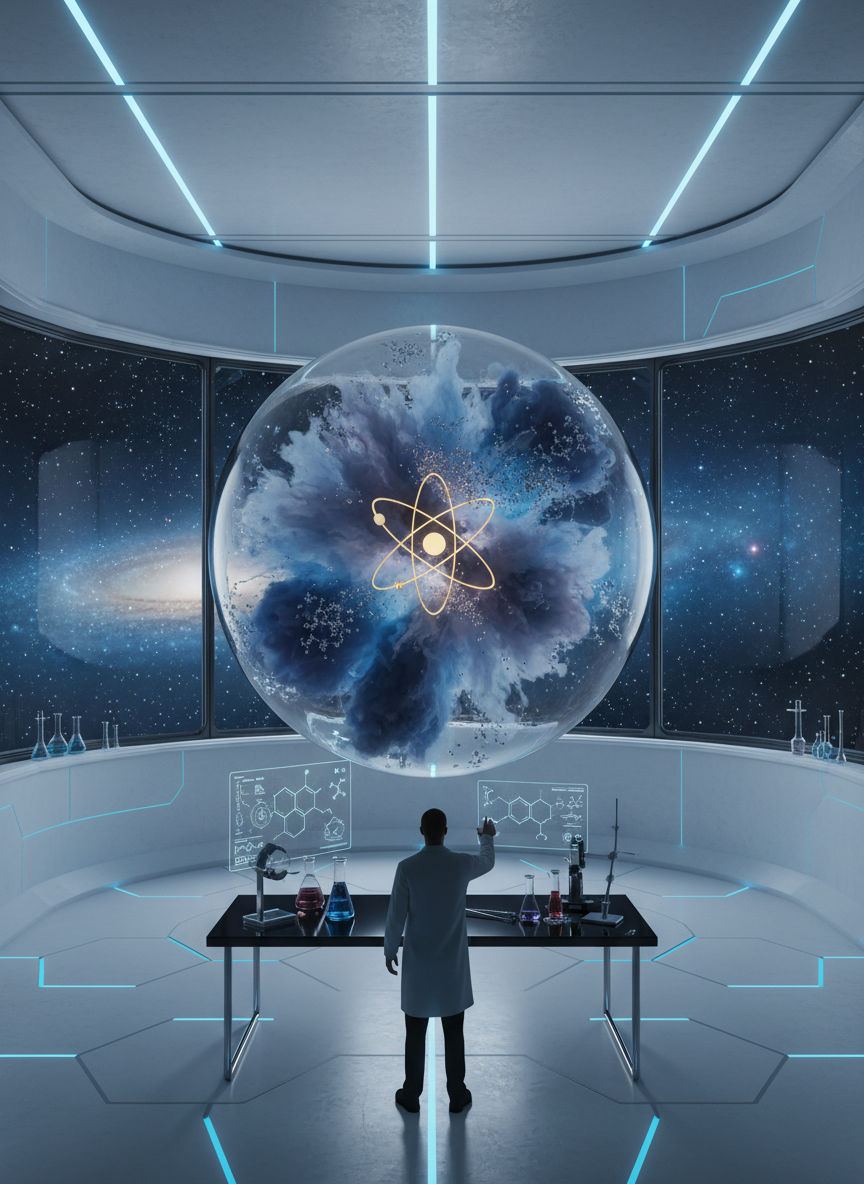
What does the empty vacuum of space actually smell like?
Prompted by A NerdSip Learner
Discover the bizarre chemistry behind the scent of the cosmos.
Have you ever wondered what the final frontier smells like? Since space is a near-perfect vacuum, you can't exactly roll down your spaceship window and take a deep breath. If you tried, you wouldn't survive to tell the tale!
So how do we know what space smells like? The secret lies in the airlock. When astronauts perform spacewalks outside the International Space Station, their spacesuits are exposed to the harsh, unfiltered environment of our solar system.
When they return inside and the airlock repressurizes, they take off their helmets. Immediately, a distinct, pungent odor wafts off their suits, helmets, gloves, and tools. The vacuum of space might be completely empty of breathable air, but it is actually filled with tiny, odor-causing particles that love to hitch a ride back indoors.
Key Takeaway
We know the smell of space because odor-causing particles cling to astronauts' suits and equipment during spacewalks.
Test Your Knowledge
How do astronauts experience the smell of space?
If you ask an astronaut to describe the scent of our solar system, they won't say it smells like nothing. In fact, they usually describe a complex bouquet of bizarre, industrial, and surprisingly savory aromas that linger long after a spacewalk.
Astronauts have compared the smell of space to a strange mix of hot metal, spent gunpowder, and sweet-smelling welding fumes. Others have described distinct notes of burnt almond cookies, brake pads, and even walnuts.
But the most famous and frequent comparison? Seared steak. Many space explorers report that the scent wafting off their heavy protective gear smells almost exactly like a charcoal grill on a late summer evening. The overall consensus among those who have been there is that our immediate cosmic neighborhood has a heavy, burnt, and distinctly metallic profile.
Key Takeaway
Space smells surprisingly like a summer barbecue mixed with a metal fabrication shop.
Test Your Knowledge
Which of the following is a common description of the smell of space?
Why does the freezing, empty vacuum of space smell like a weekend barbecue? For the answer to this cosmic mystery, scientists point to the dramatic, explosive deaths of ancient stars.
When massive stars finally reach the end of their lives, they release incredible amounts of energy and spew raw matter across the universe. This violent, interstellar combustion produces highly pungent compounds known as Polycyclic Aromatic Hydrocarbons (PAHs).
These PAHs float endlessly through the cosmos, clinging to comets, meteors, space dust, and eventually, the fabric of astronaut spacesuits. The most fascinating part? We have these exact same PAHs right here on Earth. They are the very same chemical compounds found in coal, crude oil, and the charred, blackened bits of a severely overcooked burger.
Key Takeaway
Dying stars create molecules called PAHs, which are the same compounds that make burnt food smell charred.
Test Your Knowledge
What celestial event is primarily responsible for creating Polycyclic Aromatic Hydrocarbons (PAHs)?
While PAHs explain the burnt steak aroma, they don't fully explain the sharp, metallic tang of "welding fumes" that astronauts report. For that, scientists look to a fascinating chemical reaction happening right inside the airlock.
Space is full of atomic oxygen—single, unattached oxygen atoms floating freely. During a spacewalk, these solitary atoms stick to the exterior fabric of an astronaut's suit.
When the astronaut re-enters the space station, the airlock floods with normal, breathable molecular oxygen (O2). The single oxygen atoms on the suit violently combine with the O2 in the room to form Ozone (O3). This process, a rapid form of oxidation, creates a sharp, acrid, and highly metallic scent. So, part of the "smell of space" is actually a chemical reaction happening right under the astronaut's nose!
Key Takeaway
The metallic scent of space is largely caused by ozone, which is created during a chemical reaction in the airlock.
Test Your Knowledge
What molecule is formed in the airlock that creates a sharp, metallic smell?
Our local solar system might smell heavily of gunpowder and ozone, but the rest of the universe offers a much wider, and sometimes significantly sweeter, menu of scents.
Different regions of space contain entirely different chemical makeups. For example, astronomers have pointed their telescopes at Sagittarius B2, a massive dust cloud located near the center of the Milky Way galaxy.
Within this vast cloud, they detected a chemical compound called ethyl formate. On Earth, ethyl formate is the exact chemical responsible for giving raspberries their sweet, tart flavor, and it also provides the distinct, aromatic scent of rum. So, if you were to somehow take a safe breath in the center of our galaxy, it might smell like a fruity, intergalactic cocktail!
Key Takeaway
Different parts of the universe have unique chemical makeups, meaning places like the center of our galaxy smell like raspberries and rum.
Test Your Knowledge
What chemical compound gives the Sagittarius B2 cloud the scent of raspberries and rum?
Track your progress, earn XP, and compete on leaderboards. Download NerdSip to start learning.