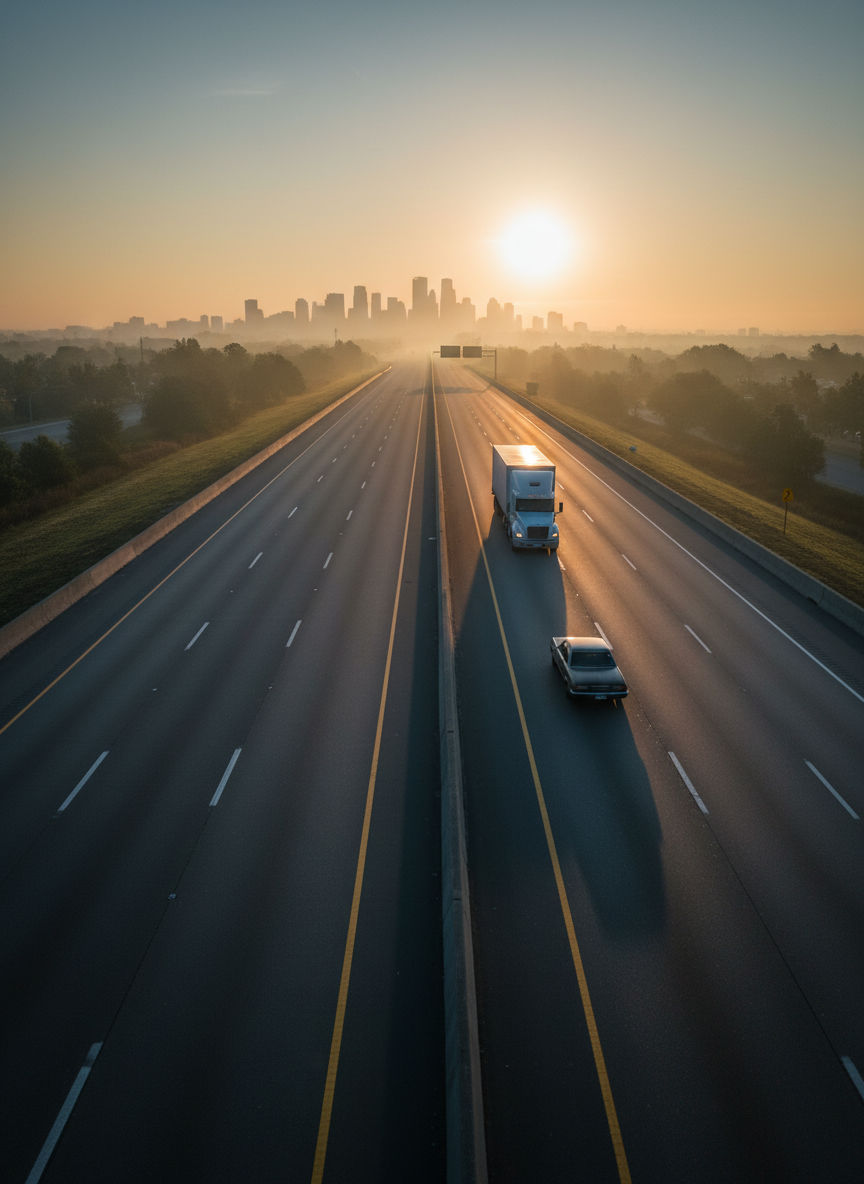
Why does the lane next to you always seem to move faster?
Prompted by A NerdSip Learner
Understand the psychology and physics of traffic illusions.
We’ve all been there: you’re stuck in a miserable commute, and the lane next to you is zooming by. Frustrated, you signal, find a gap, and switch lanes. But almost instantly, your new lane grinds to a complete halt, and the lane you just left begins to speed up. Are you cursed by the universe?
Actually, science says no. The intense feeling that you are always stuck in the absolute slowest lane is mostly a psychological and mathematical illusion.
In 1999, researchers Donald Redelmeier and Robert Tibshirani decided to investigate this exact phenomenon. They used advanced computer simulations of congested roadways to study how drivers perceive speed in heavy traffic.
Their findings were surprising. They discovered that even when two parallel lanes have the exact same average speed over time, drivers consistently perceive the *other* lane as moving faster. The grass is always greener on the other side of the white dashed line. Your feeling of being uniquely unlucky in traffic is actually a well-documented cognitive illusion shared by millions of drivers every single day.
Key Takeaway
Your feeling of being cursed in traffic is a scientifically proven cognitive illusion.
Test Your Knowledge
What did researchers find when they simulated two traffic lanes moving at the exact same average speed?
To understand why the other lane always seems faster, we have to look closely at the physical dynamics of traffic flow. It all comes down to how vehicles occupy space at different speeds.
Vehicles naturally spread out when they are moving fast to maintain a safe stopping distance. Conversely, they pack tightly together bumper-to-bumper when they are moving slowly.
Imagine your lane is currently slow and tightly packed, while the adjacent lane is moving quickly. Because that fast lane is highly spread out, you will only watch a few cars whiz by you.
But when the roles inevitably reverse—your lane speeds up and the other lane slows down—you will zoom past a very large number of tightly packed cars in a very short amount of time. Because of this, you spend significantly more *total time* watching cars pass you than you do actively passing them. This creates a powerful illusion that you are losing the race, even if you are passing the exact same number of cars!
Key Takeaway
You spend more time being passed than passing because fast cars spread out while slow cars pack together.
Test Your Knowledge
Why do you spend more total time watching cars pass you than you do passing them?
Human attention and visual processing play a massive role in reinforcing the slow-lane illusion. When you are driving a car, you naturally direct the vast majority of your attention forward through the windshield. Your brain is wired to focus on what is ahead of you to avoid crashing.
Because of this necessary forward focus, when you finally pass a car in the adjacent lane, it quickly disappears into your rearview mirror and out of your conscious mind. Mentally, passed cars become invisible almost immediately.
However, when a car passes *you*, it enters your primary forward field of vision. It stays visible through your windshield for a prolonged period, constantly reminding you that it 'beat' you.
Furthermore, you tend to make comparison glances at the other lane much more often when you are sitting idle in a dead stop. This combination of visual bias and idle frustration tricks your brain into heavily remembering the cars that overtake you, while completely forgetting the ones you left in the dust.
Key Takeaway
Cars that pass you stay in your forward vision, while cars you pass quickly disappear from your mind.
Test Your Knowledge
How does our natural driving focus contribute to the slow-lane illusion?
If you are driving on a standard multi-lane highway, simple mathematical probability is also working against your perception. It is not just your brain playing tricks on you; it is the reality of fractions.
Let’s say you are driving on a busy highway with three lanes of traffic. Assuming the flow of traffic is relatively randomized, what are the exact odds that your specific lane is currently the absolute fastest moving lane? It is exactly 1 in 3, or roughly 33 percent.
This means there is a 67 percent chance that at least one of the other lanes is moving faster than yours at any given snapshot in time.
When you sit in your single lane and intuitively compare your speed against the combined probability of *all* the other lanes, you are mathematically guaranteed to feel like you are losing most of the time. You aren’t an unlucky driver; you are just experiencing the inescapable laws of probability playing out on the asphalt!
Key Takeaway
On a three-lane highway, there is mathematically a 67% chance that a lane other than yours is moving faster.
Test Your Knowledge
On a three-lane highway, what is the probability that a lane OTHER than yours is the fastest?
So, knowing all of this, should you aggressively switch to that faster-looking lane? Traffic experts and safety data overwhelmingly say no.
The constant, frustrating starting and stopping in heavy traffic is often caused by phantom traffic jams. This phenomenon occurs when just one driver taps their brakes. The driver behind them overreacts and brakes slightly harder, creating a backward-traveling shockwave of stopped cars that can persist for miles.
When you impatiently switch into a 'faster' lane, you cut off the cushion of space for the driver behind you. You force them to hit their brakes to maintain a safe following distance. This single action triggers a brand new phantom jam in the lane you just joined!
Studies consistently show that excessive lane-hopping barely improves your overall arrival time—often saving mere seconds. However, it drastically increases your risk of a collision and creates ripple effects that make the overall traffic jam worse for everyone on the road.
Key Takeaway
Changing lanes triggers braking shockwaves that worsen traffic without significantly speeding up your trip.
Test Your Knowledge
What is a 'phantom traffic jam'?
Track your progress, earn XP, and compete on leaderboards. Download NerdSip to start learning.