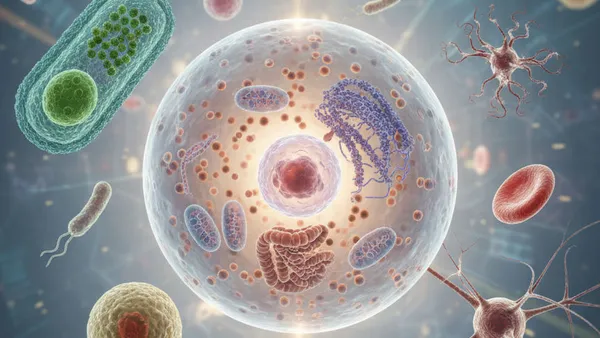
What if you are a walking city of 30 trillion tiny, living robots?
Prompted by NerdSip Explorer #6738
Master the microscopic building blocks of life.
Imagine building the most complex Lego castle in the world. No matter how huge or detailed the castle gets, it is still made of individual, tiny plastic bricks. In the natural world, those bricks are cells.
Cells are the microscopic building blocks of all living things. Every dog, tree, mushroom, and human is made of them. Some living things, like yeast, are just a single cell! But you? You are a walking metropolis made of roughly 30 trillion of them.
Even though they are incredibly tiny, each cell is actually alive. It takes in food, creates energy, grows, and responds to its environment. They aren't just empty blocks; they are tiny, bustling factories working 24/7 to keep you alive and functioning.
Key Takeaway
Cells are the living, microscopic building blocks that make up every living organism.
Test Your Knowledge
What is the best way to describe a cell?
Even though all cells are building blocks, they don't all look the same. In fact, scientists divide all cells on Earth into two main categories based on how they are organized on the inside.
Think of the first type, the Prokaryote (pro-KARE-ee-oat), like a tiny studio apartment. Everything the cell needs is floating in one open room. There are no internal walls dividing up the space. These are usually simple, single-celled organisms like bacteria.
The second type is the Eukaryote (you-KARE-ee-oat). This is like a massive mansion with separate, walled-off rooms for cooking, cleaning, and storing information. Plants, animals, and humans are made of these complex "mansion" cells.
The most important "room" in the mansion is the nucleus. It acts as a secure vault that holds the cell's master instruction manual—your DNA.
Key Takeaway
Prokaryotic cells are simple like a studio apartment, while eukaryotic cells are complex mansions with separate compartments.
Test Your Knowledge
What is a Eukaryotic cell most like?
Since you are a human, you are made entirely of animal cells. These cells are the ultimate flexible shape-shifters of the microscopic world.
Unlike a cardboard box that holds a rigid shape, an animal cell is more like a water balloon. It is surrounded by a squishy, flexible outer skin called a cell membrane. This incredible flexibility is what allows humans and animals to bend, dance, run, and move around freely.
Inside this flexible balloon is a jelly-like liquid filled with tiny machines called organelles. These little machines work together to burn the food you eat, create energy, clean up waste, and build new parts for your body.
Because they don't have hard outer walls, animal cells rely on a microscopic internal skeleton to keep from collapsing completely!
Key Takeaway
Animal cells are flexible and squishy, allowing animals and humans to move freely.
Test Your Knowledge
Why can animal cells change shape so easily?
Have you ever noticed that trees can stand hundreds of feet tall without having a skeleton made of bones? They owe this amazing superpower entirely to the brilliant design of the plant cell.
While animal cells are like squishy water balloons, plant cells are like fortresses. They are wrapped in a thick, tough outer layer called a cell wall. When millions of these rigid boxes stack together, they create incredibly sturdy structures, like thick tree trunks and tough green stems.
Plant cells also have a special superpower: they can make their own food! They contain tiny green solar panels called chloroplasts.
These chloroplasts capture energy from the sun and use it to bake sugary snacks for the plant. Thanks to this feature, plant cells are the ultimate self-sufficient fortresses!
Key Takeaway
Plant cells have rigid outer walls for structure and built-in solar panels to make their own food.
Test Your Knowledge
What allows plants and trees to stand tall without bones?
When you hear the word "bacteria," you might immediately think of getting sick. But bacterial cells are actually the hidden heroes of the natural world, and the vast majority of them are totally harmless!
Remember the "studio apartment" cells we talked about earlier? Bacteria are exactly that. They are tiny, single-celled organisms that are far smaller and simpler than human cells. But what they lack in size and complexity, they make up for in sheer numbers.
Bacteria are literally everywhere. They live deep in the soil, in the freezing oceans, and even floating in the air. Right now, there are billions of them living peacefully inside your stomach, helping you break down and digest your food!
They are the ultimate survivors of the cellular world, able to thrive in environments where no human could ever survive.
Key Takeaway
Bacteria are simple, single-celled organisms that exist almost everywhere and often help us survive.
Test Your Knowledge
Which of the following is true about bacterial cells?
Now that we know about the main types of cells, let's zoom in on your own body. You have hundreds of different *specialized* cells, each with a specific job. Let's start with red blood cells.
Think of a red blood cell as a microscopic delivery truck. Its main job is to pick up oxygen from your lungs and drive it through your veins to every single cell in your body.
To carry as much oxygen as possible, these cells do something crazy: as they mature, they actually spit out their own nucleus! By getting rid of their central "room," they make more space in the trunk for their oxygen cargo.
Because of this missing nucleus, they look like a red doughnut with a filled-in hole. They constantly zip around your bloodstream, dropping off fresh oxygen and picking up waste gas to take back to your lungs.
Key Takeaway
Red blood cells are specialized delivery cells that lose their nucleus to carry more oxygen around your body.
Test Your Knowledge
Why do mature red blood cells look like little doughnuts?
How does your brain tell your toe to wiggle in a fraction of a second? The secret lies in one of the weirdest-looking cells in nature: the neuron, or nerve cell.
If red blood cells are delivery trucks, neurons are the body's electrical wiring. Instead of being round and squishy, a neuron looks like a bizarre tree with a long trunk and wild, branching roots.
These "roots" reach out and physically connect to other neurons, forming a massive, incredibly complex web. When you want to move, think, or feel something, your brain shoots a tiny spark of electricity down these branches.
This electrical signal jumps from cell to cell at speeds of up to 260 miles per hour! It is a lightning-fast communication network that makes you exactly who you are.
Key Takeaway
Neurons are long, branching cells that use electricity to send messages around your body instantly.
Test Your Knowledge
How do neurons communicate with each other?
If you want to lift a heavy box, run a race, or even just blink your eyes, you have to rely on your muscle cells. These are the tiny biological engines that power all of your movements.
Muscle cells look very different from other animal cells. They are long, stretchy, and shaped like little tubes or cylinders. Inside these tubes are overlapping rows of microscopic fibers.
When your brain sends an electrical spark (via a neuron!) to a muscle cell, those little fibers slide over each other. This causes the whole cell to shorten and tighten up. When millions of these cells shorten at the exact same time, your entire muscle flexes!
Because they work so incredibly hard, muscle cells are packed with extra energy "power plants" to give them the immense fuel they need to keep you moving.
Key Takeaway
Muscle cells are long, stretchy tubes with internal fibers that pull together to create movement in your body.
Test Your Knowledge
What happens inside a muscle cell to make you move?
Take a look at your hand. What you are actually looking at is a massive wall of skin cells. These cells act as the ultimate microscopic bodyguards, protecting your sensitive insides from the dangerous outside world.
Skin cells are flat and shaped a bit like irregular paving stones. They lock tightly together to form a tough, waterproof barrier that keeps dirt, bugs, and bacteria out, while keeping your body's precious moisture locked in.
The amazing (and slightly gross) thing about skin cells is that the ones on the very outside of your body are actually dead! Your body constantly pushes older cells to the surface as they die.
This means you are constantly shedding dead skin cells and replacing them with fresh new ones from underneath. In fact, a huge amount of the dust in your house is actually old skin cells!
Key Takeaway
Skin cells lock tightly together to form a protective, waterproof shield for your body, with the outermost layer made of dead cells.
Test Your Knowledge
What is an interesting fact about the skin cells on the very outer surface of your body?
We've looked at delivery cells, electrical cells, engine cells, and bodyguard cells. But a single cell on its own cannot do much. The true magic happens when they decide to team up.
When a large group of the exact same type of cells works together, they form a tissue. For example, millions of muscle cells bundled together create muscle tissue. Millions of skin cells together make up skin tissue.
But the teamwork doesn't stop there. When different types of tissues combine to do a massive job, they form an organ. Your heart is a perfect example: it is an organ made of muscle tissue to pump, nerve tissue to keep the beat, and blood tissue to carry oxygen!
From simple bacteria to the trillions of cells working in perfect harmony inside you right now, cells are the ultimate proof that tiny things can achieve magnificent results.
Key Takeaway
Cells group together to form tissues, and different tissues combine to form the complex organs that keep you alive.
Test Your Knowledge
What do you call a large group of the exact same type of cells working together?
Track your progress, earn XP, and compete on leaderboards. Download NerdSip to start learning.