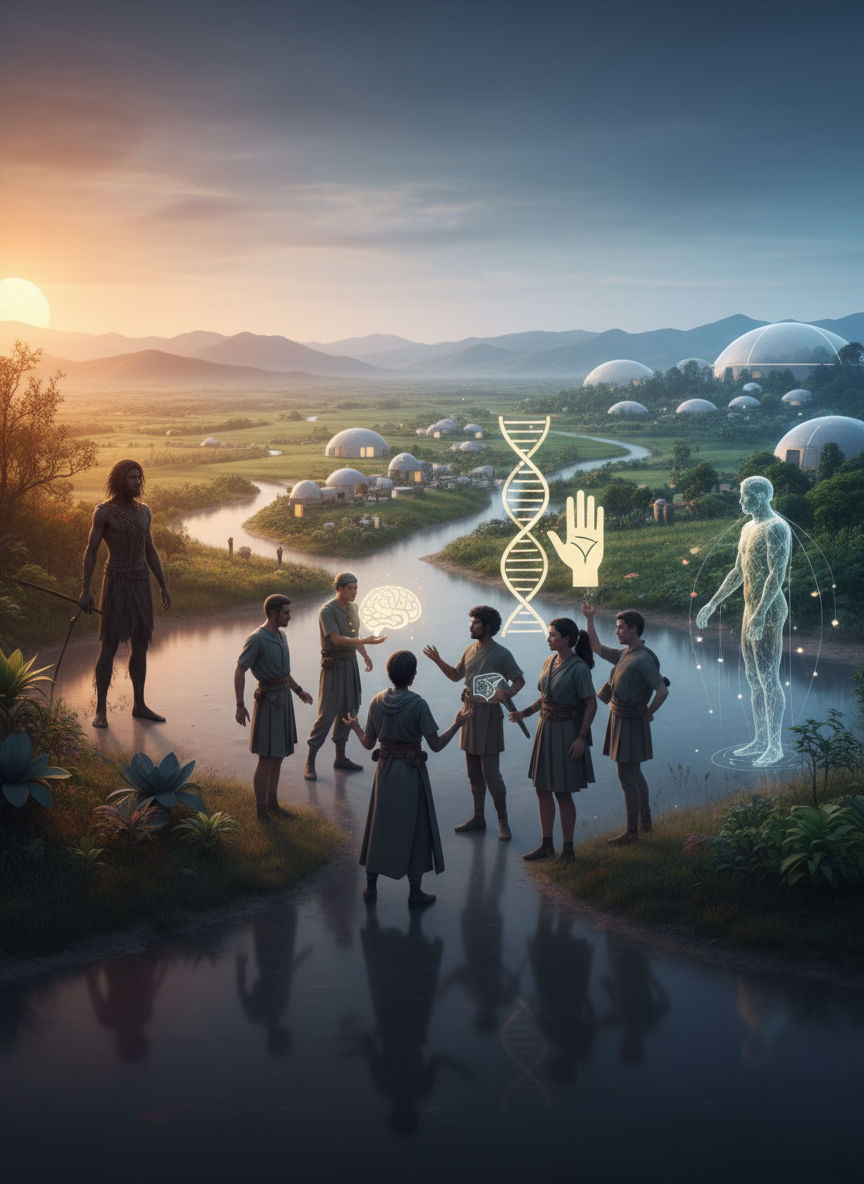
What if human friendliness was born from dark conspiracies and genetic mutations?
Prompted by A NerdSip Learner
Master the advanced science of human self-domestication.
During vertebrate development, a highly specialized group of stem cells called neural crest cells migrate throughout the embryo. They form our facial cartilage, skin pigment, and adrenal glands (which control stress hormones). Evolutionary biologists hypothesize that a mild deficit in these migrating cells causes the classic 'domestication syndrome'—resulting in smaller faces, floppy ears in animals, and reduced aggression.
In humans, scientists have pinpointed the BAZ1B gene as a master regulator of these neural crest cells. Interestingly, deleting this specific gene region in modern humans causes Williams Syndrome, a genetic condition characterized by a distinctly softer facial structure and extreme, outgoing friendliness.
When comparing our DNA to extinct relatives, researchers found that modern humans possess unique variations in the BAZ1B gene that Neanderthals and Denisovans lacked. This provides compelling genetic evidence that as we evolved to be friendlier, the biological machinery shaping our faces simultaneously changed. Our sociability and our anatomy are inextricably linked at the genetic level.
Key Takeaway
The BAZ1B gene controls neural crest cells, physically linking our softer facial anatomy to our cooperative behavior.
Test Your Knowledge
What physical mechanism links smaller facial features with reduced aggression in domesticated species?
While humans are often compared to domesticated dogs or foxes, our closest parallel in the animal kingdom is the bonobo. Chimpanzees and bonobos share a common evolutionary ancestor, but their societies are complete opposites.
Chimpanzees evolved in environments with scarce food, leading to intense competition, high male aggression, and strict hierarchies. Bonobos, however, evolved in the lush, resource-rich Congo basin where feeding competition was incredibly relaxed. This ecological abundance allowed female bonobos to travel together and form strong coalitions.
These female alliances effectively policed the group, actively thwarting and breeding out violent, alpha-male behavior. The result? Bonobos naturally "self-domesticated." They developed juvenile physical features, high social tolerance, and deep playfulness without any human intervention. They prove that nature can breed a domesticated, peaceful species purely through relaxed environmental pressures and social selection.
Key Takeaway
Bonobos self-domesticated because a resource-rich environment allowed females to form coalitions that selected against aggressive male behavior.
Test Your Knowledge
What primary environmental factor allowed bonobos to self-domesticate compared to chimpanzees?
Self-domestication isn't just about structural genes; it requires a massive biochemical overhaul. As human ancestors evolved to be less physically reactive to threats, our brains experienced a fundamental shift in hormone regulation, specifically involving serotonin and oxytocin.
These neurochemicals are heavily associated with social bonding, trust, and reduced emotional reactivity. But here is the fascinating evolutionary twist: oxytocin and testosterone are largely antagonistic.
As evolutionary pressures favored in-group cooperation, the natural rise in oxytocin and serotonin effectively suppressed the aggressive, impulsive effects of testosterone. This created a positive biochemical feedback loop. We became biologically wired to soothe rather than strike, transforming our neurochemistry to favor cuddling, parenting, and in-group cooperation over reactive violence. We didn't just learn to be nice; our chemical makeup was rewritten to make aggression physically less appealing.
Key Takeaway
An evolutionary increase in oxytocin and serotonin naturally suppressed the effects of testosterone, chemically wiring us for cooperation.
Test Your Knowledge
Which hormone acts as an antagonist to testosterone, helping to reduce reactive aggression in humans?
If early humans selected *against* aggressive, tyrannical alpha males, how did the physically weaker members of the group actually overthrow them? Anthropologist Richard Wrangham suggests a fascinating, if somewhat dark, mechanism: language-based conspiracies.
As early humans developed more complex language skills, weaker individuals were no longer at the mercy of the biggest bully. Language allowed them to whisper, gossip, and secretly plan. They could form coordinated coalitions to execute targeted, premeditated violence against tyrannical alphas.
Because of this, humans traded reactive aggression (sudden, explosive, bar-brawl rage) for proactive aggression (planned, calculated, cooperative action). By systematically conspiring to remove bullies from the gene pool, complex communication quite literally shaped our psychological evolution. We didn't just become tamer by chance; the invention of language provided the ultimate weapon for the weak to selectively breed out the aggressive.
Key Takeaway
The invention of complex language allowed weaker individuals to form coalitions and secretly plot to overthrow aggressive alpha males.
Test Your Knowledge
According to the language conspiracy theory, what type of aggression actually INCREASED as humans self-domesticated?
Not all scientists buy the self-domestication hypothesis. Critics argue that comparing humans to golden retrievers fundamentally misses the mark of what makes us human.
The domestication theory relies heavily on neoteny—the idea that we are biologically arrested in a juvenile, highly playful state. However, counterarguments suggest that humans actually undergo an *extended* and highly accelerated period of brain development, not an arrested one.
This critique proposes we didn't domesticate ourselves; we evolved unparalleled socially mediated emotional control. We still feel intense rage, jealousy, and aggression, but our massive prefrontal cortices give us the extreme emotional plasticity needed to suppress those urges. Through storytelling, music, and societal norms, we train our brains to override our primal instincts. In this view, we aren't inherently tame animals; we are simply wild apes with incredibly disciplined, culturally-programmed minds.
Key Takeaway
Critics argue humans aren't biologically domesticated, but rather possess highly advanced, socially-conditioned emotional control.
Test Your Knowledge
What do critics of the self-domestication hypothesis believe is primarily responsible for human cooperative behavior?
Track your progress, earn XP, and compete on leaderboards. Download NerdSip to start learning.