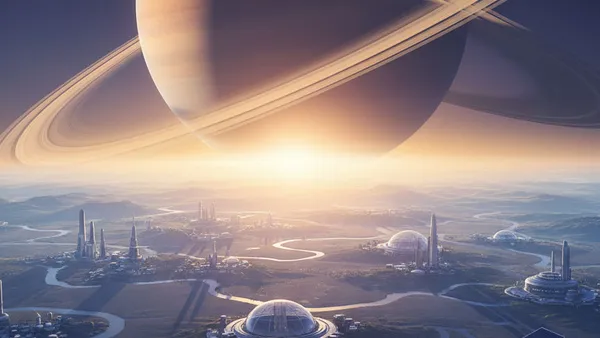
Would Saturn shred Earth to pieces?
Prompted by A NerdSip Learner
Master the extreme astrophysics of a planetary swap.
Many claim Earth would be instantly torn apart if a gas giant got this close. In astrophysics, the Roche Limit describes the critical distance where tidal forces become so intense they shred a moon into a spectacular ring system.
Luckily, physics is on our side! The Roche Limit depends heavily on the density of the objects involved. Earth is dense rock and iron (5.5 g/cm³), while Saturn is a low-density gas giant (0.69 g/cm³). For a dense object like Earth, Saturn’s Roche Limit is only about 71,000 kilometers.
Our Moon orbits at an average of 384,400 kilometers. If Saturn occupied that exact spot, Earth would be safely outside the danger zone. Instead of becoming ring debris, our planet would stay structurally intact and totally fine!
Key Takeaway
Earth survives because its high density keeps it safe far beyond Saturn’s Roche Limit.
Test Your Knowledge
Why wouldn't Earth be shredded into a ring system in this scenario?
Saturn usually chills in the dark reaches of the outer solar system, 1.4 billion kilometers from the Sun. Moving it to Earth’s orbit (1 Astronomical Unit) would shatter its chemical and thermal balance instantly.
Exposed to intense solar radiation, Saturn would transform into a class of exoplanets called 'Hot Jupiters.' The extreme heat would bloat its outer gas layers, turning it into a 'Puffy Planet' with a radius expanding far beyond its current size.
Meanwhile, the solar wind would strip away Saturn’s light hydrogen and helium atmosphere. This would create a massive, comet-like gas tail stretching millions of kilometers. Earth would pass through this surreal mist during every single orbit, experience a neon-tinted sky.
Key Takeaway
In Earth's orbit, solar heat would bloat Saturn and create a massive comet-like tail.
Test Your Knowledge
What is a 'Hot Jupiter' (or Hot Saturn) in astrophysics?
Beyond its rings, Saturn possesses a gargantuan magnetic field—a bubble of charged particles called a magnetosphere. If Earth replaced the Moon, we’d be trapped inside this intense, rotating radiation belt.
This plasma bombardment would have wild consequences. Visually, it would be stunning: global auroras would light up the night sky even at the equator in a glowing, fluorescent spectacle that would never end.
However, the physical downside is lethal. The magnetic fields of Earth and Saturn would clash and short-circuit via magnetic reconnection. This process could funnel high-energy particles into our upper atmosphere, stripping away oxygen and nitrogen. Over time, our protective air would simply bleed into space.
Key Takeaway
Earth would be trapped in Saturn's magnetosphere, causing global auroras but eroding our atmosphere.
Test Your Knowledge
What lethal effect would Saturn’s magnetic field have on Earth?
We often imagine Saturn in isolation, but it hosts a complex family of moons. Even without them, Earth’s arrival would be a massive gravitational disruption. At 50 times the mass of Titan, Earth is a heavy-hitter in this system.
Earth and Saturn wouldn't just circle each other; they’d orbit a shared center of mass called the barycenter. Since Saturn is only 95 times heavier than Earth, this point would shift outside Saturn’s core, making the gas giant wobble significantly.
Any existing moons would be thrown into chaos by Earth’s gravity. Through orbital resonances, smaller satellites would be nudged out of place, potentially crashing into Saturn, being ejected from the system, or ending up on a collision course with Earth.
Key Takeaway
Earth’s massive gravity would shift the system's center, causing Saturn to wobble significantly.
Test Your Knowledge
What happens to the shared center of mass (barycenter) in this scenario?
Our Moon takes 27 days to orbit Earth. But if Earth orbited the massive Saturn at that same distance, our speed would skyrocket due to the gas giant's immense gravity.
According to Kepler’s Third Law, an "Earth-month"—one full trip around Saturn—would shrink to just 68 hours. But there’s a catch: Saturn’s tidal forces would act like a cosmic brake on Earth’s rotation.
Earth would be forced into tidal locking. This means our rotation would synchronize with our orbit, making one day exactly 68 hours long. One side of Earth would permanently face the looming giant of Saturn, while the other side would stare eternally into the void.
Key Takeaway
Extreme tidal forces would lead to tidal locking, making an Earth day exactly 68 hours long.
Test Your Knowledge
What does 'tidal locking' mean in this planetary scenario?
Track your progress, earn XP, and compete on leaderboards. Download NerdSip to start learning.