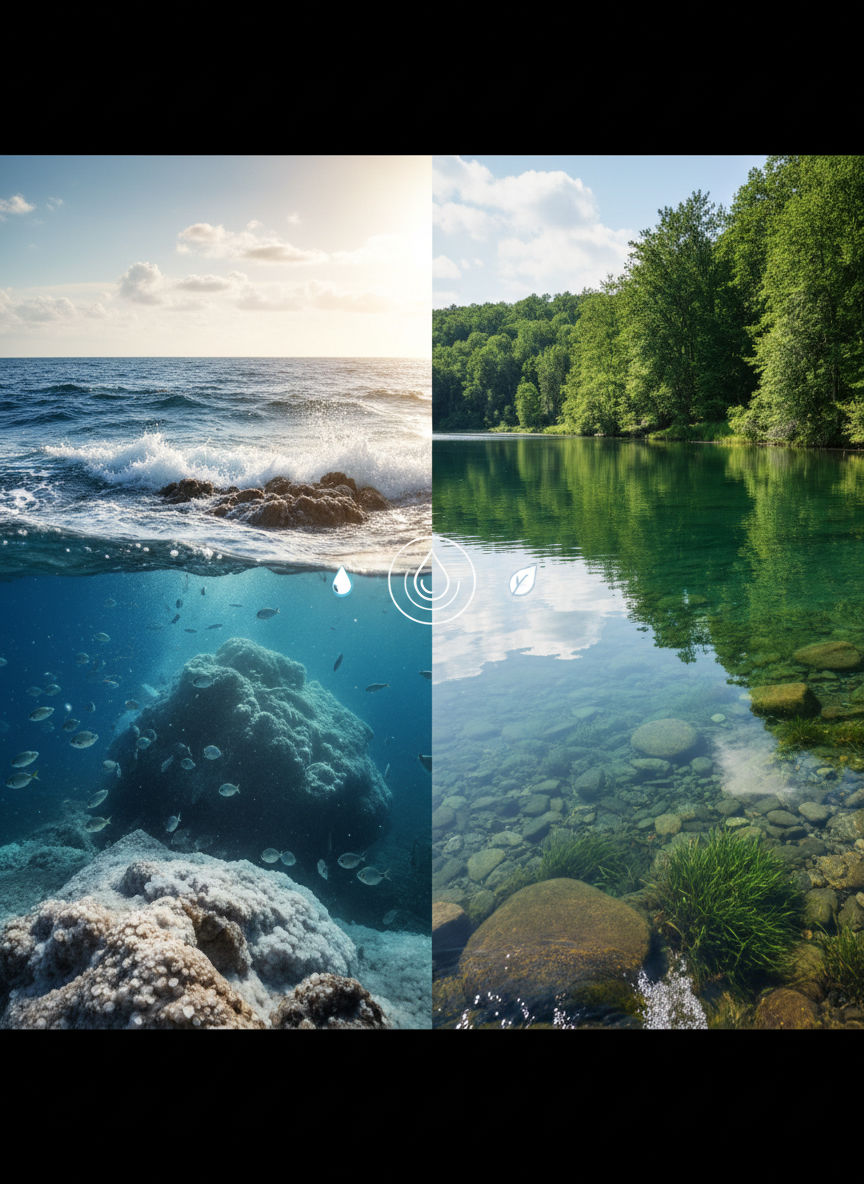
Ever wondered why oceans are salty but lakes are fresh?
Prompted by A NerdSip Learner
Discover the geological secrets of Earth's water bodies.
Have you ever tasted a raindrop? It tastes fresh, right? But believe it or not, the journey of ocean salt actually begins with rain falling from the sky.
As rain falls, it mixes with trace amounts of carbon dioxide in the atmosphere, creating a very weak carbonic acid. When this slightly acidic rainwater hits rocks on mountains and hills, it slowly breaks them down through a process called chemical weathering.
This weathering releases tiny, electrically charged particles called ions—specifically sodium and chloride, the exact two ingredients that make up salt!
These ions get washed into streams and rivers. So, technically, rivers *are* slightly salty! However, the concentration of salt is so incredibly low that our taste buds can't even detect it. The rivers act as massive conveyor belts, silently carrying millions of tons of these dissolved minerals down toward their final destination: the ocean.
Key Takeaway
Rain breaks down rocks on land, creating tiny salt ions that rivers carry away.
Test Your Knowledge
What causes rainwater to break down rocks into salt ions?
If rivers are constantly dumping salt into lakes and oceans, why are most lakes completely fresh while the ocean tastes like an accidental mouthful of regret? It all comes down to plumbing.
Think of a standard lake as a bathtub with both the faucet running and the drain wide open. Rivers flow into the lake, but other rivers also flow *out* of it, carrying water down to the sea. This constant flushing prevents any minerals or salts from building up.
The ocean, however, is a massive dead end. It sits at the lowest points on Earth, meaning water flows in, but it can never flow out.
The only way water escapes the ocean is through evaporation. When the sun heats the ocean, pure liquid turns into vapor and rises into the sky. But the heavy salt ions are left behind. Over hundreds of millions of years of water evaporating and rivers dumping more minerals, the salt just kept accumulating!
Key Takeaway
Oceans are salty because they have no outlets; water evaporates, but the salt is left behind to accumulate.
Test Your Knowledge
Why don't typical lakes accumulate salt over time?
Land isn't the only source of the ocean's seasoning. A massive amount of salt actually comes from deep beneath the waves, bubbling up from the Earth's crust itself!
In the late 1970s, scientists made a shocking discovery at the bottom of the ocean: hydrothermal vents. These are essentially underwater hot springs or geysers located along the deep ridges of the seafloor.
Ocean water seeps down into cracks in the ocean floor, where it gets superheated by magma from the Earth's mantle. This intense heat causes a chemical reaction. The water strips minerals and metals—like iron, zinc, and more salt—directly from the surrounding crust.
The scalding, mineral-rich water then shoots back up into the dark ocean through these chimney-like vents. Along with underwater volcanoes erupting and spewing minerals directly into the sea, these deep-sea vents have been pumping salt into the ocean since the Earth was young.
Key Takeaway
Hydrothermal vents and underwater volcanoes release huge amounts of dissolved minerals from the Earth's crust directly into the ocean.
Test Your Knowledge
What is a hydrothermal vent?
We established earlier that lakes aren't salty because they have rivers flowing out of them. But in nature, there are always fascinating exceptions to the rule.
Have you ever heard of the Dead Sea or the Great Salt Lake? These bodies of water are actually *saltier* than the ocean! The Dead Sea is so saturated with minerals that humans effortlessly float on its surface like corks.
These unique lakes are known as endorheic basins. This is a scientific term for a closed basin or a "terminal lake." Just like the ocean, they are located in deep depressions in the earth. Water flows into them from surrounding rivers, but there is absolutely no outlet for the water to escape.
Because the water has nowhere to go, it sits there until it evaporates under the hot sun, leaving all the dissolved minerals behind. Over thousands of years, the concentration of salt skyrockets.
Key Takeaway
Some rare lakes are incredibly salty because, just like the ocean, they have no rivers flowing out of them.
Test Your Knowledge
What is an endorheic basin?
If rivers and hydrothermal vents are constantly pumping salt into the ocean 24/7, you might be wondering: is the ocean just going to get saltier and saltier until it turns into a solid block of salt?
Surprisingly, the answer is no! The ocean’s salinity has actually remained relatively stable—or in a steady state—for hundreds of millions of years.
How is this possible? Just as salt is constantly being added to the ocean, it is also constantly being removed.
Some of the dissolved salts react with volcanic rocks on the sea floor and form brand new solid minerals, effectively pulling the salt out of the water. Additionally, billions of marine organisms use these dissolved ions to build their shells and skeletons. When they die, their shells sink to the bottom and lock the minerals away forever. It is an incredibly perfect, planet-wide balancing act!
Key Takeaway
The ocean's salt level is stable because dissolved minerals are removed by chemical reactions and marine life just as fast as they enter.
Test Your Knowledge
Why isn't the ocean getting continuously saltier over time?
Track your progress, earn XP, and compete on leaderboards. Download NerdSip to start learning.