Ever wonder what exactly happens when you flip a light switch?
Prompted by NerdSip Explorer #6258
Understand how electricity powers our modern world.
Look around you. Everything you see, including your own body, is made of incredibly tiny building blocks called atoms. At the center of an atom is a nucleus, but orbiting around it are even tinier particles called electrons.
Usually, electrons stick close to their home atom. However, in certain materials, some electrons are loosely held and can easily be pushed to the neighboring atom. When you get a whole bunch of these electrons hopping from one atom to the next in the same direction, you get electricity!
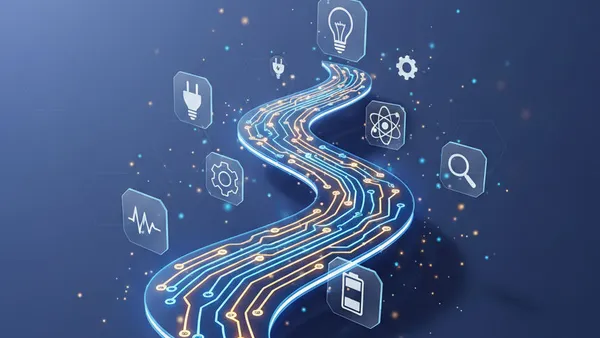
Put simply, electricity is just the organized movement of electrons. It’s an invisible river of energy flowing through the wires in your walls, your smartphone, and even your nervous system.
Every time you flip a switch, you are creating a path for these tiny subatomic particles to race through. The magic of modern engineering is figuring out how to direct that river to light up screens, heat up ovens, and keep our world spinning.
Key Takeaway
Electricity is the organized movement of tiny subatomic particles called electrons.
Test Your Knowledge
At its core, what is electricity?
To really grasp how electricity works, imagine water flowing through a pipe. This classic analogy makes the invisible forces of electricity easy to picture.
First, think about the water pressure pushing the water through the pipe. In the electrical world, this pressure is called Voltage (measured in Volts). The higher the voltage, the harder the electrons are being pushed. A tiny AA battery has low voltage (1.5V), while a thundercloud has millions of volts.
Next, look at the amount of water actually flowing past a point every second. This flow rate is called Current (measured in Amps). If voltage is the push, current is the amount of electrons doing the moving.
You can have high voltage with low current (like a static shock from a doorknob—it hurts, but it's brief and relatively harmless). Or you can have high current with lower voltage. It's the combination of the two that determines how much actual work the electricity can do!
Key Takeaway
Voltage is the pressure pushing the electricity, and current is the actual flow of electrons.
Test Your Knowledge
Using the water pipe analogy, what does Voltage represent?
If voltage is the push and current is the flow, what happens when the pipe gets narrow or clogged? In electrical terms, this restriction is called Resistance (measured in Ohms).
Resistance is the friction of the electrical world. Every material pushes back against the flow of electrons at least a little bit. When electrons encounter resistance, they bump around and release energy. This isn't always a bad thing!
In fact, we use this friction on purpose. When electricity forces its way through the highly resistant wire in a toaster, the friction generates heat. When it pushes through an old-school lightbulb filament, it generates light.
The relationship between these three forces is known as Ohm's Law. It states that the current flowing through a circuit is directly proportional to the voltage and inversely proportional to the resistance. In plain English: more push (voltage) means more flow, but more friction (resistance) means less flow.
Key Takeaway
Resistance restricts the flow of electricity, often releasing the lost energy as heat or light.
Test Your Knowledge
How do electric toasters generate heat?
Why are electrical wires made of copper, but covered in rubber? It all comes down to how tightly different materials hold onto their electrons.
Materials that allow electrons to flow easily are called conductors. Metals like copper, silver, and gold are excellent conductors because they have 'free electrons'—particles that are practically eager to detach and join the electrical river. Copper is the superstar of the group because it's highly conductive and relatively cheap.
On the flip side, we have insulators. These are materials like rubber, glass, and plastic. The atoms in insulators grip their electrons very tightly. Because the electrons can't move freely, electricity cannot flow through these materials.
This pairing is what keeps us safe. The conductive copper wire gives the electricity a superhighway to travel on, while the insulating rubber jacket acts as a guardrail, ensuring the electrons don't jump into your hand when you plug in your laptop!
Key Takeaway
Conductors let electricity flow freely, while insulators block it entirely to keep us safe.
Test Your Knowledge
Why is copper frequently used in electrical wiring?
Electricity is a bit of a homebody—it always wants to return to its source. For electricity to do any work, it must travel in a continuous, unbroken loop. We call this loop a circuit.
A basic circuit needs three things: a power source (like a battery), a path (wire), and a load (something to use the power, like a lightbulb). If you break the wire or flip a switch to 'off', you create a gap. The electrons stop moving instantly, and the power shuts off.
Electricity is also incredibly lazy; it always takes the path of least resistance. If a frayed wire touches metal, the electricity might bypass your TV and rush directly back to the source. This is a short circuit, and it causes wires to dangerously overheat.
This is also why birds can sit safely on high-voltage power lines! Because they aren't touching the ground to complete a circuit, the electricity simply stays in the highly conductive wire rather than traveling through the bird.
Key Takeaway
Electricity requires an unbroken, continuous loop (a circuit) to travel and do work.
Test Your Knowledge
Why don't birds get electrocuted when sitting on a single power line?
Not all electrical rivers flow the same way. There are two main types of electrical current that power our world: Direct Current (DC) and Alternating Current (AC).
In Direct Current, the electrons flow continuously in one single direction, like cars on a one-way street. Everything that runs on a battery—from your smartphone to an electric car—uses DC power. The energy steadily pours from the negative side to the positive side.
Alternating Current is radically different. Instead of flowing steadily forward, the electrons wiggle back and forth rapidly, switching directions dozens of times per second. This back-and-forth motion creates an energy wave that can travel massive distances across power lines without losing much energy.
This is why AC is the standard for the power grid. The electricity coming out of your wall socket is AC. When you plug in your phone, the bulky charger block actually acts as a translator, converting the wall's AC power into the steady DC power your phone's battery needs!
Key Takeaway
DC flows in one direction (batteries), while AC wiggles back and forth (wall outlets).
Test Your Knowledge
What is the primary difference between AC and DC power?
When you pay your monthly utility bill, what are you actually buying? To understand that, we need to look at Power and Energy.
Power is the rate at which electricity does work, and it’s measured in Watts. Remember our water analogy? If voltage is the pressure and current is the flow, Watts represent the total splashing force of the water hitting the wheel. A 10-watt LED bulb uses energy slowly, while a 1500-watt microwave blasts through energy quickly.
But power is only half the story. The electric company charges you for *Energy*, which is power multiplied by time. If you run a 1000-watt (1 kilowatt) appliance for one hour, you've used 1 Kilowatt-hour (kWh) of energy.
So, your electricity bill is basically a receipt for the total number of Kilowatt-hours you consumed. Leaving a low-wattage light bulb on for a minute costs almost nothing, but running a high-wattage air conditioner all day? That’s where the bill adds up!
Key Takeaway
Watts measure how fast an appliance uses power, while Kilowatt-hours measure the total energy consumed over time.
Test Your Knowledge
What standard unit does your power company use to measure and bill your energy consumption?
Electricity and magnetism might seem like entirely different forces, but they are actually two sides of the same coin. This profound discovery changed human history forever.
In the 1800s, scientists noticed something wild: whenever electricity flows through a wire, it generates an invisible magnetic field around it. Even cooler, the reverse is also true! If you take a regular magnet and physically wave it near a copper wire, the moving magnetic field will push the electrons in the wire, creating an electrical current.
This principle, called electromagnetic induction, is the secret behind almost all of our electricity generation.
Inside a power plant, giant turbines spin massive magnets around huge coils of wire. Whether those turbines are pushed by wind, falling water, or steam from burning coal, the goal is exactly the same: to spin the magnets and shove electrons down the wires to your home.
Key Takeaway
Moving a magnet near a wire pushes electrons, which is how power plants generate electricity.
Test Your Knowledge
What happens when you physically wave a magnet near a copper wire?
How does electricity get from a power plant hundreds of miles away directly into your toaster? Welcome to the Electrical Grid, one of the most complex machines ever built by humanity.
When electricity leaves a power plant, it enters a 'step-up transformer'. This device ramps the electricity up to an incredibly high voltage—sometimes over 300,000 volts! Pushing voltage this high allows the electricity to shoot across vast distances on tall transmission towers with very little energy lost.
But you can’t safely plug your TV into 300,000 volts. As the electricity gets closer to your town, it passes through substations and 'step-down transformers' (those gray cylindrical cans you see on wooden telephone poles).
These transformers gradually lower the voltage to a safe, manageable level—usually 120 or 240 volts—before it finally enters the wiring of your home. The grid is an elaborate, perfectly balanced highway system constantly routing power exactly where it's needed.
Key Takeaway
The grid uses very high voltages to transport power over long distances, stepping it down to safe levels near your house.
Test Your Knowledge
Why is electricity stepped up to extremely high voltages (like 300,000V) on large transmission towers?
Electricity is incredible, but it has a massive flaw: it’s really hard to store en masse. On the power grid, electricity is generated at the exact millisecond it is consumed.
To detach from the grid, we use batteries. But batteries don't actually hold 'bottled electricity'. Instead, they store energy as chemical potential. When you connect a battery to a circuit, a chemical reaction occurs inside, pushing electrons out. When you plug your phone in to charge it, you force electricity backward into the battery to reverse that chemical reaction.
As we shift toward renewable energy like solar and wind, energy storage is our biggest hurdle. The sun doesn't always shine, and the wind doesn't always blow when we need power the most.
To run a green grid, we need massive breakthroughs in battery technology to bank the sun's energy for nighttime use. The future of electricity isn't just about how we generate it—it's entirely about how effectively we can store it!
Key Takeaway
Batteries store electricity as chemical energy, and improving them is the key to our renewable energy future.
Test Your Knowledge
How does a battery store energy?
Track your progress, earn XP, and compete on leaderboards. Download NerdSip to start learning.