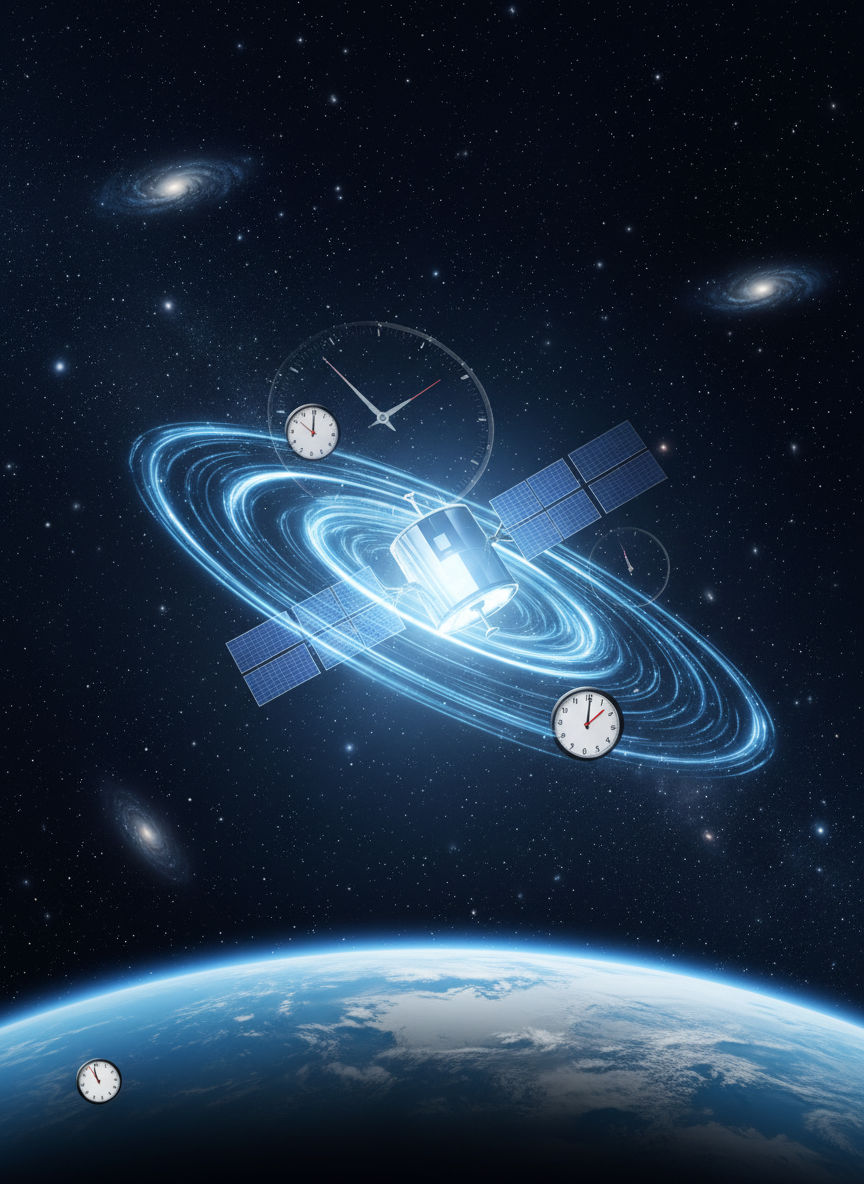
If you spent a year on a spaceship, your twin would be older than you.
Prompted by A NerdSip Learner
Explain Einstein's Theory of Special Relativity in simple terms.
Imagine you have an identical twin. You hop into a spaceship capable of traveling at 90% the speed of light, while your sibling stays comfortably on Earth. You zoom off to a distant star and return five years later according to your spaceship's calendar.
Here is the mind-bending part: When you step out of the ship, you have aged five years, but your twin on Earth might have aged ten or twenty years! Your twin is now significantly older than you, complete with gray hair and wrinkles you don't have yet.
This isn't biology or magic; it is physics. This famous thought experiment, known as the "Twin Paradox," illustrates a fundamental concept of our universe: time is not constant. It flows at different rates depending on how fast you are moving.
Key Takeaway
Time is not absolute; it passes differently for people moving at different speeds.
Test Your Knowledge
In the Twin Paradox, which twin is younger upon reunion?
To understand why time warps, we have to look at light. Light travels at approximately 300,000 kilometers per second (186,000 miles per second). In Einstein's Theory of Special Relativity, this speed (denoted as 'c') is the universal speed limit. Nothing can travel faster than light.
But here is the kicker: the speed of light is constant for everyone, regardless of how they are moving. If you shine a flashlight while standing still, the light moves away at *c*. If you shine that same flashlight while flying a jet at supersonic speeds, the light *still* moves away from you at exactly *c*.
In classical physics, speeds usually add up (if you throw a ball from a moving car, the ball moves faster relative to the ground). But light breaks this rule. Because the speed of light refuses to change, something else has to give way to make the math work. That 'something' is time itself.
Key Takeaway
The speed of light is constant and unchangeable, regardless of the observer's motion.
Test Your Knowledge
If you are in a spaceship moving at half the speed of light and turn on a headlight, how fast does the beam travel?
Before Einstein, we thought of space and time as a fixed stage where events happened. Einstein realized that motion is relative. Imagine you are sitting on a smooth, high-speed train with the shades drawn. You toss a coin in the air and catch it. To you, the coin goes straight up and down.
Now, imagine an observer standing outside watching the train pass. They see the coin move up and down, but also *sideways* because the train is rushing forward. You and the outside observer see two different paths for the same coin toss.
This is a 'Frame of Reference.' There is no 'absolute zero' state of rest in the universe. You might feel like you are sitting still right now, but the Earth is spinning and orbiting the Sun at massive speeds. Physics works the same in any 'inertial' (non-accelerating) frame of reference.
Key Takeaway
Motion is defined by your frame of reference; there is no single 'stationary' point in the universe.
Test Your Knowledge
Why does the coin toss look different to the person outside the train?
Let's combine the previous lessons. Imagine a clock that works by bouncing a particle of light (photon) between two mirrors—one on the floor and one on the ceiling. One 'tick' is the photon going up and down.
Now, put this clock on a spaceship moving incredibly fast. From inside the ship, the light just goes up and down. But from *outside* (watching the ship fly by), the light has to travel diagonally to keep up with the moving mirrors. A diagonal line is longer than a straight vertical line.
Since we know the speed of light cannot speed up to cover that extra distance, it simply takes longer for the photon to complete the trip. To the outside observer, the 'tick' takes longer to happen. The moving clock is literally running slower.
Key Takeaway
Because light must travel a longer path in a moving object, time effectively stretches out to compensate.
Test Your Knowledge
In the 'Light Clock' experiment, why does the 'tick' take longer for the outside observer?
Einstein unified the three dimensions of space (up/down, left/right, forward/backward) with the fourth dimension: time. Together, they make Spacetime. Think of your existence as moving through Spacetime at a constant speed.
Right now, sitting in your chair, you are moving almost entirely through *Time* and barely moving through *Space*. However, if you start moving rapidly through *Space* (in a rocket), you have to borrow some of that speed from your movement through *Time*.
It is a trade-off. The faster you move through space, the slower you move through time. If you could travel at the speed of light (which is impossible for mass), you would stop moving through time entirely—time would stand still for you!
Key Takeaway
Speed through space comes at the cost of speed through time.
Test Your Knowledge
What happens to your movement through time as you move faster through space?
So far, we have talked about speed causing time dilation (Special Relativity). but there is another major factor: Gravity (General Relativity). Massive objects, like Earth, the Sun, or a Black Hole, bend the fabric of spacetime.
The stronger the gravity, the more it curves spacetime, and the slower time passes. If you've seen the movie *Interstellar*, this is why the characters on the water planet (near a black hole) aged only hours while their friend on the ship aged decades.
A clock at sea level on Earth actually ticks slightly slower than a clock at the top of Mount Everest because the sea-level clock is closer to Earth's heavy center. Gravity is literally weighing down time.
Key Takeaway
Heavy gravity bends spacetime, causing time to pass slower near massive objects.
Test Your Knowledge
Where would time pass the slowest?
You might think this is all just theoretical sci-fi stuff, but you use it every day. The GPS system on your phone relies on satellites zooming around the Earth at 14,000 km/h.
Because they are moving fast, Special Relativity says their clocks should tick slower (by about 7 microseconds a day). However, because they are high up in orbit with weaker gravity, General Relativity says their clocks should tick *faster* (by about 45 microseconds a day).
Engineers have to calculate the difference (a net gain of 38 microseconds per day) and program the satellite clocks to tick slightly slower than clocks on Earth. If they didn't adjust for Einstein's relativity, your Google Maps accuracy would drift by kilometers every single day!
Key Takeaway
GPS satellites must adjust their clocks for time dilation, proving relativity is real and practical.
Test Your Knowledge
What would happen to GPS if we ignored relativity?
Track your progress, earn XP, and compete on leaderboards. Download NerdSip to start learning.