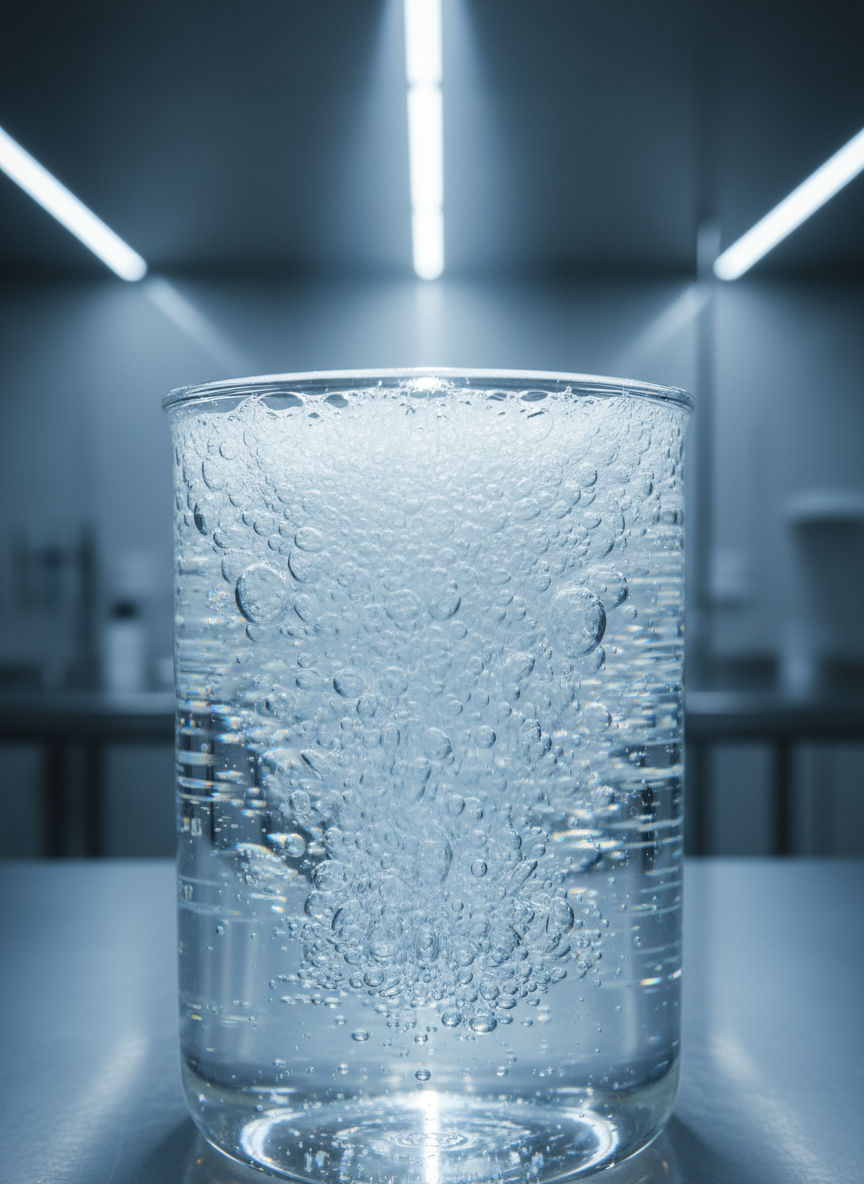
Why do liquid foams inevitably self-destruct?
Prompted by NerdSip Explorer #8712
Master the physical chemistry of foams.
In the 'wet limit' (liquid fraction > 35%), a foam is essentially just a close-packed suspension of spherical bubbles. But as liquid inevitably drains away, the foam enters the 'dry limit' (liquid fraction < 5%). Here, the spherical bubbles are forcefully compressed against one another, deforming into intricate polyhedra.
This architecture isn't random; it perfectly obeys Plateau's laws. The thin liquid films separating the bubbles—the lamellae—always meet three at a time at exactly 120-degree angles. These interconnected, liquid-filled channels are called Plateau borders.
The driving force behind this rigorous geometry is Laplace pressure. Because the films are highly curved, a pressure difference exists between the gas inside the bubble and the liquid within the Plateau border. The system continuously seeks to minimize its surface area, creating a precarious mechanical equilibrium.
In a true dry foam, exactly four of these Plateau borders converge at a single vertex, forming a tetrahedral junction at precisely 109.5 degrees. This exquisite topological arrangement minimizes interfacial free energy, setting the stage for the foam's eventual decay.
Key Takeaway
Foam architecture transitions from spherical to polyhedral, strictly governed by Plateau's laws and Laplace pressure.
Test Your Knowledge
What angle governs the meeting of three liquid films in a dry foam's Plateau border?
Because liquid foams possess a massive air-water interfacial area, they exist entirely out of thermodynamic equilibrium. Their eventual demise is inevitable, driven by three entangled kinetic mechanisms: drainage, coalescence, and coarsening.
Gravitational and capillary drainage forces the continuous liquid phase to flow downward through the intricate network of Plateau borders. As the liquid fraction plummets, the thin films separating the bubbles become critically thin, increasing the likelihood of catastrophic rupture (coalescence).
Simultaneously, the foam undergoes a structural evolution known as coarsening, or Ostwald ripening. According to the Young-Laplace equation, the internal pressure of a given bubble is inversely proportional to its radius. Consequently, smaller bubbles harbor a significantly higher internal gas pressure than their larger neighbors.
This stark pressure gradient drives a relentless, slow diffusion of gas directly through the liquid lamellae. Smaller bubbles steadily shrink and vanish, while larger bubbles gorge on the displaced gas and swell. This topological reshuffling ensures the foam's average bubble size perpetually increases.
Key Takeaway
Foams relentlessly decay as liquid drains out and gas diffuses from high-pressure small bubbles to low-pressure large bubbles.
Test Your Knowledge
In the context of foam coarsening, why does gas diffuse from smaller bubbles to larger ones?
If foams are thermodynamically doomed to collapse, how do a glass of beer or a fire-extinguishing froth persist? The secret lies in the dynamic, kinetic armor provided by surfactants. Merely lowering the static surface tension of the liquid is insufficient to prevent rapid film rupture.
The primary kinetic stabilizing mechanism is the Gibbs-Marangoni effect. When a liquid lamella is suddenly stretched by external stress or internal drainage, the local concentration of adsorbed surfactant molecules plummets. This creates an immediate interfacial gradient: the localized spike in surface tension violently pulls sub-phase liquid back into the thinned region, effectively 'healing' the film.
Furthermore, as the liquid film thins down to a few nanometers, macroscopic fluid mechanics give way to complex intermolecular interactions. A repulsive force known as disjoining pressure emerges between the two opposing gas-liquid interfaces.
Driven by steric hindrance and electrostatic repulsions between the hydrophilic surfactant headgroups, this disjoining pressure acts as a fundamental physical barrier. It directly opposes the capillary suction from the Plateau borders, halting further thinning and preserving the fragile architecture.
Key Takeaway
Surfactants grant kinetic stability to foams through self-healing Marangoni flows and repulsive disjoining pressure in the nanometer-thin films.
Test Your Knowledge
How does the Gibbs-Marangoni effect help 'heal' a stretching foam film?
Track your progress, earn XP, and compete on leaderboards. Download NerdSip to start learning.