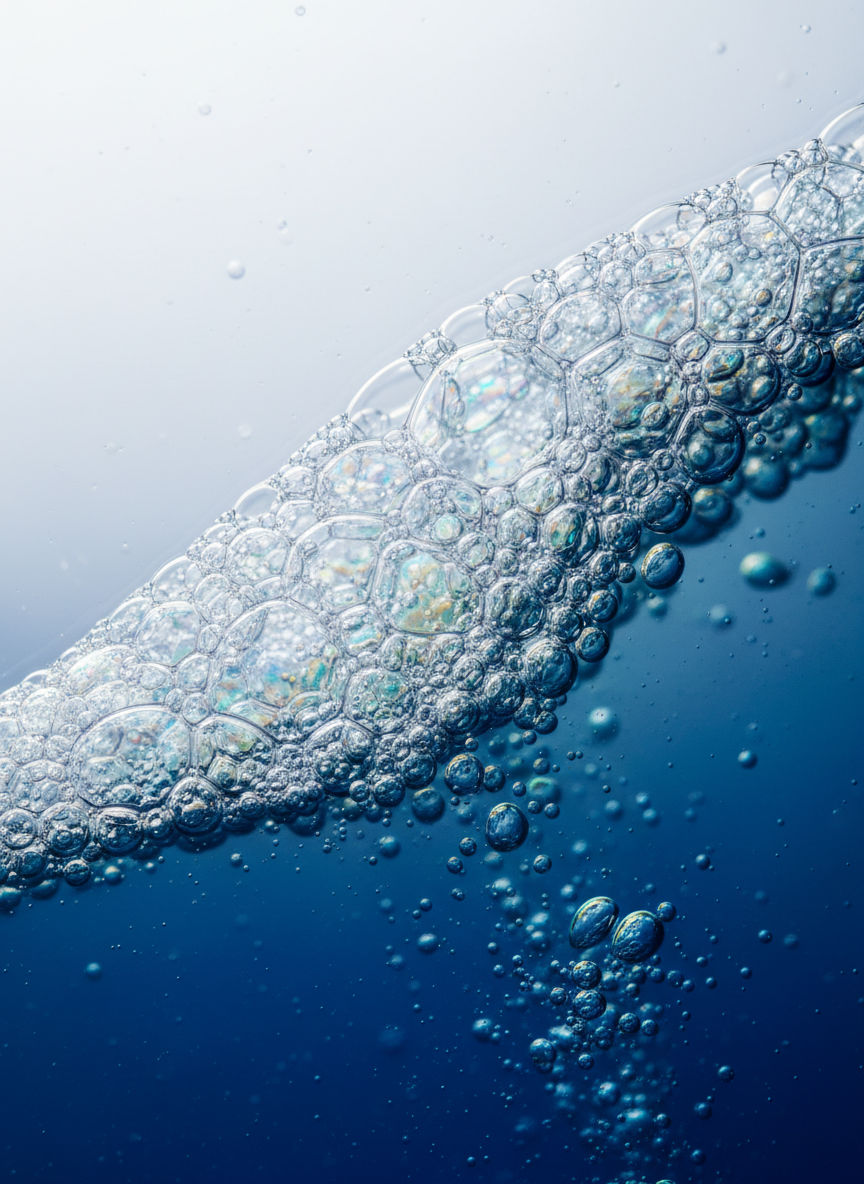
What makes a beer head or soap lather act like a solid?
Prompted by NerdSip Explorer #8712
Master the physics and geometry of liquid foams.
Have you ever stopped to look closely at the fluffy head on a freshly poured pint of beer, the thick lather of your daily shampoo, or the expansive spray from a fire extinguisher? You are looking at a liquid foam—a fascinating and incredibly complex state of matter that manages to behave like a solid and a liquid simultaneously.
A liquid foam is simply a massive collection of gas bubbles trapped within a continuous liquid matrix. In most of the everyday foams we encounter in our homes or in nature, the gas is usually air or carbon dioxide, and the continuous liquid phase is primarily water.
Because they are made up almost entirely of gas, foams are astonishingly lightweight. However, the densely interconnected network of liquid walls gives them a surprising amount of structural rigidity. That’s exactly why a dollop of shaving cream holds its stiff shape in the palm of your hand instead of pooling and pouring away like normal water. It’s a literal architectural marvel constructed almost entirely out of empty space!
Key Takeaway
A liquid foam is a dispersion of gas bubbles tightly packed within a liquid matrix, giving it unique structural properties.
Test Your Knowledge
Which two phases of matter make up a liquid foam?
If you were to zoom in on a mundane foam with a high-powered microscope, you wouldn't just see a chaotic, random jumble of floating spheres. You would actually discover a highly structured, three-dimensional architectural network made up of three very distinct anatomical parts.
First, there are the films. These are the ultra-thin, delicate walls of liquid that act as physical boundaries separating any two neighboring gas bubbles. They are remarkably thin and constantly shifting.
Second, look exactly where three of these films meet. They merge to form a much thicker liquid channel known as a Plateau border. You can think of these triangular borders as the load-bearing beams or the sturdy framing of a house.
Finally, where four Plateau borders intersect, they create a vertex (or junction). Interestingly, almost all the actual liquid in a tightly packed "dry" foam is safely stored within these thicker borders and junctions, rather than in the ultra-thin films between the bubbles!
Key Takeaway
Foam architecture consists of thin liquid films, thicker channel-like Plateau borders, and intersecting vertices.
Test Your Knowledge
Where is most of the liquid held in a tightly packed dry foam?
Try vigorously whisking a bowl of pure, distilled water. You might manage to whip up a few temporary bubbles, but they will pop almost instantly. Pure liquids simply cannot form stable foams on their own.
To conjure a lasting foam, you absolutely need a secret ingredient: a surfactant (which stands for surface-active agent). Everyday items like soap, the proteins in milk, and chemical detergents are all excellent surfactants.
These clever molecules are "amphiphilic"—meaning they have a "water-loving" head and a "water-hating" tail. When mixed with water and air, they immediately rush to the surface interface. They submerge their heads in the water and let their tails hang out in the air. This microscopic alignment dramatically lowers the water's surface tension and creates a flexible, protective armor around each bubble, preventing them from bursting immediately!
Key Takeaway
Surfactants are special molecules that lower surface tension and stabilize the liquid films between bubbles.
Test Your Knowledge
Why can't pure water form a stable foam on its own?
In the 1870s, a brilliant, completely blind Belgian physicist named Joseph Plateau made a stunning scientific discovery. He realized that despite the seemingly chaotic, random appearance of a pile of suds, foams always obey very strict mathematical and geometric rules.
Plateau's First Law dictates that exactly three liquid films always meet at a single Plateau border. Furthermore, they always do so at exactly 120-degree angles. You will never see two or four films meeting this way—always exactly three.
Plateau's Second Law takes this geometry into the next dimension. It states that exactly four Plateau borders always meet at a vertex, intersecting at roughly 109.5 degrees (which is known as the tetrahedral angle).
These foundational laws aren't just polite suggestions; they are physical mandates driven entirely by the mechanics of surface tension. The microscopic bubbles naturally arrange themselves into these exact geometries to perfectly minimize their total surface area and save energy, resulting in flawless mathematical precision!
Key Takeaway
Due to surface tension, foam bubbles always intersect at mathematically precise angles, known as Plateau's Laws.
Test Your Knowledge
According to Plateau's laws, how many films meet at a single Plateau border?
When a liquid film in a soap bubble gets stretched entirely too thin, why doesn't it instantly tear and pop? For this impressive durability, we can thank a phenomenon called the Marangoni effect.
Imagine a soap film getting physically stretched. As it expands, the protective surfactant molecules on its surface get pulled apart, leaving a "bare" spot with far fewer surfactants. Because surfactants lower surface tension, having fewer of them means the surface tension in that exact bare spot suddenly skyrockets.
This localized area of high surface tension acts like a microscopic vacuum. It physically pulls surrounding liquid and surfactant molecules back into the thinning spot. The fluid literally flows against gravity and physical stress to heal its own weak points, maintaining the bubble's structural integrity!
Key Takeaway
The Marangoni effect is a self-healing mechanism where differences in surface tension pull liquid back into thinning spots.
Test Your Knowledge
What triggers the Marangoni effect in a thinning foam film?
No matter how perfectly structured they are, foams are locked in a constant, losing battle with gravity. This unavoidable downward flow of liquid is known in physics as drainage.
Because the liquid matrix is vastly heavier than the pockets of gas it traps, gravity relentlessly pulls the liquid downward through the interconnected network of Plateau borders.
If you closely observe a fresh pint of beer, you'll notice the foam at the very top quickly becomes "dry" and rigid. It consists of razor-thin films and tightly packed, angled bubbles. Meanwhile, the foam near the liquid boundary at the bottom remains "wet," featuring thicker borders and rounder bubbles. Over time, as more and more liquid drains out to the bottom, the upper sections of the foam become increasingly fragile and delicate.
Key Takeaway
Drainage is the process where gravity pulls liquid downward through the foam, leaving the top dry and fragile.
Test Your Knowledge
Through which structure does liquid primarily drain downwards in a foam?
Foam bubbles are essentially trapped pockets of pressurized gas. And due to a physics principle called the Laplace pressure law, smaller bubbles actually have a much *higher* internal pressure than their larger neighbors.
Because nature naturally seeks to eliminate imbalances, a fascinating invisible process occurs. The highly pressurized gas inside the tiny bubbles slowly dissolves directly into the surrounding liquid film and diffuses into the adjacent, lower-pressure larger bubbles.
This relentless gas transfer is called Ostwald Ripening (or coarsening). Over time, the small bubbles literally squeeze themselves out of existence, while the larger bubbles gorge themselves on the stolen gas and grow even more massive. This is exactly why an aging foam develops a few giant, wobbly bubbles right before it completely dies!
Key Takeaway
Ostwald ripening is the process where gas diffuses from small, high-pressure bubbles into larger, low-pressure bubbles.
Test Your Knowledge
Why does gas move from small bubbles to large bubbles during Ostwald ripening?
The ultimate, violent demise of a foam bubble is a process known to physicists as coalescence. Simply put, this is the sudden rupture of the liquid film separating two neighboring bubbles.
As a foam ages, several forces work against it. Drainage pulls the stabilizing liquid downward, while Ostwald ripening stretches the remaining bubbles larger and larger. Eventually, the film between two expanding bubbles becomes critically thin—sometimes narrowing down to just a few nanometers across.
At this unimaginably tiny scale, the protective Marangoni effect can no longer save the film. The intermolecular forces of the liquid finally break down under the strain, the film tears, and two bubbles explosively merge into one. A rapid cascade of coalescence will quickly destroy an entire foam matrix, leaving behind nothing but a sad puddle of soapy water.
Key Takeaway
Coalescence is the sudden rupture of a thin liquid film, causing two distinct bubbles to violently merge into one.
Test Your Knowledge
What is the direct cause of bubble coalescence?
Not all foams look or behave the same way. Their physical appearance and structural properties depend entirely on their liquid fraction—the percentage of the foam's volume that is liquid versus gas.
In a wet foam (like the rich, heavy lather on a shower loofah), the liquid fraction is relatively high. The bubbles remain mostly spherical because there is plenty of fluid separating them; they aren't forced to press tightly against one another. If the liquid fraction exceeds roughly 36%, the bubbles detach entirely, transitioning into a "bubbly liquid."
In a dry foam (like the airy top of an old beer head), the liquid fraction is incredibly low, often under 5%. The bubbles are severely crammed together, compressing into sharp, multi-sided shapes called polyhedra. This tight packing gives dry foams a surprisingly rigid, solid-like structure!
Key Takeaway
A foam's structure changes from independent spherical bubbles to rigid, multi-sided polyhedra as it transitions from wet to dry.
Test Your Knowledge
What geometric shape do bubbles primarily take in a highly compressed dry foam?
Liquid foams are undeniably incredible, but their natural destiny is to drain, coarsen, and eventually collapse. However, clever engineers, materials scientists, and bakers have figured out how to freeze them in time!
If you can cure, bake, or freeze the liquid matrix before the foam has a chance to collapse, you create a permanent solid foam.
A loaf of bread is a perfect everyday example: yeast ferments to create gas bubbles in the dough (forming a wet liquid foam), and the heat of the oven quickly bakes the starches into a permanent solid network. This exact same physical principle is used to manufacture memory foam mattresses, insulating styrofoam, and even ultra-light metallic foams used to build modern spacecraft! They lock the incredible lightweight strength of a liquid foam into a lasting material.
Key Takeaway
By hardening the continuous liquid matrix before it collapses, liquid foams can be transformed into highly useful solid foams.
Test Your Knowledge
Which of the following is an everyday example of a solidified foam?
Track your progress, earn XP, and compete on leaderboards. Download NerdSip to start learning.