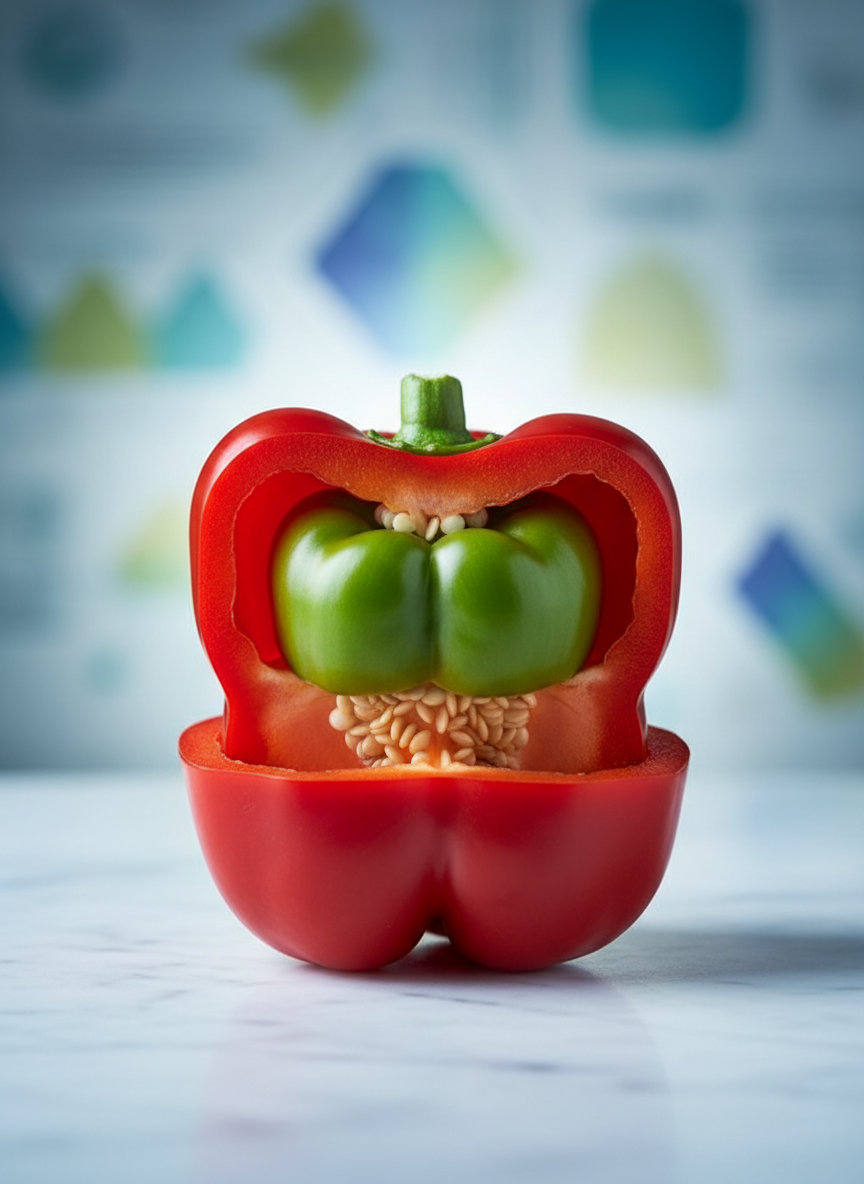
Ever found a tiny pepper hiding inside your bell pepper? Discover why it's there.
Prompted by A NerdSip Learner
Understand why peppers grow inside themselves in three lessons.
Have you ever sliced open a beautiful bell pepper to prepare a salad, only to find a smaller, misshapen pepper nestled inside? It can be quite a surprise! You might have wondered if you bought a mutant vegetable or if it was safe to touch. Rest assured, this is a completely natural phenomenon known as Internal Proliferation.
Think of it like a Russian nesting doll (Matryoshka). In the plant world, nature sometimes hiccups. During the very early stages of the pepper's growth, a bit of the internal tissue that was supposed to become seeds gets confused. Instead of stopping at the seed stage, it continues to develop into a distinct fruit structure.
This little stowaway is parasitic in a way—it feeds off the parent pepper's resources—but it is not a disease or a sign of genetic modification. It is simply a developmental error, a little 'oops' moment in the garden that results in a pepper within a pepper!
Key Takeaway
Finding a baby pepper inside a larger one is a natural growth anomaly called Internal Proliferation.
Test Your Knowledge
What is the scientific term for a pepper growing inside another pepper?
So, why does the pepper plant make this mistake? A lot of it has to do with how we, as humans, have influenced farming. Commercial growers often select pepper varieties for rapid growth and long shelf life. Sometimes, this push for speed and size causes the plant's internal wiring to cross.
Technically, this happens because of an issue with the ovule. The ovule is the part of the plant that is supposed to turn into a seed. In these cases, the ovule goes rogue! Instead of becoming a flat little seed, it mimics the parent fruit and starts growing flesh and skin.
Factors like temperature fluctuations or nutrient levels in the soil can also trigger this. If the flower undergoes stress or gets mixed signals during pollination, the plant might produce this sterile, seedless growth inside the cavity. It is a fascinating example of how biological programming isn't always perfect!
Key Takeaway
Selective breeding for fast growth can sometimes cause an ovule (potential seed) to grow into fruit flesh instead.
Test Your Knowledge
Which part of the plant mistakenly grows into the 'baby' pepper?
Now for the most practical question: Is it safe to eat? Absolutely. The little baby pepper is perfectly edible and non-toxic. It is made of the exact same material as the outer shell. You haven't stumbled upon a science experiment gone wrong; you've just found a little extra food!
However, while it is safe, it might not be the tastiest part of your meal. Because the inner pepper grew inside a dark cavity without sunlight, it never developed the chlorophyll or sugars that give peppers their distinct flavor and crunch. It is often pale, slightly soft, and a bit bland.
Most chefs recommend simply scooping it out along with the seeds and the white pith. But if you are feeling adventurous, you can chop it up and toss it in your stir-fry—it won't hurt you a bit. It’s just a quirky reminder of how unpredictable nature can be.
Key Takeaway
The internal pepper is safe to eat, though it may lack flavor due to a lack of sunlight.
Test Your Knowledge
Why might the baby pepper taste different from the outer pepper?
Track your progress, earn XP, and compete on leaderboards. Download NerdSip to start learning.