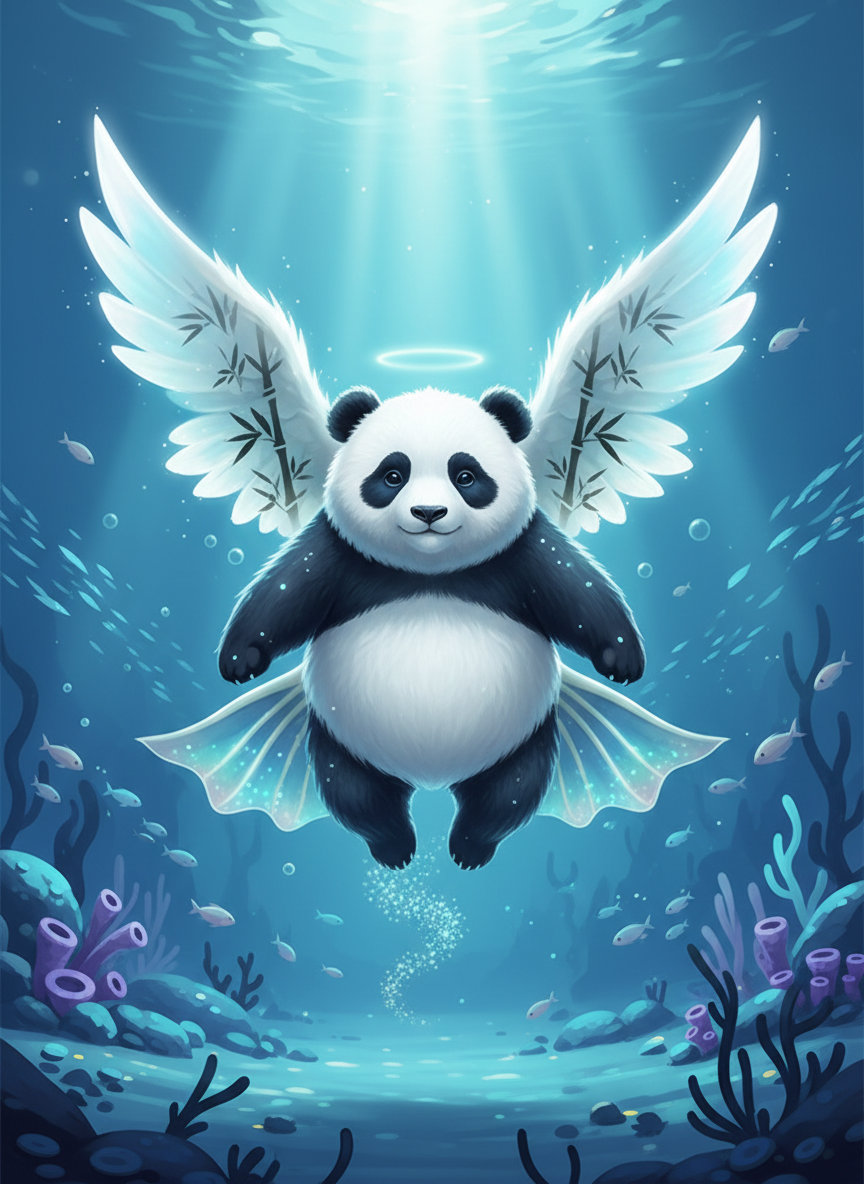
What has wings, a panda face, and hides in the deep, freezing ocean?
Prompted by A NerdSip Learner
Identify and understand the rare panda bear sea angel.
If you've been scrolling through social media, you likely saw a tiny, translucent creature that looks exactly like a skeleton panda. While often shared alongside "Sea Angels" (which are swimming slugs), this viral celebrity is actually something entirely different: the Skeleton Panda Sea Squirt!
Its scientific name is *Clavelina ossipandae*. Discovered by divers in Kumejima, Japan, it became an internet sensation long before scientists officially described it in 2024.
Unlike the free-swimming Sea Angel (*Clione*), this little panda is a sessile animal, meaning it stays anchored to one spot on the reef. It represents a fantastic example of how citizen science (divers taking photos) can lead to brand-new biological discoveries. So, while it's angelic in cuteness, it’s technically a tunicate, not a slug!
Key Takeaway
The viral 'Panda' is actually a newly discovered species of Sea Squirt named *Clavelina ossipandae*.
Test Your Knowledge
What type of animal is the 'Skeleton Panda'?
How does nature accidentally paint a perfect panda face on a sea creature? It’s all an optical illusion created by the animal's internal anatomy. The body of *Clavelina ossipandae* is mostly transparent, like a glass bottle.
The white structures that look like rib bones are actually the animal's blood vessels running horizontally through its gills (branchial basket).
As for the adorable "panda face"? The black spots that form the eyes and nose are simply patches of pigment located on the anterior (front) end. Scientists are still baffled by *why* they have this pattern—it doesn't seem to camouflage them well! It might just be a whimsical evolutionary coincidence that happens to look like a terrestrial bear to human eyes.
Key Takeaway
The 'skeleton' is made of white blood vessels, and the 'panda eyes' are mysterious pigment spots.
Test Your Knowledge
The white 'bones' visible inside the creature are actually:
Here is the wildest twist: this tiny blob is closer to you on the evolutionary tree than it is to a crab, starfish, or worm.
Sea Squirts belong to the phylum Chordata. This means they are distant relatives of vertebrates (animals with backbones). When they are larvae (babies), they look like tadpoles and actually have a notochord—a primitive spinal cord!
Once they find a nice rock, they absorb their tail, eat their own brain (literally reabsorbing the cerebral ganglion), and settle down to become filter feeders. They pump water in through one siphon, filter out plankton, and squirt clean water out the other. So, the Skeleton Panda is essentially a highly evolved, stationary, water-filtering cousin!
Key Takeaway
Sea Squirts are Chordates, meaning they share a common ancestor with humans and other vertebrates.
Test Your Knowledge
Why are Sea Squirts considered relatives of humans?
Track your progress, earn XP, and compete on leaderboards. Download NerdSip to start learning.