Can a lightning bolt turn into a floating, glowing ball of fire?
Prompted by A NerdSip Learner
Identify the science behind nature's most elusive electrical mystery.
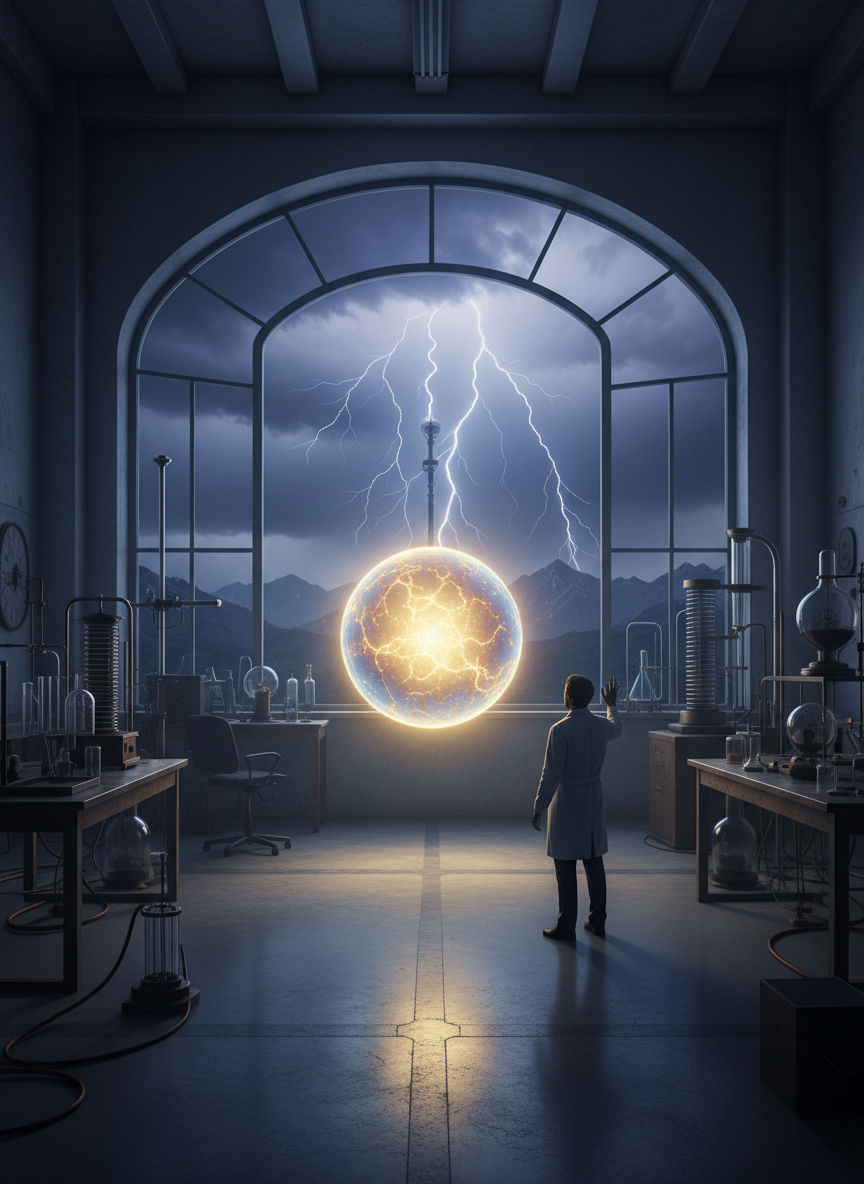
For centuries, sailors and hikers reported seeing something impossible: luminous, grapefruit-sized spheres that floated through the air during thunderstorms. These "balls of light" didn't act like normal lightning. Instead of a split-second zap, they would drift for several seconds, bounce off furniture, or even pass through closed glass windows before vanishing silently or with a loud bang.
Because these sightings were so rare and unpredictable, many scientists once dismissed them as hallucinations or optical illusions. How could a ball of electricity just... hang out in mid-air? Without hard evidence, ball lightning remained in the realm of folklore, right next to UFOs and sea monsters.
However, the sheer number of consistent reports from pilots and scientists eventually made it impossible to ignore. They described colors ranging from angry red to eerie blue, and a tendency for the balls to follow power lines or metal objects. The mystery wasn't *if* they existed, but *how* physics allowed them to survive for so long.
Key Takeaway
Ball lightning is a rare, spherical electrical phenomenon that lasts much longer than a typical lightning strike.
Test Your Knowledge
What is a common characteristic of ball lightning compared to regular lightning?
The debate over whether ball lightning was a myth ended in 2012 on the Tibetan Plateau. A team of Chinese researchers was studying ordinary lightning with high-speed cameras and spectrometers—tools that identify elements by the light they emit. By total luck, a bolt hit the ground nearby and a glowing ball rose up, traveling roughly 15 meters before fading.
When the scientists analyzed the data, they found something incredible. The light from the ball contained traces of silicon, iron, and calcium. These are the exact same elements found in the local soil! This was the first time ball lightning had ever been captured by scientific instruments, and it provided a massive clue about its origin.
This discovery suggested that ball lightning isn't just "pure energy." It is likely a physical cloud of vaporized dirt and minerals that remains super-heated and glowing after a lightning strike. This turned a ghost story into a concrete subject of plasma physics.
Key Takeaway
Spectroscopic evidence from 2012 proved that ball lightning contains elements found in the soil, like silicon.
Test Your Knowledge
What did the Chinese researchers find inside the light of the ball lightning?
So, how does a bolt of lightning turn soil into a floating orb? The leading explanation is the Vaporized Silicon Theory. When lightning hits the ground, the intense heat turns silicon dioxide in the dirt into silicon vapor. As this vapor cools, it forms a cloud of tiny nanoparticles that glow as they react with oxygen in the air—effectively a slow-burning chemical reaction.
Another theory involves microwaves. Some scientists believe that lightning strikes can create a "bubble" of trapped electromagnetic radiation. This radiation ionizes the air, turning it into a plasma ball that stays stable as long as the energy remains trapped inside. This might explain how ball lightning can pass through glass without breaking it!
While we have some great theories, we still can't perfectly recreate natural ball lightning in a lab. It requires a perfect storm of high energy, specific soil chemistry, and humidity. We've solved the 'myth' part of the mystery, but the 'how-to' remains one of nature's coolest unfinished puzzles.
Key Takeaway
The leading theories suggest ball lightning is either vaporized soil particles or a bubble of plasma held together by microwaves.
Test Your Knowledge
According to the Vaporized Silicon Theory, what causes the ball to glow?
Track your progress, earn XP, and compete on leaderboards. Download NerdSip to start learning.