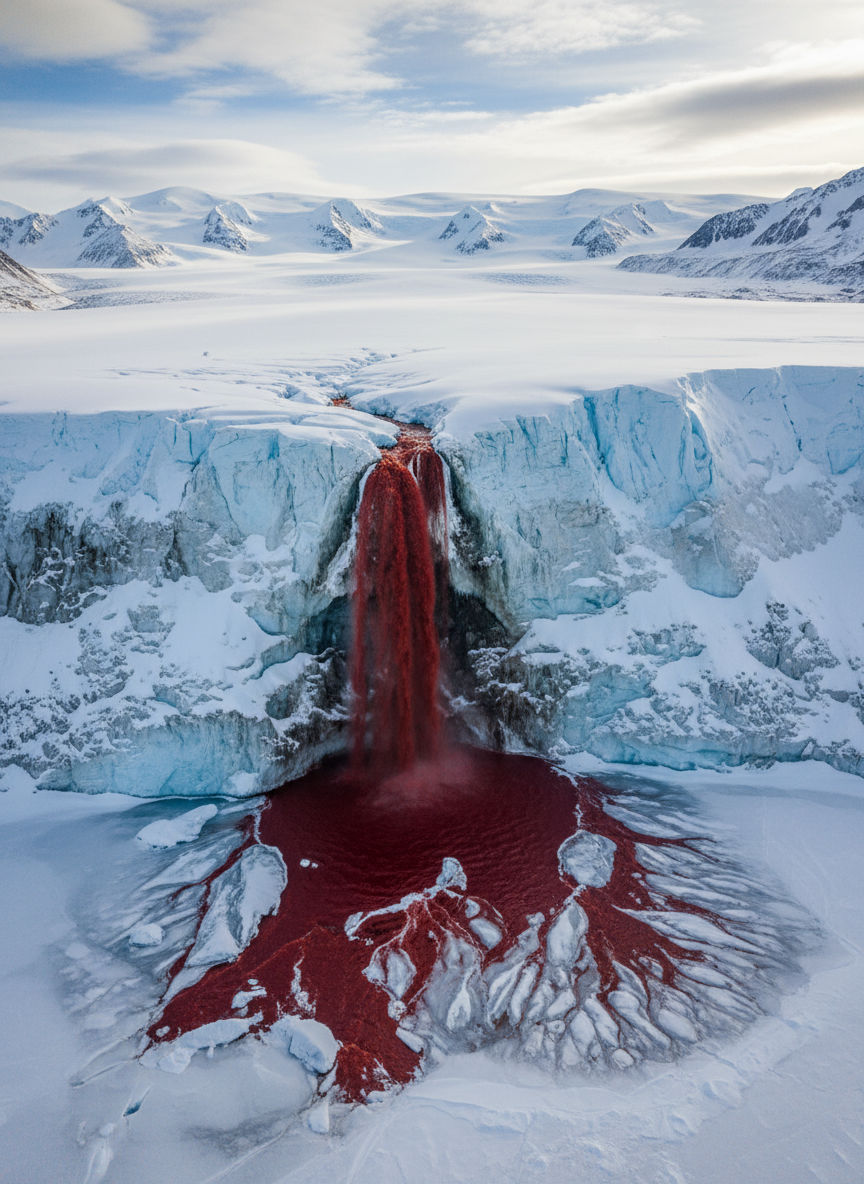
Why is a massive Antarctic glacier seemingly oozing a five-story waterfall of blood?
Prompted by A NerdSip Learner
Uncover the science behind Antarctica's bleeding glacier.
Picture this: you are an explorer in 1911, trekking through the pristine, white McMurdo Dry Valleys of Antarctica. Suddenly, you stumble upon a towering, five-story glacier that appears to be actively bleeding into the frozen lake below.
This gruesome spectacle, famously dubbed Blood Falls, has baffled scientists for over a century. Early explorers chalked it up to red algae. Later, scientists figured it was simply standard iron oxide—essentially, rust—staining the water. But the full truth is much weirder.
In 2023, powerful electron microscopes revealed the true culprit: iron-rich nanospheres. These tiny, non-crystalline particles are a hundredth the size of human red blood cells. Because they lack a standard crystalline mineral structure, they went completely undetected by older testing methods for decades.
When this iron-loaded, oxygen-starved water finally squeezes its way out of the glacier and meets the open air, these tiny nanospheres rapidly oxidize. The result? A breathtaking, bloody cascade against the bright white ice.
Key Takeaway
Blood Falls gets its crimson color from microscopic iron-rich nanospheres rusting as they hit the oxygen-rich air.
Test Your Knowledge
What did scientists recently discover is the true cause of the waterfall's red color?
So, where exactly is this endless supply of "blood" coming from? The source is a hidden, subterranean time capsule. Deep beneath the Taylor Glacier lies an ancient pool of water that has been sealed off from light and atmospheric oxygen for millions of years.
You might be wondering how water continues to flow in one of the coldest, most unforgiving environments on Earth. The secret lies in its extreme saltiness.
The water trapped beneath the glacier is a hypersaline brine—up to three times saltier than the ocean. Because salt drastically lowers the freezing point of water, this ancient lake remains a liquid slush even at subzero temperatures.
Over time, the immense, crushing weight of the slow-moving glacier presses down on this underground pool. When the pressure builds up, the salty brine is forcefully squeezed through tiny cracks in the ice, eventually oozing out at the glacier's edge.
Key Takeaway
The water originates from a highly pressurized, ultra-salty underground lake that remains liquid despite freezing temperatures.
Test Your Knowledge
Why doesn't the water feeding Blood Falls freeze solid in the extreme Antarctic cold?
You would probably assume that a freezing, pitch-black, oxygen-deprived pool of extreme saltwater would be completely dead. Yet, the waters of Blood Falls are teeming with resilient, ancient microbes that have been isolated from the rest of the world for millennia.
Without sunlight or oxygen, these bacteria had to get creative. They survive by "breathing" iron and sulfates, recycling the limited nutrients in their icy underground prison. This makes them incredibly exciting to astrobiologists.
Scientists view Blood Falls as a perfect earthly laboratory for studying how life might survive on harsh, icy planets like Mars. If bacteria can thrive beneath the Taylor Glacier, extraterrestrial life could theoretically hide in similar subglacial lakes across the solar system.
But there is a catch! Because the iron nanospheres produced by these microbes aren't crystalline, scientists realized that our current Mars rovers wouldn't even be equipped to detect them. We might need entirely new tools to find alien life!
Key Takeaway
Ancient microbes surviving in this extreme environment offer vital clues about how life could exist on icy planets.
Test Your Knowledge
Why might current Mars rovers fail to detect similar signs of life on the Red Planet?
Track your progress, earn XP, and compete on leaderboards. Download NerdSip to start learning.