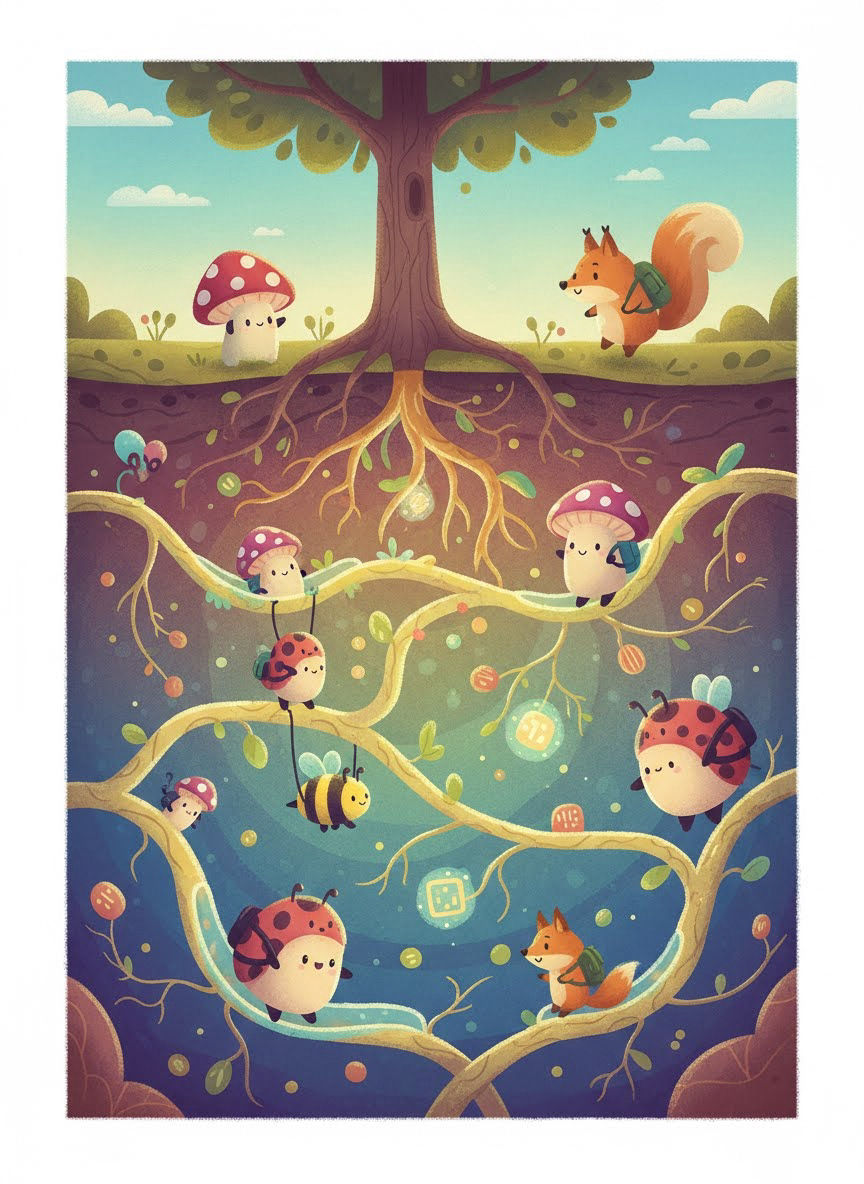
Did you know trees secretly talk to each other underground?
Prompted by A NerdSip Learner
Understand how forests communicate and trade resources.
Imagine you are standing in a quiet forest. It looks peaceful, right? But beneath your feet, there is a bustling city full of traffic! We often think the mushrooms we see popping out of the ground are the whole plant, but they are actually just the "fruit"—like an apple on an apple tree.
The real body of the fungus lives underground. It is made of miles of tiny, white threads called mycelium. These threads stretch out like a massive spiderweb, connecting the roots of trees and plants together. Scientists call this the "Wood Wide Web" because it works just like our internet!
Through this web, the forest isn't just a bunch of lonely trees; it is a giant, connected super-team. Just like your computer connects to the internet to share data, trees plug into the mycelium to share the secrets of the forest.
Key Takeaway
Mushrooms are just the fruit; the real living network is the hidden underground web called mycelium.
Test Your Knowledge
If a forest is like a computer network, what is the mycelium?
So, what are these underground cables made of? The mycelium is built from microscopic tubes called hyphae (pronounced *hi-fee*). These tubes are incredibly thin—much thinner than a human hair! But don't let their size fool you; they are powerful.
Think of hyphae like the fiber optic cables that bring high-speed internet to your house. They grow incredibly fast and can spread through the soil to find water and nutrients that tree roots can't reach on their own.
In a single teaspoon of healthy forest soil, there can be miles of these hyphae threads packed together. They weave a dense mat that links almost every tree in the forest, creating a physical bridge for sharing resources.
Key Takeaway
Mycelium is made of tiny tubes called hyphae that act like wires connecting the forest floor.
Test Your Knowledge
What is the name of the tiny tubes that make up the mycelium network?
Why do trees and fungi work together? It’s strictly business! Trees are tall and have leaves, so they are great at catching sunlight and turning it into sugar (their food) through photosynthesis. Fungi live underground in the dark, so they can't make their own sugar.
However, fungi are amazing miners. Their tiny threads can dissolve rock and soak up minerals like phosphorus and nitrogen better than tree roots can. So, they make a deal!
The fungus gives the tree minerals and water from the soil. In exchange, the tree pays the fungus with sugar. It is the ultimate fair trade. Both sides get exactly what they need to survive. Without this partnership, many of the world's forests wouldn't exist!
Key Takeaway
Trees trade sugar for minerals collected by fungi, helping both of them survive.
Test Your Knowledge
What does the tree give the fungus in exchange for minerals?
The mycelium network isn't just for trading food; it’s also a security system. Imagine if you could text your friends to warn them about a pop quiz. Trees do something similar!
If a tree is attacked by nasty bugs or a disease, it senses the danger. It immediately releases chemical signals into the mycelium network. These signals travel through the fungal threads to neighboring trees, acting like a "Danger Ahead!" text message.
When the other trees receive this warning, they can boost their defenses. They might make their leaves taste bitter or produce tough chemicals to stop the bugs from eating them. Thanks to the network, trees can prepare for a fight before the enemy even arrives.
Key Takeaway
Trees use the fungal network to send chemical warnings to their neighbors about pests and diseases.
Test Your Knowledge
What happens when a tree sends a warning signal through the network?
In every forest, there are the oldest, biggest, and most connected trees. Scientists call these the Mother Trees. They act like the hubs or servers of the forest internet.
Because they are so tall, Mother Trees have access to the most sunlight. They produce way more sugar than they need. Instead of keeping it all, they use the mycelium network to send extra food to the young seedlings growing in their shadow.
Without this help, the baby trees wouldn't get enough light to survive. The Mother Tree acts like a parent, feeding the kids until they are tall enough to reach the sun themselves. It proves that the forest isn't just about survival of the fittest; it's about cooperation.
Key Takeaway
Older 'Mother Trees' feed young seedlings through the network to keep the forest family alive.
Test Your Knowledge
How do Mother Trees help young seedlings survive in the shade?
Track your progress, earn XP, and compete on leaderboards. Download NerdSip to start learning.