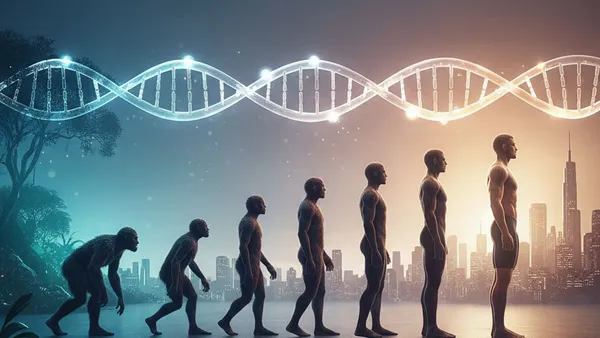
Are our genomes simply mosaics of ancient hominin ghosts and ongoing genetic experiments?
Prompted by A NerdSip Learner
Master the advanced genetics and biomechanics of human evolution.
In evolutionary genomics, the divergence between the *Pan* (chimpanzee and bonobo) and *Homo* lineages wasn't a clean, instantaneous break. Occurring roughly 6 to 8 million years ago, this split was a deeply complex process characterized by sustained hybridization and Incomplete Lineage Sorting (ILS).
ILS explains a fascinating genomic quirk: about 15% of the modern human genome is actually more closely related to gorillas than to chimpanzees. Because the ancestral population of all three apes was highly diverse, certain genetic variants segregated randomly as the lineages ultimately splintered over millions of years.
Instead of a linear ladder, early hominin evolution is better visualized as a braided stream. Early fossil candidates near this divergence, such as *Sahelanthropus tchadensis* and *Orrorin tugenensis*, show a mosaic of basal ape features alongside incipient bipedal traits. Understanding this deep-time genetic variation prevents us from oversimplifying our origins, acknowledging the highly fluid population dynamics of Miocene apes.
Key Takeaway
The evolutionary split between humans and chimpanzees was gradual, leaving traces of Incomplete Lineage Sorting in our modern genome.
Test Your Knowledge
Which evolutionary concept explains why a minority of the human genome is more closely related to gorillas than to chimpanzees?
The shift to obligate bipedalism is the defining morphological hallmark of the earliest hominins. This transition required a radical biomechanical overhaul of the skeletal system. Key adaptations include an anteriorly shifted foramen magnum (balancing the skull perfectly over the spine), an S-shaped lumbar curve to absorb shock, and a highly derived, bowl-shaped pelvis to support internal organs.
The femur also developed a pronounced valgus angle. This inward angling positions the knees directly under the body's center of gravity, optimizing balance and energetic efficiency during the swing phase of walking.
However, these adaptations created fierce evolutionary trade-offs. The narrowing of the pelvic birth canal, paired with the subsequent expansion of the fetal hominin brain, led to what anthropologists traditionally called the obstetrical dilemma. This tension resulted in secondary altriciality—where human infants are born highly neurologically undeveloped—which profoundly shaped human social structures, forcing reliance on cooperative breeding.
Key Takeaway
Obligate bipedalism required massive skeletal remodeling, creating trade-offs between locomotive efficiency and the mechanics of childbirth.
Test Your Knowledge
What is the primary biomechanical function of the valgus angle in the hominin femur?
As early hominins faced fluctuating Plio-Pleistocene climates, their dietary niches fundamentally shifted. This transition is best explained by the Expensive Tissue Hypothesis, proposed by anthropologists Leslie Aiello and Peter Wheeler. The hypothesis posits a severe metabolic trade-off.
To support the staggering energetic costs of a rapidly expanding brain (encephalization), early humans had to simultaneously reduce the size of another metabolically demanding organ: the gastrointestinal tract. A smaller gut is less efficient at processing highly fibrous plant matter, necessitating a dietary shift toward highly digestible, calorie-dense foods like animal tissue, bone marrow, and eventually, cooked tubers.
The advent of lithic technology (such as the Oldowan and Acheulean tool industries) allowed early *Homo* to process these foods extra-corporeally. Essentially, stone tools and controlled fire acted as external digestive organs. This relaxed the selective pressures on large teeth and massive digestive systems, redirecting vital caloric energy to fuel the explosive expansion of the neocortex.
Key Takeaway
Brain expansion in early Homo was metabolically funded by the shrinking of the gut, enabled by high-calorie diets and food processing tools.
Test Your Knowledge
The Expensive Tissue Hypothesis suggests a metabolic evolutionary trade-off between the expanding hominin brain and which other organ system?
Human evolution is characterized not just by an increase in absolute brain size, but by an extraordinary Encephalization Quotient (EQ)—the ratio of actual brain mass to the predicted brain mass for an animal of a given body size. However, raw volumetric growth is only part of our cognitive story.
The true evolutionary leap in the genus *Homo* stems from profound neurological reorganization. Our brains exhibit disproportionate expansion in the neocortex, particularly the prefrontal and temporal association cortices. These regions govern executive function, language syntax, and complex social cognition.
Furthermore, human brain evolution heavily prioritized increased connectivity over sheer neuron count. The development of specialized microcircuitry, including a remarkably high density of Von Economo neurons (cells associated with rapid intuitive processing and social awareness), allowed for incredibly complex behavioral flexibility. This extensive neural remodeling is what ultimately enabled symbolic thought, linguistic abstraction, and cumulative culture.
Key Takeaway
Human cognitive dominance resulted from both raw brain expansion (high EQ) and the profound structural reorganization of the neocortex.
Test Your Knowledge
Beyond absolute brain size, which of the following best describes the key neurological shift in hominin evolution?
For decades, paleoanthropologists fiercely debated two extreme models of modern human origins: the strict Multiregional Hypothesis and the pure Recent African Origin model. Today, advanced genomic data has definitively resolved this conflict with a nuanced synthesis: the Recent African Origin with Assimilation model.
Anatomically modern humans (*Homo sapiens*) evolved as a highly structured, diverse meta-population across the African continent roughly 300,000 years ago. When these populations decisively expanded out of Africa around 60,000 to 70,000 years ago, they did not expand into empty continents.
Eurasia was already populated by deeply divergent, endemic hominins like *Homo neanderthalensis* and the Denisovans. Modern humans largely absorbed and replaced these archaic populations, but not without significant genetic admixture. This assimilation proves that while our primary ancestry is overwhelmingly recent and African, modern non-African genomes are mosaics, bearing the permanent legacy of multiple ancient hominin lineages.
Key Takeaway
Modern humans originated recently in Africa but assimilated genetic material from older, archaic hominins as they spread globally.
Test Your Knowledge
Which model of human origins is overwhelmingly supported by modern genomic evidence?
The sequencing of the Neanderthal genome by Svante Pääbo revolutionized our understanding of hominin evolution. We now know definitively that modern non-African human populations carry approximately 1% to 2% Neanderthal DNA, a permanent genomic scar of introgression events that occurred as early *Homo sapiens* migrated through the Middle East and Europe.
This admixture was not merely a passive genetic artifact; it resulted in widespread adaptive introgression. Neanderthals had spent hundreds of thousands of years adapting to harsh Eurasian pathogens and climates. By interbreeding with them, migrating modern humans essentially "borrowed" highly advantageous, field-tested alleles.
Introgressed Neanderthal genes are notably enriched in genomic regions linked to the immune system, particularly the HLA (Human Leukocyte Antigen) complex, rapidly enhancing resistance to local viral strains. Other inherited archaic alleles significantly influence keratin production, affecting skin and hair phenotypes in colder, low-UV environments.
Key Takeaway
Interbreeding with Neanderthals provided modern humans with crucial, pre-adapted genetic traits for surviving the Eurasian environment.
Test Your Knowledge
What is the evolutionary term for when modern humans inherited advantageous immune and structural genes from Neanderthals?
In 2010, the genomic analysis of a tiny finger bone found in a Siberian cave revealed an entirely new hominin population: the Denisovans. Identified almost exclusively through ancient DNA rather than robust skeletal records, Denisovans were a sister group to Neanderthals that ranged widely across Asia.
Their genetic legacy profoundly impacts modern human populations, particularly in Oceania, where Indigenous Australians and Papuans derive up to 4-5% of their genomes from Denisovan introgression. But the most striking physiological example of Denisovan adaptive introgression is found in modern Tibetan populations.
Tibetans inherited a highly specialized variant of the EPAS1 gene from Denisovan ancestors. This gene acts as a master regulator of the body's response to hypoxia. Unlike most humans who overproduce thick, clot-prone red blood cells at extreme altitudes, this Denisovan allele allows Tibetans to maintain healthy hemoglobin levels, representing a brilliant example of rapid genetic adaptation through ancient admixture.
Key Takeaway
Denisovan DNA remains active in certain modern populations, famously conferring high-altitude hypoxia resistance to Tibetans via the EPAS1 gene.
Test Your Knowledge
The EPAS1 gene variant, introgressed from Denisovans, provides which direct evolutionary advantage to modern Tibetan populations?
The traditional, textbook view of a clean, linear progression from *Australopithecus* to *Homo sapiens* has been entirely dismantled by stunning recent fossil discoveries. The late Pleistocene epoch was radically biologically diverse, featuring late-surviving hominins with baffling mosaic morphologies.
Deep in a South African cave system, anthropologists discovered *Homo naledi*. This hominin displayed a tiny brain size similar to early australopithecines, yet possessed highly derived, human-like hands capable of tool use, surviving hundreds of thousands of years later than its primitive cranial capacity would suggest.
Similarly, in Indonesia, *Homo floresiensis* (informally dubbed the "Hobbit") demonstrated extreme insular dwarfism. Trapped on an island, this species shrank in stature and brain volume to conserve energy, yet remained associated with sophisticated stone tools. These discoveries highlight that hominin evolution was governed by immense morphological plasticity, where traits evolved in isolated pockets based on hyper-local selective pressures.
Key Takeaway
Recent fossil discoveries prove human evolution was not linear; multiple species with mixed primitive and advanced traits lived concurrently.
Test Your Knowledge
The diminutive size of Homo floresiensis is considered a classic biological example of which evolutionary phenomenon?
Human evolution is uniquely characterized by Gene-Culture Coevolution (often formalized as Niche Construction Theory). This is the process by which cultural practices engineer new ecological niches that, in turn, radically alter our own genetic selective pressures.
The classic example is the evolution of lactase persistence. Historically, all human populations lost the ability to digest lactose after weaning. However, with the cultural invention of dairy farming around 10,000 years ago, mutations in the regulatory region of the *LCT* gene that kept lactase active into adulthood provided a massive caloric survival advantage.
Remarkably, multiple independent lactase mutations arose via convergent evolution in distinct pastoralist populations across Europe, the Middle East, and Africa. Similarly, the transition to agrarian societies with high-starch diets drove rapid positive selection for copy number variations in the AMY1 gene, boosting salivary amylase production. Human culture is not separate from biology; it is its strongest catalyst.
Key Takeaway
Cultural inventions, like dairy farming and agriculture, have directly driven recent, dramatic shifts in the human genome.
Test Your Knowledge
The independent genetic emergence of lactase persistence in geographically distinct pastoralist societies is a primary example of:
A pervasive biological misconception is that human evolution ceased with the advent of agriculture and modern medicine. In reality, human evolution is ongoing and, mathematically, likely accelerating due to our massive global population size, which generates millions of novel spontaneous mutations.
However, the mechanics of selection have shifted. Today, we are documenting widespread polygenic adaptation, where natural selection simultaneously acts on hundreds of minuscule genetic variations distributed across the genome, rather than favoring a single, sweeping mutation. Recent large-scale genomic analyses reveal ongoing directional selection for highly nuanced traits, such as later ages of menopause, altered metabolic profiles, and rapidly shifting immune receptor diversity.
Furthermore, global urbanization and unprecedented global mobility are actively breaking down historical geographic isolation. This is resulting in unparalleled levels of global gene flow. While cultural and technological buffering do relax certain historical survival pressures (like predation), they continually impose novel evolutionary constraints.
Key Takeaway
Human evolution has not stopped; it is actively occurring today, primarily driven by massive gene flow and subtle polygenic adaptations.
Test Your Knowledge
How has the mechanism of natural selection predominantly shifted in contemporary, global human populations?
Track your progress, earn XP, and compete on leaderboards. Download NerdSip to start learning.