Why do mirrors swap left and right, but never up and down?
Prompted by A NerdSip Learner
Master the mind-bending physics of reflections.
Have you ever stared into a mirror and wondered why your right hand becomes your reflection's left, but your head doesn't swap with your feet? It is one of the most common everyday mysteries, yet the answer is completely mind-bending.
Here is the spoiler: mirrors do not flip left and right at all. The left-right flip is entirely an illusion created by your brain, not a rule of physics!
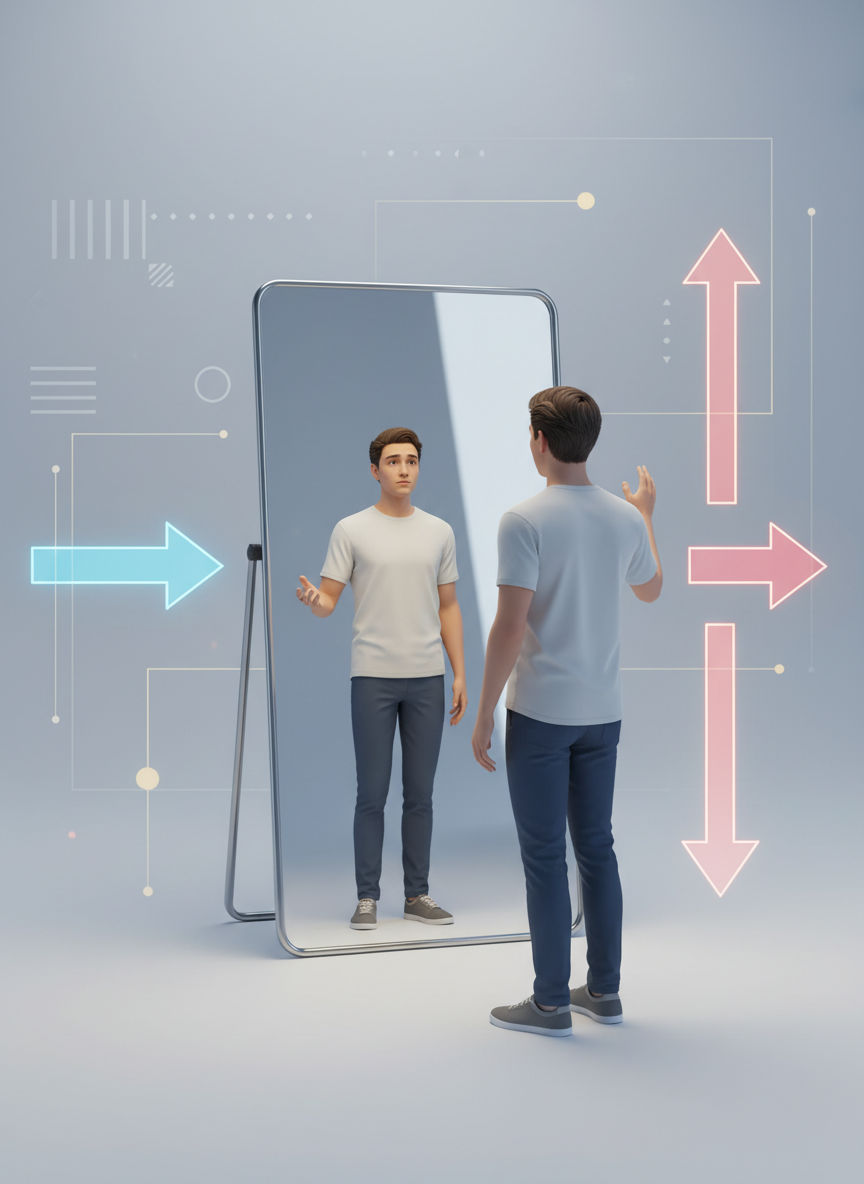
When you look in the mirror, the light bouncing off your right shoulder travels straight forward and hits the right side of the mirror. The light from your left shoulder hits the left side. The light from your head hits the top, and the light from your feet hits the bottom. Everything stays exactly where it is.
So, if the mirror isn't flipping things left-to-right, what exactly is it doing? The secret lies in a different dimension entirely: depth. The mirror is actually flipping you front-to-back, pushing your reflection "inside out."
Key Takeaway
Mirrors do not flip left and right; they reflect light exactly straight back where it hits them.
Test Your Knowledge
What is actually happening to the light when it hits a flat mirror?
To understand what mirrors are truly doing, we have to think about the Z-axis, which is the dimension of depth. Mirrors don't reverse the X-axis (left/right) or the Y-axis (up/down). They reverse the Z-axis (front/back).
Imagine holding a right-handed glove. If you pull it inside out, it perfectly fits your left hand. The mirror is essentially doing the exact same thing to your reflection. It is pulling your image "inside out" along the dimension of depth.
Think of it like squishing yourself flat against a window pane. Your nose touches the glass first, while the back of your head is furthest away. The mirror reflects what is closest to it first, reversing the order of depth.
So, when you point North toward a mirror, your reflection points South back at you. Your right side stays on the right side of the room, but because the image is facing backwards, it acts like a left side.
Key Takeaway
Mirrors reverse the Z-axis, meaning they flip things from front to back, much like pulling a glove inside out.
Test Your Knowledge
Which axis does a standard flat mirror actually reverse?
If the mirror only flips front-to-back, why are we so convinced it flips left-to-right? The answer is a brilliant trick played by human psychology and our everyday experiences.
When we see a face looking back at us, our brains immediately try to make sense of the situation. Because we interact with other humans every day, our brain assumes the "person" in the mirror is another human who has walked up and turned around to face us.
To turn around and face someone, humans rotate around our vertical axis. We spin around like a top. When we mentally project this rotation onto the mirror image, our right hand lines up with their left hand.
Your brain essentially says, "If I were standing where my reflection is, I would have had to spin around horizontally to face myself. Therefore, that must be my left hand." The left-right flip is completely manufactured by your brain's expectation of how bodies move!
Key Takeaway
The left-right flip is a psychological illusion caused by our brain mentally rotating our body horizontally to face itself.
Test Your Knowledge
Why do we perceive a left-right flip in the mirror?
We just learned that the left-right flip happens because we imagine ourselves turning around horizontally. But what if we imagined turning around differently?
Imagine you wanted to face someone, but instead of spinning around like a top, you did a forward somersault and stood on your head. If you mentally rotated yourself vertically to face the mirror, your right hand would perfectly match the reflection's right hand. But suddenly, your head would be at the bottom and your feet would be at the top!
Because human beings are mostly symmetrical vertically (our left side looks like our right side), rotating horizontally feels completely natural. But we are incredibly asymmetrical horizontally (our heads look nothing like our feet), so we never mentally rotate ourselves upside down.
If you lie down perfectly sideways on the floor and look into a mirror, your brain gets confused. Suddenly, the mirror will appear to flip you top-to-bottom relative to the room!
Key Takeaway
We don't perceive a top-down flip because humans are naturally symmetrical left-to-right, not top-to-bottom, dictating how we imagine rotating.
Test Your Knowledge
What would happen if we mentally rotated ourselves vertically (somersault) to face the mirror?
Now that you know standard mirrors only flip front-to-back, you might be wondering: is it possible to create a mirror that actually flips left-to-right? Yes, by building what is called a True Mirror or a Non-Reversing Mirror.
To make one, you simply take two regular flat mirrors and place them together at an exact 90-degree angle, like an open book. When you look directly into the seam where they meet, you will see a reflection that doesn't reverse your movements.
Here is how it works: light bounces off your right side, hits the mirror on the right, bounces to the mirror on the left, and then travels back to your eyes. Because the light reflects twice, the front-to-back reversal is canceled out!
When you wave your right hand in a True Mirror, the reflection waves the hand on the same side. It can be incredibly disorienting at first, but it is exactly how the rest of the world sees you.
Key Takeaway
Placing two mirrors at a 90-degree angle reflects light twice, canceling out the reversal and showing you exactly as others see you.
Test Your Knowledge
How do you build a True Mirror that doesn't reverse your image?
Track your progress, earn XP, and compete on leaderboards. Download NerdSip to start learning.