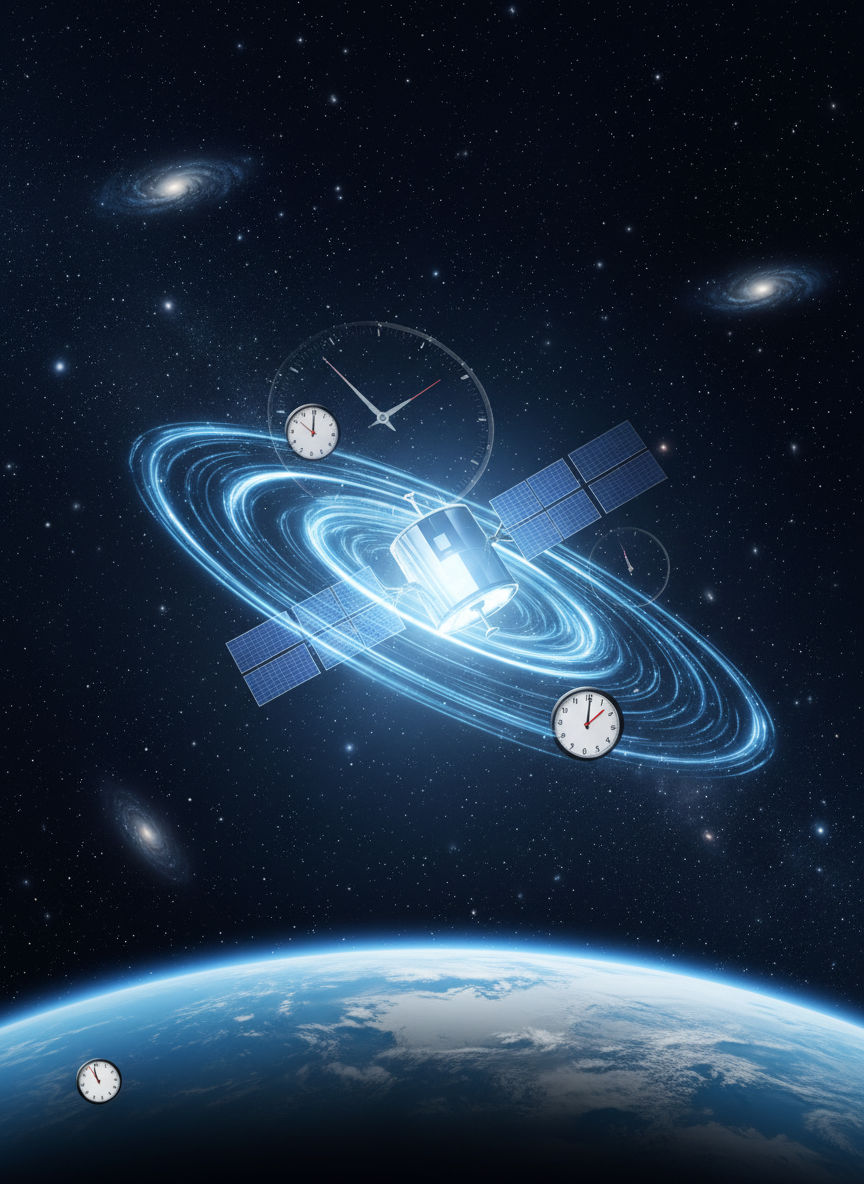
Discover the bizarre space physics behind your phone's little blue dot.
Prompted by A NerdSip Learner
Master the hidden science powering daily navigation.
Let's clear up the biggest misconception about GPS right away: your phone is not talking to space. Many people assume their device sends a signal to a satellite, which bounces it back with a location. In reality, the relationship is entirely one-way.
Think of GPS satellites as a fleet of extremely precise, highly synchronized lighthouses floating in medium Earth orbit. They continuously broadcast a simple, identical message in all directions: 'I am Satellite X, and my current time is precisely *this*.'
Your smartphone is entirely passive. It acts as a highly sensitive radio receiver, quietly listening for these signals raining down from the sky. Because radio waves travel at the speed of light, there is a tiny delay between when the satellite sends the signal and when your phone hears it.
By calculating exactly how long that signal took to arrive, your phone figures out exactly how far away the satellite is. It is not tracking you; you are simply doing some incredibly fast math based on a celestial radio broadcast!
Key Takeaway
Your phone receives signals from GPS satellites to calculate distance, but it never sends data back to them.
Test Your Knowledge
What is the primary function of your smartphone in the GPS network?
So, your phone knows the distance to one satellite. How does that translate to the blue dot on your map? The secret is a geometric concept called trilateration.
Imagine you know you are exactly 12,000 miles from Satellite A. That means you could be anywhere on the surface of an imaginary sphere with a 12,000-mile radius around that satellite. It is not very helpful on its own.
But if you also know you are 13,000 miles from Satellite B, those two giant spheres intersect to form a ring of possible locations. Bring in a third sphere from Satellite C, and that ring narrows down to just two exact points. Since one of those points is usually deep out in space, your phone easily rules it out!
However, to get a truly precise location—and to correct the cheap quartz clock inside your phone—you actually need a signal from a fourth satellite. This final measurement perfectly syncs your phone's time with the network, pinning down your exact latitude, longitude, and altitude.
Key Takeaway
GPS pinpoints your location by finding the exact intersection point of imaginary spheres drawn around four different satellites.
Test Your Knowledge
Why does your phone usually need a signal from a fourth satellite?
If trilateration relies on measuring the exact moment a radio signal reaches your phone, the entire system hinges on one critical factor: flawless timekeeping. GPS is, fundamentally, a giant clock network rather than a mapping system.
Radio waves travel at the speed of light—roughly 186,000 miles per second. If a satellite's clock is off by just one-thousandth of a second, your calculated location will be off by nearly 200 miles! To prevent this, every single GPS satellite carries multiple atomic clocks.
These incredibly expensive clocks measure time by tracking the ultra-consistent vibrations of atoms (like rubidium or cesium). They are so precise that they will lose only a few seconds over millions of years.
Your smartphone, however, cannot fit a $100,000 atomic clock inside it. That is why the fourth satellite from our previous lesson is so vital. It acts as a master timekeeper, allowing your phone to constantly adjust its own internal clock to match the atomic perfection of the satellites in space.
Key Takeaway
GPS is essentially a massive network of perfectly synchronized atomic clocks, as tiny timing errors cause massive location errors.
Test Your Knowledge
Why are atomic clocks necessary on GPS satellites?
Here is where GPS gets genuinely weird: it relies on Albert Einstein’s theories of relativity to function. Without accounting for mind-bending physics, the entire system would fail in a matter of minutes.
First, we have Special Relativity. Because the satellites are zipping around the Earth at about 8,700 mph, time actually slows down for them relative to us on the ground. This effect causes their atomic clocks to lose about 7 microseconds a day.
But there is also General Relativity. Gravity warps time, and because the satellites are 12,500 miles away from Earth's mass, they experience much weaker gravity than we do. This lack of gravitational pull makes their clocks run *faster* by about 45 microseconds a day.
When you combine these two wild relativistic effects, the satellites' clocks naturally tick about 38 microseconds faster per day than clocks on Earth. Engineers have to deliberately program the satellite clocks to run slightly slow before launch to cancel out Einstein’s invisible hand!
Key Takeaway
Because of relativity, satellite clocks experience time differently than we do on Earth, requiring constant mathematical corrections.
Test Your Knowledge
What would happen if engineers ignored the effects of relativity on GPS satellites?
Because we associate GPS primarily with road trips and food delivery, we often overlook its true role in modern civilization. The Global Positioning System is actually the invisible backbone of the global economy.
Remember those atomic clocks? Their ultra-precise timekeeping is broadcast worldwide, for free. As a result, major industries have hijacked this time signal to synchronize their own complex networks.
When you swipe a credit card or execute a stock trade, the financial system uses GPS timestamps to ensure billions of transactions are processed in the exact right order. Cell phone towers rely on GPS time to smoothly hand off your call from one tower to the next while you drive. Even the electrical power grid uses it to monitor the precise flow of alternating current across entire continents.
If the GPS network were to suddenly go offline, we wouldn't just get lost on the highway. Global communications, financial markets, and power distribution would face cascading, catastrophic failures.
Key Takeaway
GPS provides a free, globally synchronized time signal that underpins banking, communications, and power grids.
Test Your Knowledge
Why do industries like banking and telecommunications rely heavily on GPS?
Track your progress, earn XP, and compete on leaderboards. Download NerdSip to start learning.