Is there really a lake that instantly turns animals into stone?
Prompted by A NerdSip Learner
Master the chemistry of nature's petrifying lake.
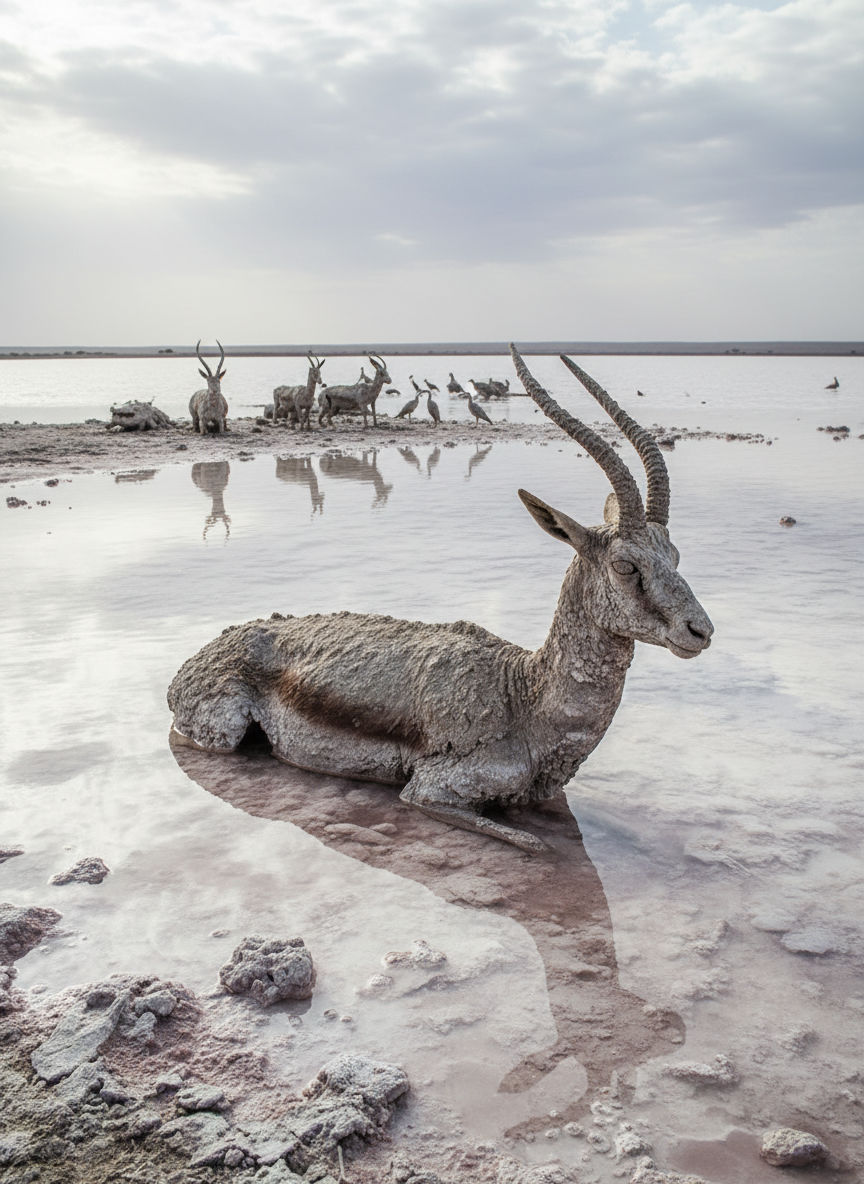
Have you ever seen those haunting, viral photos of birds and bats that look like they've been instantly turned to solid stone? It looks like a scene straight out of Greek mythology, as if the creatures made eye contact with Medusa herself!
The location is Lake Natron in northern Tanzania. But before you start believing in curses, the reality is a bit more grounded—though just as fascinating. Animals do not instantly turn to stone when they touch the water.
In reality, the famous images that shocked the internet were the work of a wildlife photographer. He found these perfectly preserved, calcified carcasses washed up along the shoreline. To highlight their eerie beauty, he carefully picked them up and posed them on branches and in the water, making them look alive in death.
So, what actually killed them? The lake has a highly reflective, glassy surface that often confuses birds, causing them to crash. Once they die in the water, the lake's unique chemistry takes over to create these "stone" statues.
Key Takeaway
The "stone animals" of Lake Natron are naturally preserved mummies, not victims of an instant petrifying curse.
Test Your Knowledge
Why do the animals in the famous viral photos of Lake Natron look like they were turned to stone while perching on branches?
If Lake Natron isn't magically petrifying animals, what is actually happening to their bodies? The secret lies in the lake's name: natron.
Natron is a naturally occurring compound made mostly of sodium carbonate and sodium bicarbonate. This mineral washes into the lake from a nearby active volcano. Because Lake Natron has no outlet, the water simply evaporates under the intense African sun, leaving behind a highly concentrated, caustic brine.
The water here is extreme. It can reach scorching temperatures of up to 140°F (60°C) and boasts a pH level that can exceed 10.5—making it almost as alkaline as household ammonia!
When an animal dies in this toxic soup, the natron acts as a powerful desiccant. It rapidly draws the moisture and fat out of the carcass, effectively mummifying it before it can decompose. If this sounds familiar, it should: natron is the exact same substance that ancient Egyptians used to preserve their pharaohs!
Key Takeaway
The lake's extreme alkalinity and volcanic salts dehydrate and calcify dead animals, much like ancient Egyptian mummification.
Test Your Knowledge
What historical practice relied on the exact same chemical compound found in Lake Natron?
With its scalding temperatures, caustic water, and shores littered with mummified carcasses, you might assume Lake Natron is a completely dead zone. Surprisingly, it is a bustling hub of life!
The lake is famous for its striking, blood-red color. This vibrant hue comes from halophiles—specialized, salt-loving microorganisms that actually thrive in the extreme alkalinity.
But the real stars of Lake Natron are the birds. It is actually the most important breeding ground in the world for Lesser Flamingos. Millions of them flock here to nest. But how do they survive the caustic water that would easily burn human skin? Flamingos have evolved incredibly tough, scaly skin on their legs that protects them from chemical burns.
In fact, the deadly nature of the lake is their greatest advantage. The harsh, alkaline mud creates an impenetrable barrier for predators like hyenas. For the flamingos, this "deadly" lake is the ultimate safe haven to raise their chicks!
Key Takeaway
Far from being a dead zone, Lake Natron's harsh conditions actually provide a predator-free sanctuary for specialized creatures like Lesser Flamingos.
Test Your Knowledge
Why is Lake Natron considered the perfect breeding ground for Lesser Flamingos?
Track your progress, earn XP, and compete on leaderboards. Download NerdSip to start learning.