How do we print circuits thinner than a strand of DNA?
Prompted by A NerdSip Learner
Master the mechanics of 2nm chip manufacturing.
Imagine trying to draw a detailed portrait on a tiny grain of rice using a thick, fuzzy marker. It’s impossible, right? To make the chips inside your phone faster and more powerful, scientists need to draw electrical circuits that are incredibly small—thousands of times thinner than a single human hair! This is where Extreme Ultraviolet (EUV) Lithography comes in. Think of it as using a 'light pen' with a beam so fine it can sketch microscopic patterns onto silicon wafers. It is the secret sauce that allows your smartphone to have the power of a supercomputer in your pocket.
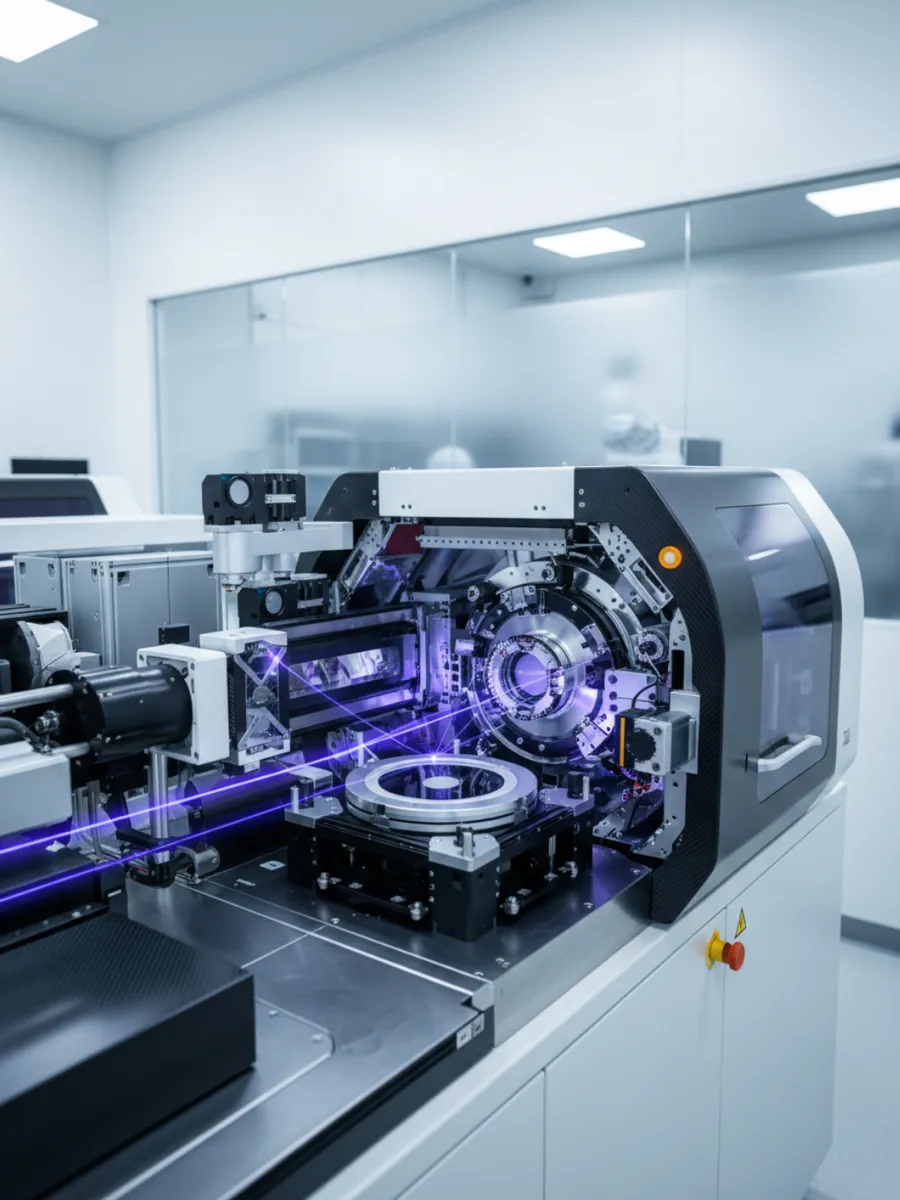
Traditional tools used 'regular' ultraviolet light, but as chips got smaller, that light became too 'blurry' to draw the tiny lines needed. EUV light has a much shorter wavelength, meaning it can draw much sharper, more precise lines. It’s like switching from a fat crayon to a laser-pointed needle. These machines are some of the most complex tools ever built by humans, costing hundreds of millions of dollars each, all just to print the tiny 'streets' and 'buildings' that make up a computer chip's city-like structure!
Key Takeaway
EUV lithography uses an incredibly fine 'light pen' to draw microscopic circuits that make our gadgets faster and smaller.
Test Your Knowledge
Why is EUV light used instead of regular light to make modern computer chips?
Normally, when you want to focus light, you use a glass lens—like in a camera or a magnifying glass. But EUV light is a bit of a rebel. It is so energetic that it doesn't pass through glass; instead, the glass absorbs it like a sponge! If we used normal lenses, the light would just disappear. To solve this, scientists had to invent a way to bounce the light instead. They use specialized mirrors that are the smoothest surfaces ever created. If these mirrors were the size of a whole country, the biggest 'bump' on them would be less than a millimeter tall!
These mirrors are coated with dozens of layers of special materials to ensure they reflect as much EUV light as possible. Even then, every time the light hits a mirror, some of it is lost. By the time the light reaches the chip, only a tiny fraction of the original beam is left. This is why the light source has to be incredibly powerful to begin with. It’s a delicate dance of bouncing light across a series of perfect mirrors to land exactly where it needs to go on the silicon wafer without being absorbed along the way.
Key Takeaway
Because EUV light is absorbed by glass, the machines use the world's smoothest mirrors to guide the light instead.
Test Your Knowledge
What happens if EUV light hits a regular glass lens?
Creating EUV light isn't as simple as flipping a light switch. To make this special light, the machine actually blasts tiny droplets of molten tin with a high-power laser. Imagine a tiny drop of metal falling through the air. A laser hits it twice: once to flatten it into a pancake shape, and a second time to vaporize it into a glowing cloud of plasma. This plasma cloud is what actually glows with that sweet EUV light. This process happens 50,000 times every single second! It’s like a high-tech machine gun firing light instead of bullets.
Because EUV light is so easily absorbed by almost anything—including the air we breathe—the entire process must happen inside a massive vacuum chamber. If even a few molecules of air were in the way, they would soak up the light before it could ever reach the chip. This makes the machines huge, heavy, and extremely sensitive. It’s a feat of engineering that combines liquid metal, powerful lasers, and the emptiness of outer space to build the technology of the future. You’re literally holding 'star power' in your hand every time you use your phone!
Key Takeaway
EUV light is created by vaporizing tin droplets with lasers inside a vacuum so the light doesn't get blocked by air.
Test Your Knowledge
Why does the process happen inside a vacuum chamber?
Track your progress, earn XP, and compete on leaderboards. Download NerdSip to start learning.