Did you know giant squids have eyes as large as dinner plates?
Prompted by A NerdSip Learner
Tracing the history of giant squids and maritime legends.
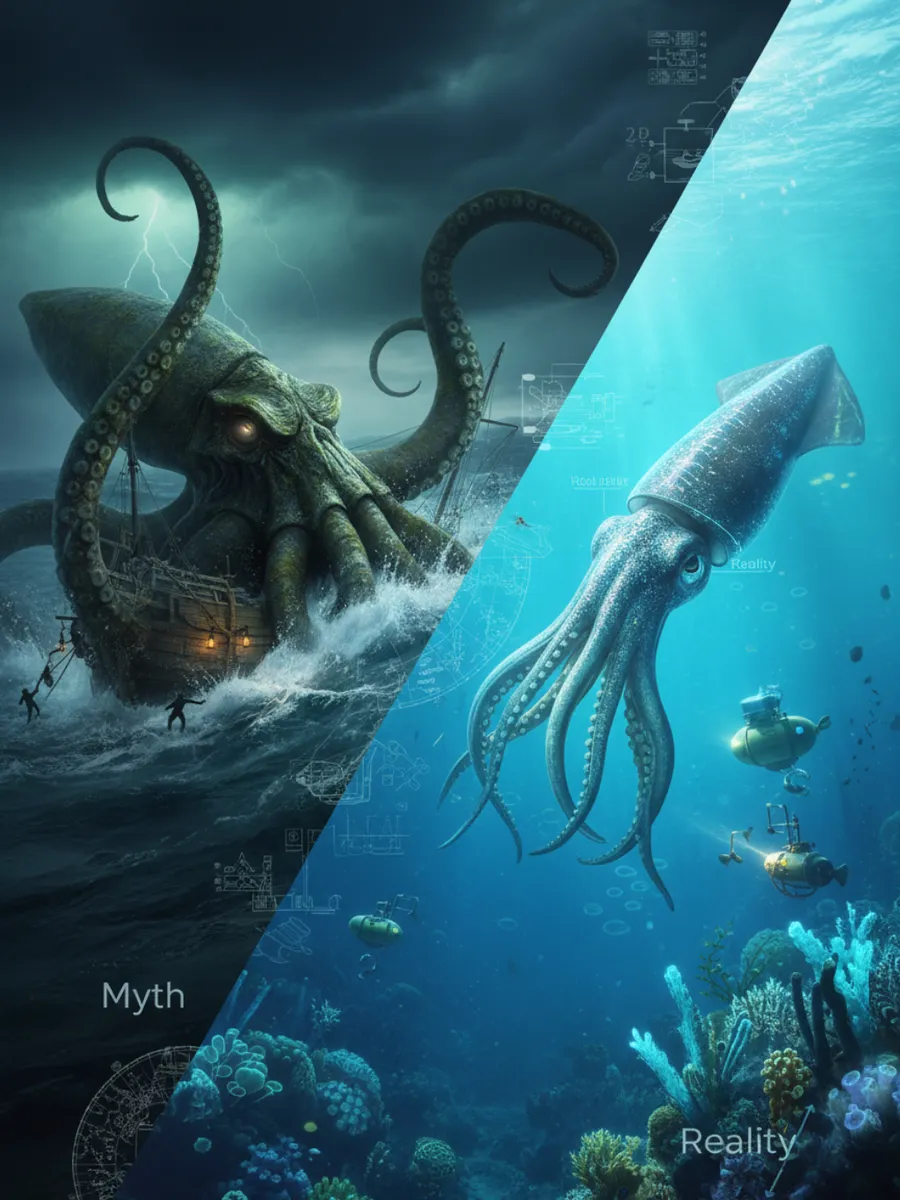
For centuries, sailors whispered of the Kraken—a monster so vast it was often mistaken for a series of islands. Originating in Scandinavian folklore, the legend likely stems from sightings of the giant squid, though the myths greatly exaggerated its size and malice. Early accounts described it as a creature capable of pulling entire warships beneath the waves with its massive, writhing arms.
In the mid-18th century, Bishop Erik Pontoppidan of Bergen described the Kraken in his work *The Natural History of Norway*. He portrayed it as the largest and most dangerous sea monster in existence. While Pontoppidan believed the creature was real, he relied on second-hand accounts from fishermen who claimed the beast would create massive whirlpools as it descended back into the abyss.
Today, we understand that these myths were a blend of fear, limited visibility at sea, and the genuine shock of encountering a creature that defied the biological norms of the surface world. The transition from 'island-monster' to 'biological entity' marks the beginning of our scientific journey into the deep.
Key Takeaway
The Kraken legend originated in Nordic folklore and was popularized by early naturalists who blended myth with real, albeit rare, sightings.
Test Your Knowledge
Which historical figure provided one of the first detailed, albeit exaggerated, descriptions of the Kraken in the 1750s?
The transition from myth to reality began with the study of *Architeuthis dux*, the giant squid. One of its most staggering features is its eyes. Measuring roughly 27 centimeters (about 11 inches) in diameter, they are the largest in the animal kingdom. These massive organs are designed to detect even the smallest traces of light in the pitch-black environment of the deep sea.
Unlike human eyes, which use a lens to change focus, the giant squid has a rigid lens. However, the sheer size of the eye allows it to capture significantly more photons than any other creature. This adaptation is believed to be a defense mechanism, specifically evolved to detect the bioluminescence triggered by its primary predator, the sperm whale, as it moves through the water.
Beyond their eyes, giant squids possess a sophisticated nervous system. They have giant axons—nerve fibers—that are significantly thicker than those found in humans. This allows for rapid signal transmission, enabling the squid to react with lightning speed to threats or prey in the dark, high-pressure depths of the ocean.
Key Takeaway
The giant squid's eyes are the largest on Earth, measuring roughly 27cm, evolved specifically to detect predators in the dark.
Test Your Knowledge
What is the primary evolutionary reason for the giant squid's massive eye size?
Scientific skepticism regarding the Kraken began to shift in 1861 due to a famous encounter near the Canary Islands. The French naval ship *Alecton* came across a giant squid swimming at the surface. The crew, recognizing they had found a legendary beast, spent hours attempting to capture it using harpoons and ropes.
They managed to secure a rope around the squid's tail, but the creature was so heavy—and its flesh so soft—that the rope cut right through its body. Most of the squid sank back into the depths, but the crew managed to salvage a small portion of the tail. This physical evidence, combined with the detailed report from the ship's captain, forced the scientific community to take the existence of 'giant calamari' seriously.
Before this event, many scientists dismissed the Kraken as pure fantasy. The *Alecton* incident provided the first credible bridge between maritime lore and marine biology. It proved that there was indeed a massive, multi-armed cephalopod roaming the Atlantic, though it was not quite the 'ship-crusher' of legend.
Key Takeaway
The 1861 encounter by the French ship Alecton provided the first physical proof that moved the giant squid from the realm of myth into science.
Test Your Knowledge
What happened during the Alecton's attempt to capture the giant squid?
One of the most dramatic relationships in the ocean is the battle between the giant squid and the sperm whale. We know these battles occur because of the scars found on the skin of many sperm whales. These circular scars are made by the serrated suckers of the giant squid as it fights to escape the whale's jaws.
Sperm whales are the giant squid's primary predator. By examining the stomach contents of stranded sperm whales, scientists have found thousands of 'beaks'—the hard, parrot-like mouthparts of squids that are indigestible. These beaks provide crucial data on the size and quantity of squids living in the deep, suggesting they are much more common than sightings would imply.
While the giant squid is massive, reaching lengths of up to 12-13 meters (43 feet), it is often outweighed by its cousin, the Colossal Squid (*Mesonychoteuthis hamiltoni*). The Colossal Squid lives in Antarctic waters and possesses rotating hooks on its tentacles, making it an even more formidable opponent for deep-diving whales.
Key Takeaway
Giant squids and sperm whales are natural enemies, a fact proven by sucker scars on whales and squid beaks found in whale stomachs.
Test Your Knowledge
How do scientists primarily estimate the population and size of giant squids?
Giant squids live in the 'Midnight Zone' (the bathypelagic zone), roughly 300 to 1,000 meters below the surface. In this high-pressure environment, their physiology is uniquely adapted. For instance, their muscles contain high concentrations of ammonium chloride, which makes them more buoyant but also makes their flesh taste like ammonia—and explains why humans don't eat them!
This buoyancy allows the squid to hover in the water column with minimal effort, waiting for prey like smaller squids or deep-sea fish to pass by. They use two long feeding tentacles to snatch prey from a distance, bringing it toward their eight shorter arms and powerful beak.
The phenomenon of 'deep-sea gigantism' is what allows these creatures to reach such massive sizes. Scientists believe that colder temperatures and a lack of predators (other than whales) allow deep-sea species to grow larger and live longer than their shallow-water relatives. However, because they live so deep, they are rarely seen alive in their natural habitat.
Key Takeaway
Giant squids use ammonium chloride for buoyancy and benefit from deep-sea gigantism, a phenomenon where deep-sea species grow to massive sizes.
Test Your Knowledge
Why is giant squid meat generally considered inedible for humans?
For decades, the giant squid was the 'Holy Grail' of marine photography. It wasn't until 2004 that researchers led by Tsunemi Kubodera of Japan’s National Science Museum captured the first still images of a live giant squid in its natural habitat. This was achieved using a camera and a baited line near the Ogasawara Islands.
The even greater breakthrough came in 2012, when a team including Kubodera and marine biologist Edith Widder captured the first-ever video of the creature. They used a specialized, low-light camera system called the 'Medusa.' Instead of using bright white lights that would scare deep-sea creatures, the Medusa used infrared light and an 'electronic jellyfish' lure.
The lure mimicked the bioluminescent distress signal of a jellyfish, which attracted the squid. The footage revealed a majestic, metallic-silver creature, debunking the myth that they are bright red or aggressive monsters. It showed a curious, tactical predator that moved with grace, changing our understanding of their behavior forever.
Key Takeaway
The first video of a live giant squid was captured in 2012 using non-invasive infrared technology and bioluminescent lures.
Test Your Knowledge
What was unique about the 'Medusa' camera system used to film the giant squid?
The journey from the terrifying Kraken of the 13th-century sagas to the biological *Architeuthis dux* of the 21st century is a testament to human curiosity. While science has stripped away the supernatural elements, the reality is arguably more fascinating. We now know that 'monsters' do exist, but they are complex animals perfectly adapted to one of Earth's harshest environments.
In pop culture, the Kraken remains a powerful symbol. From Jules Verne’s *Twenty Thousand Leagues Under the Sea* to modern films, the image of the giant squid continues to represent the mystery of the unknown. However, the 'monster' is now a mascot for ocean conservation and exploration, reminding us how little we still know about the deep sea.
As technology advances, we continue to learn more about their mating habits, their lifespan, and how they interact with the global ecosystem. The Kraken isn't a myth that was debunked; it’s a legend that was finally discovered. The ocean still holds many secrets, and the giant squid is just the most famous of its many residents.
Key Takeaway
The evolution of the Kraken from myth to science highlights the progress of marine biology and our enduring fascination with the deep ocean.
Test Your Knowledge
Which famous 19th-century novel helped cement the giant squid's place in modern pop culture?
Track your progress, earn XP, and compete on leaderboards. Download NerdSip to start learning.