Could a beautiful mountain shrub be hiding a toxic secret?
Prompted by A NerdSip Learner
Master the botany and lore of the Japanese red elder.
Welcome to the fascinating world of the Japanese red elder, known scientifically as *Sambucus sieboldiana*. If you were wandering along the edge of a temperate forest in Japan or the Korean Peninsula, you might just stumble upon this stunning deciduous shrub.
Thriving in the dappled sunlight of low-elevation mountain thickets, the Japanese red elder is a true survivor. It can grow up to 4 meters (about 13 feet) tall, creating a lush, leafy canopy that adds structure to the forest understory. Because it is deciduous, it sheds its leaves in the winter, resting before an explosive burst of spring growth.
What makes this plant so special for a nature lover? It is incredibly adaptable, tolerating a variety of soils while providing a crucial anchor for the local ecosystem. Unlike delicate hothouse flowers, this robust shrub knows how to hold its own in the wild.
Whether you are a budding botanist or just love learning about global ecosystems, the Japanese red elder is a perfect gateway into East Asian ecology!
Key Takeaway
The Japanese red elder is a resilient, medium-sized shrub native to East Asian forests.
Test Your Knowledge
Where does the Japanese red elder naturally grow?
If you want to identify the Japanese red elder in the wild, you need to know what to look for! Let’s break down its striking visual anatomy.
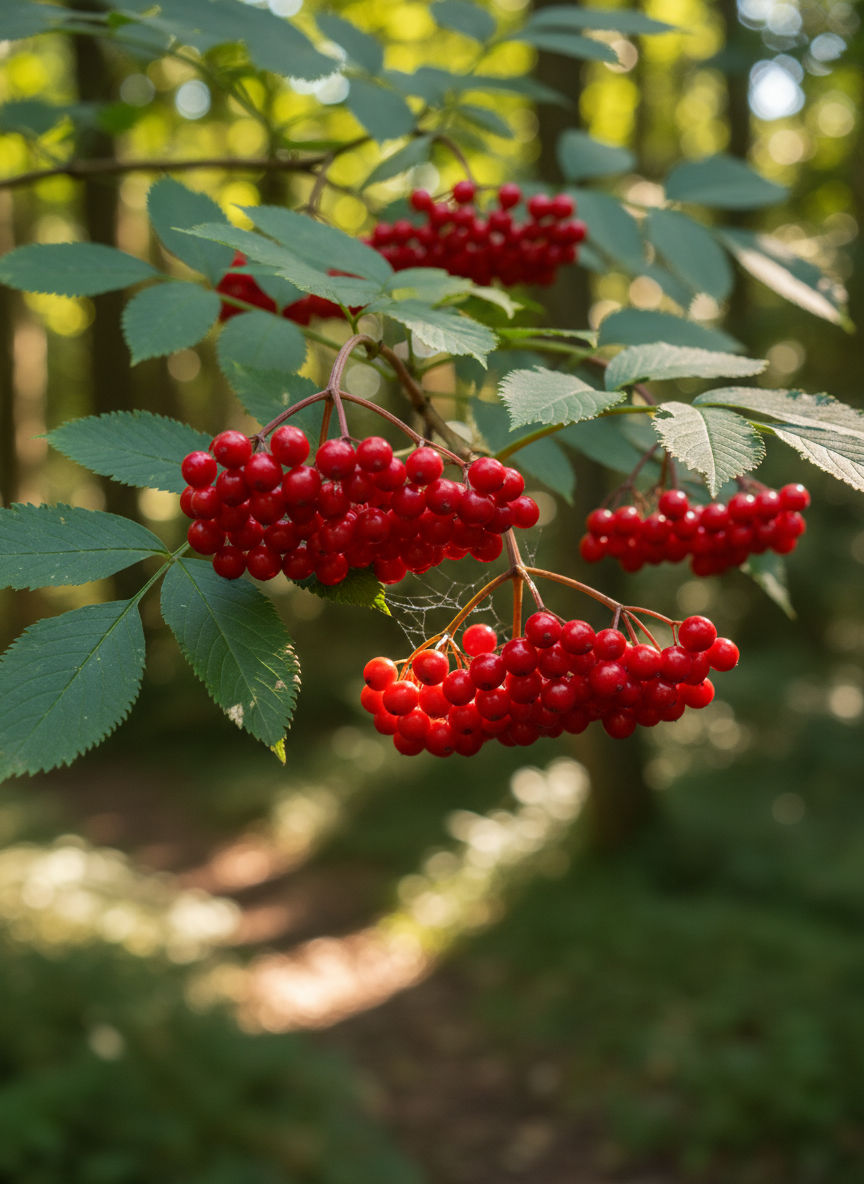
First, look at the foliage. Its leaves are arranged in opposite pairs along the stem and are pinnately compound. This means each leaf is divided into 5 to 7 smaller leaflets arranged like a feather, complete with jagged, toothed edges.
When late spring arrives, the shrub puts on a spectacular show. It erupts into panicles—large, branching clusters—of tiny, cream-colored or white flowers. These delicate blooms are hermaphroditic, meaning they contain both male and female reproductive parts, making them highly efficient at reproducing.
By late summer, the real magic happens. Those tiny white flowers transform into clusters of vibrant, ruby-red berries, each only about 4 millimeters wide. These jewel-like fruits hang heavily from the branches, giving the Japanese red elder its famous common name and making it incredibly easy to spot against the green forest backdrop.
Key Takeaway
You can spot this plant by its toothed leaves, clusters of spring white flowers, and vibrant red berries.
Test Your Knowledge
What happens to the flowers of the Japanese red elder in late summer?
Nature is brilliant, but it can also be strictly defensive. Because plants cannot simply run away from hungry herbivores, they rely on chemical warfare.
Like many plants in the *Sambucus* (elderberry) genus, the Japanese red elder harbors a dark secret: it contains cyanogenic glycosides. These complex chemical compounds are found in the leaves, stems, roots, and raw seeds. When crushed or digested raw, they can release cyanide, leading to severe stomach upset and nausea for humans.
However, human ingenuity has found a workaround. The toxins present in the berries are relatively low and, more importantly, they are highly sensitive to heat.
By thoroughly cooking the red berries, the harmful compounds are completely neutralized. This fascinating chemical transformation is exactly why cooked elderberries have been safely used in traditional syrups, jams, and teas for centuries. Just remember the golden rule of foraging: never eat the berries raw right off the branch!
Key Takeaway
Raw parts of the elder are toxic, but cooking the berries makes them safe to consume.
Test Your Knowledge
What must you do before consuming Japanese red elder berries?
While humans have to be incredibly careful around raw elderberries, the local wildlife views the Japanese red elder as an all-you-can-eat buffet!
In late spring, the shrub's large clusters of white flowers act as a massive beacon for early-season pollinators. Bees, butterflies, and various insects flock to the blooms to harvest nectar, unwittingly transferring pollen from flower to flower and ensuring the plant’s next generation.
By autumn, the plant's ecological role shifts from a pollinator hub to a bird feeder. The bright red berries are visually irresistible to local bird species. Because birds have different digestive systems than humans, they can safely consume the fleshy fruit without being harmed by the seeds' chemical defenses.
As the birds digest the fruit, the tough seeds pass through their systems entirely unharmed. When the birds fly away, they naturally disperse the seeds across the forest, acting as the plant's personal transportation network. It is a perfect, mutually beneficial partnership!
Key Takeaway
The Japanese red elder is a vital food source for birds and insect pollinators.
Test Your Knowledge
How are the seeds of the Japanese red elder primarily dispersed?
To truly understand the Japanese red elder, we have to look at its family tree. For a very long time, botanists grouped elderberry plants into the honeysuckle family (*Caprifoliaceae*), largely because of their physical similarities.
However, modern science changed everything! With the advent of advanced DNA sequencing, scientists realized that elderberries were genetically distinct. They officially moved *Sambucus sieboldiana* into the moschatel family (*Adoxaceae*). This shows how our understanding of nature is constantly evolving thanks to new technology.
But what about its specific name, *sieboldiana*? It is a botanical tribute to Philipp Franz von Siebold, a 19th-century German physician and botanist.
Von Siebold spent years carefully documenting the flora and fauna of Japan, introducing many incredible East Asian plants to the Western world. So, every time you say *Sambucus sieboldiana*, you are actually uttering a tiny piece of scientific history! It is a wonderful reminder that every plant name carries a hidden story.
Key Takeaway
Genetic discoveries moved this plant into the moschatel family, and it is named after a famous botanist.
Test Your Knowledge
The specific name 'sieboldiana' honors Philipp Franz von Siebold, who was known for studying:
Track your progress, earn XP, and compete on leaderboards. Download NerdSip to start learning.