What if 95% of everything in the universe was completely invisible to us?
Prompted by A NerdSip Learner
Identify the two forces shaping our entire cosmos.
Imagine you are looking at a vast ocean. You see a few icebergs poking out of the water, but you know that 95% of the ice is hidden beneath the surface. The universe is exactly like that! Everything you have ever seen—stars, planets, your phone, and even your own body—is made of normal matter (also called baryonic matter).
Shockingly, this normal matter only makes up about 5% of the universe. The rest is a mystery. Roughly 27% is Dark Matter, which acts like an invisible glue holding galaxies together. The remaining 68% is Dark Energy, a mysterious pressure that is stretching the universe apart.
We call them 'dark' not because of their color, but because they don't emit, reflect, or absorb light. We can't see them with even the most powerful telescopes, yet we know they exist because of how they affect the things we *can* see.
Key Takeaway
Visible matter is only a tiny fraction (5%) of the universe; the rest is made of dark matter and dark energy.
Test Your Knowledge
Roughly what percentage of the universe is made of the 'normal matter' we can see?
Back in the 1970s, astronomer Vera Rubin noticed something weird: galaxies were spinning way too fast. Based on the amount of visible stars and gas, they should have flown apart like a loose merry-go-round. There simply wasn't enough 'visible' gravity to hold them together.
Scientists realized there must be a massive amount of invisible 'stuff' providing extra gravitational pull. This is Dark Matter. It doesn't interact with light, but it definitely has mass. It forms a 'halo' around galaxies, acting like a cosmic web that keeps stars from drifting away into the void.
While we haven't caught a dark matter particle yet, we can see its 'shadow' through gravitational lensing. This happens when the invisible mass of dark matter is so heavy that it actually bends the light from distant stars, acting like a giant, cosmic magnifying glass.
Key Takeaway
Dark matter provides the extra gravity needed to stop galaxies from flying apart.
Test Your Knowledge
How do scientists 'see' dark matter if it doesn't emit light?
How do we know dark matter isn't just 'normal' matter we haven't found yet? The best evidence comes from a 'crime scene' called the Bullet Cluster. This is a massive collision between two groups of galaxies that happened millions of years ago.
When these clusters crashed, the hot gas (normal matter) hit the other gas and slowed down, getting stuck in the middle. But when scientists mapped the gravity, they found that most of the mass didn't stop—it sailed right through the crash without slowing down at all!
This 'ghostly' mass that passed through is dark matter. Because it doesn't interact with anything except through gravity, it didn't feel the 'friction' of the collision. This proved that dark matter is something fundamentally different from the atoms and gas that make up you and me.
Key Takeaway
The Bullet Cluster collision proved that dark matter can pass through normal matter without hitting it.
Test Your Knowledge
What happened to dark matter during the Bullet Cluster collision?
If dark matter is the 'glue' that pulls things together, Dark Energy is the 'spring' that pushes them apart. For a long time, scientists thought gravity would eventually slow down the expansion of the universe. In 1998, they looked at distant exploding stars (supernovae) to confirm this.
They were shocked to find the opposite: the universe isn't slowing down; it's accelerating. It's as if you threw a ball into the air and, instead of falling back down, it started zooming away faster and faster!
Dark energy is the name we give to this mysterious force driving the acceleration. One popular theory is that it's a property of space itself. As the universe expands and creates more space, there is more dark energy, which causes even more expansion. It's a runaway process that dominates the cosmos.
Key Takeaway
Dark energy is a mysterious force causing the expansion of the universe to speed up over time.
Test Your Knowledge
What discovery in 1998 surprised scientists about the universe?
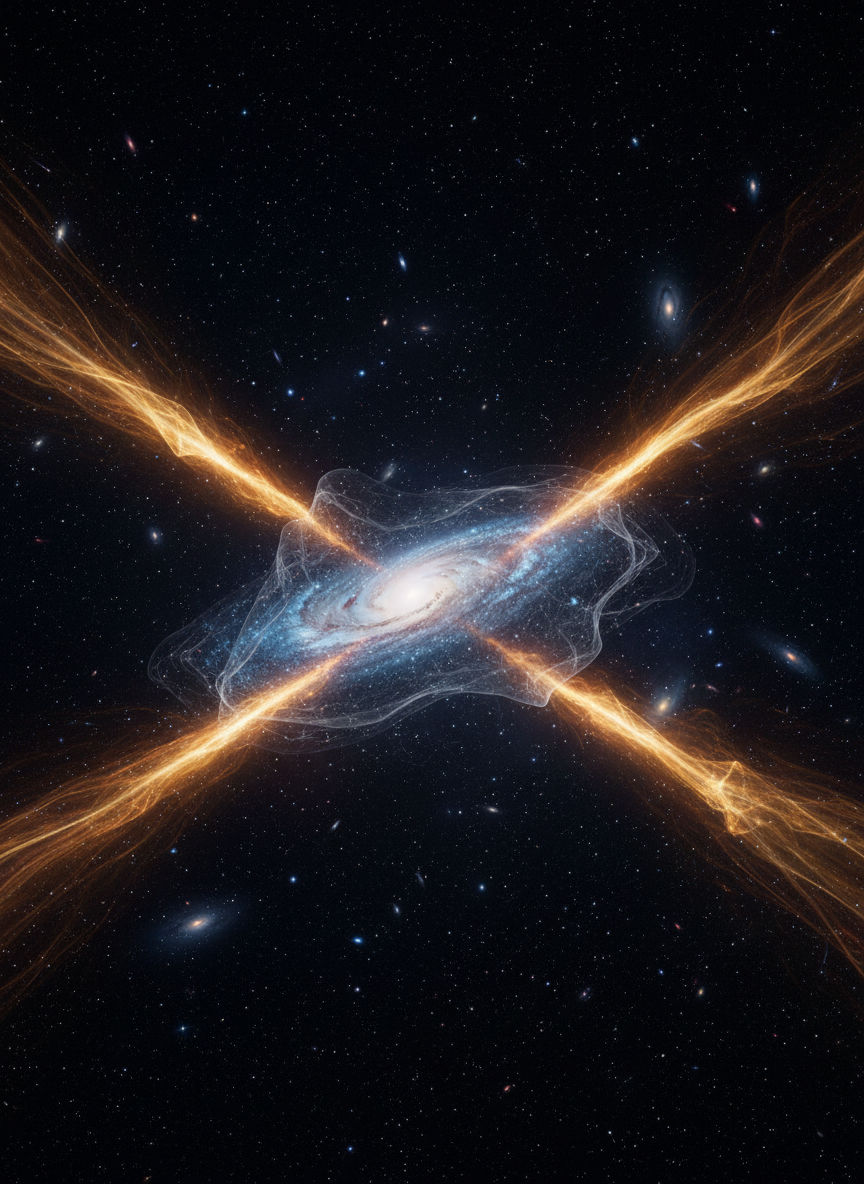
The universe is currently in a massive tug-of-war. On one side, Gravity (from normal and dark matter) wants to pull everything together into clumps. On the other side, Dark Energy wants to push everything apart.
Right now, dark energy is winning. Because it makes up 68% of the universe, it is overwhelming the pull of gravity on a large scale. If this continues, the future of our universe might be a 'Big Freeze'. Galaxies will move so far apart that they disappear from our view, stars will eventually run out of fuel, and the universe will become a cold, dark, lonely place.
Scientists are currently using missions like the Vera Rubin Observatory and the Euclid telescope to map these 'dark' forces more accurately. We are living in the golden age of discovery, where we might finally learn what the majority of our universe is actually made of!
Key Takeaway
Dark energy is currently 'winning' the cosmic tug-of-war, leading to an ever-expanding universe.
Test Your Knowledge
In the 'tug-of-war' of the universe, which force is currently winning?
Track your progress, earn XP, and compete on leaderboards. Download NerdSip to start learning.