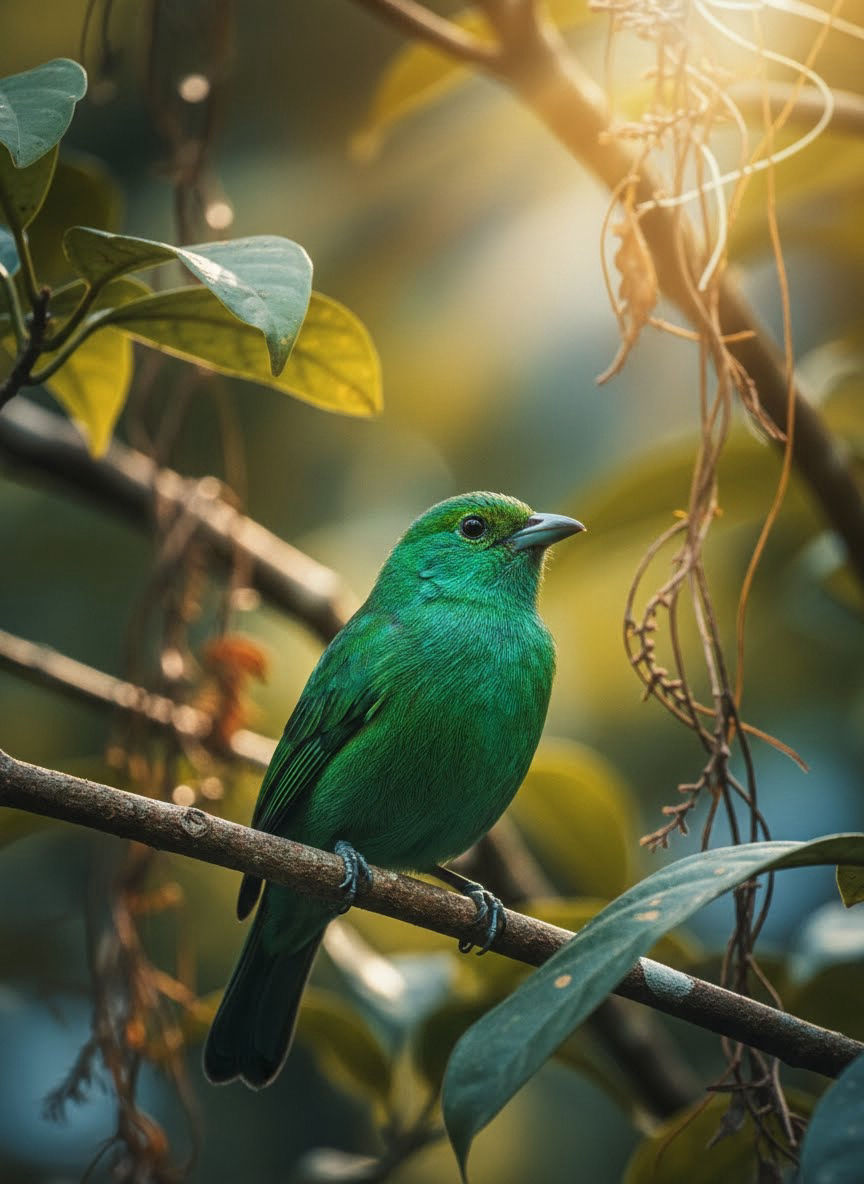
Ever seen a bird that vanishes in plain sight?
Prompted by A NerdSip Learner
Identify the rare Andean Green Tanager.
Meet the Grass-green Tanager (*Chlorornis riefferii*), the ultimate ninja of the bird world! While other tanagers show off with flashy reds, blues, and yellows, this bird commits 100% to the monochromatic look. It is massive for a tanager and is colored a brilliant, shocking lime green from head to tail.
The only giveaway? Its beak and legs. They sport a striking chestnut-orange color. When they are sitting still, they look like a bright orange beak floating mysteriously in a sea of leaves! These birds are found exclusively in the Andes mountains, making them a bucket-list sighting for birdwatchers in South America.
Understanding this bird means appreciating that evolution isn't always about standing out to find a mate. Sometimes, it's about blending in so well that predators (and frustrated birdwatchers) walk right past you. It is one of the largest tanagers, yet one of the hardest to spot until it moves!
Key Takeaway
The Grass-green Tanager uses its solid lime plumage to blend perfectly with its environment, betrayed only by an orange beak.
Test Your Knowledge
Which feature is the primary 'giveaway' that reveals a hiding Grass-green Tanager?
So, where does a neon-green bird hide without getting eaten? Welcome to the Andean Cloud Forest. These are high-altitude rainforests (usually 1,500 to 3,000 meters up) where the mountains are constantly wrapped in mist, fog, and low-hanging clouds.
In this environment, every tree branch is covered in wet moss, epiphytes, and thick foliage. The Green Tanager’s plumage is a perfect evolutionary match for this "mossy world." This biological camouflage is called crypsis—the ability to avoid detection by matching the background.
Unlike birds in the lower Amazon that might need to be darker to hide in deep shadows, the Green Tanager matches the bright, wet greenery of the high-altitude canopy. If you ever hike in Ecuador or Peru, look for the "floating beak" in the mist. Without that specific mossy environment, their bright green would make them an easy snack for hawks!
Key Takeaway
These birds live in high-altitude Cloud Forests, using 'crypsis' to match the mossy surroundings.
Test Your Knowledge
What is the specific term for the Green Tanager's ability to blend into the mossy forest?
Green Tanagers aren't loners; they are social butterflies (or birds)! They are often the core members of mixed-species flocks. Imagine a roving gang of different bird species moving through the forest together for protection. The Green Tanager often travels with Mountain-Tanagers and Flowerpiercers, bringing energy to the group.
When it comes to dinner, they are total acrobats. You will often see them hanging upside down from mossy branches to inspect the undersides of leaves. Why? They are hunting for juicy insects and searching for small berries (Melastome fruits are a favorite).
This behavior highlights their dual role in the ecosystem: they help control insect populations and disperse seeds for the forest trees. They are energetic, vocal, and constantly on the move, making that brief glimpse of lime green even more special for those lucky enough to spot them.
Key Takeaway
Green Tanagers are social, acrobatic feeders that hang upside down to find insects and fruit.
Test Your Knowledge
Why do Green Tanagers often hang upside down on branches?
Track your progress, earn XP, and compete on leaderboards. Download NerdSip to start learning.