What if you could hit a reset button on your age whenever you got old?
Prompted by A NerdSip Learner
Understand the cellular process of transdifferentiation.
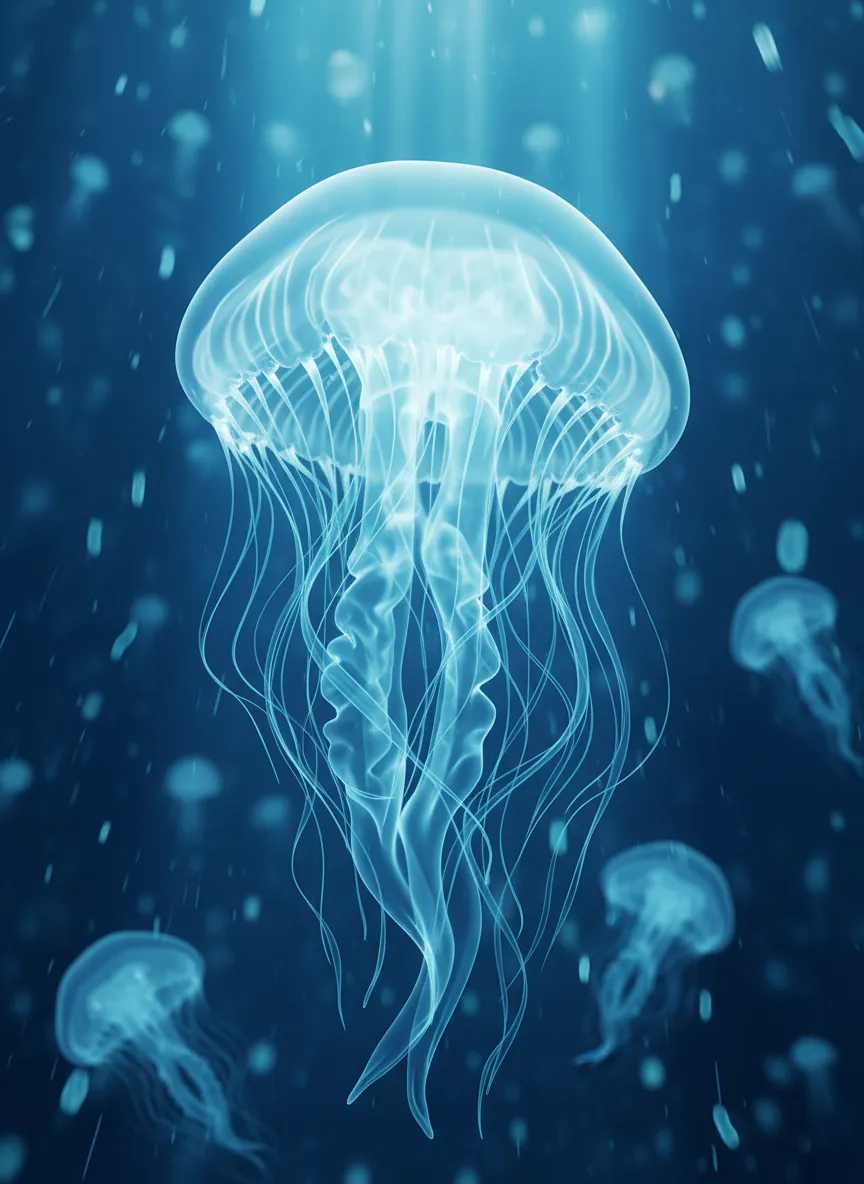
Imagine reaching your 80s, feeling the aches of old age, and suddenly deciding, "Nope, I think I'll be a toddler again." While this is pure fantasy for humans, for the *Turritopsis dohrnii*, it’s just another Tuesday. This tiny creature, smaller than your pinky nail, is the only known animal capable of reverting its biological clock completely.
Most jellyfish follow a one-way street: they are born, they grow, they reproduce, and they die. This is the natural order of things. However, when the *Turritopsis dohrnii* faces a crisis, it refuses to accept the end. Instead of dying, it activates a unique biological superpower.
Discovered in the Mediterranean Sea in the 1880s, its secret wasn't fully understood until the 1990s. Scientists were stunned to realize that this wasn't just regeneration (like a starfish growing a leg back); it was a total biological reset. Let's dive into how this miracle happens.
Key Takeaway
The Turritopsis dohrnii is a tiny jellyfish capable of completely reversing its biological aging process.
Test Your Knowledge
What makes Turritopsis dohrnii different from other jellyfish?
To understand the miracle, we first need to understand the 'normal' life of a jellyfish. It usually starts as a fertilized egg, which turns into a swimming larva called a *planula*. This larva finds a nice spot on the ocean floor and attaches itself, growing into a colony of polyps (think of them like tiny sea anemones).
Eventually, these polyps bud off and release tiny, free-swimming jellyfish called *medusae*. This is the adult form we recognize—the bell-shaped creature with tentacles. The medusa spends its days eating plankton and eventually reproduces.
For 99.9% of jellyfish species, reproduction signals the beginning of the end. Once they spawn, they deteriorate and die. But our star, the *Turritopsis dohrnii*, treats this adult 'medusa' stage not as the final chapter, but potentially as a midway point.
Key Takeaway
Jellyfish typically develop from larvae to polyps, and finally to the adult medusa stage before dying.
Test Your Knowledge
What is the adult, free-swimming stage of a jellyfish called?
So, when does the immortality kick in? The jellyfish doesn't just spontaneously turn into a baby for fun. The reversal process is actually an emergency survival mechanism. It is triggered by environmental stress, physical assault, or sickness.
If the jellyfish is starving, experiences a sudden change in water temperature, or sustains a physical injury, its body realizes it cannot survive in its current adult form. It decides that the only way to save the genetic code is to reboot the system entirely.
Instead of withering away, the adult jellyfish begins to shrink. It reabsorbs its tentacles and its bell, losing the ability to swim. It sinks to the ocean floor, transforming into a formless blob of tissue. To the untrained eye, it looks like it's dying, but it's actually preparing for a miraculous transformation.
Key Takeaway
The age-reversal process is triggered by stress, physical damage, or starvation as a survival mechanism.
Test Your Knowledge
What triggers the jellyfish to reverse its age?
Here is the core science concept you need to know: Transdifferentiation. In complex animals (like humans), cells are specialized. A muscle cell is a muscle cell; a nerve cell is a nerve cell. They don't usually switch jobs.
However, during the jellyfish's reversion process, its specialized cells lose their distinct identities. A muscle cell can regress to a neutral state and then transform into a completely different type of cell, such as a nerve or skin cell. It is cellular recycling at its absolute finest.
Think of it like taking a baked cake and separating it back into flour, eggs, and sugar, so you can bake a pie instead. This ability to switch cell types is rare in the animal kingdom and is the key to the jellyfish's ability to rebuild its body from scratch.
Key Takeaway
Transdifferentiation is the process where a specialized mature cell transforms into a completely different type of cell.
Test Your Knowledge
What is Transdifferentiation?
Once the jellyfish has sunk to the floor and its cells have undergone transdifferentiation, the 'blob' doesn't just turn into a baby jellyfish immediately. It actually turns back into a *polyp*—the stationary stage of life we discussed in Lesson 2.
From this single reverted polyp, a new colony grows. This is the most mind-blowing part: because polyps reproduce by cloning (budding), this process doesn't just save the individual; it multiplies it. One stressed adult jellyfish reverts to a polyp, which then spawns hundreds of genetically identical baby jellyfish.
So, the original individual technically 'disappears,' but its exact genetic clone lives on, restarted at day one. It creates an army of itself to ensure survival. It is the ultimate biological loophole.
Key Takeaway
The jellyfish reverts to the polyp stage and spawns a colony of genetically identical clones.
Test Your Knowledge
What happens after the jellyfish reverts to a polyp?
Why are scientists obsessed with this jelly? It's all about Regenerative Medicine. Humans have stem cells, which can turn into any cell, but we mostly have them when we are embryos. As adults, our cells are 'locked' in their roles. If you damage your heart tissue, it scars; it doesn't just turn into fresh heart cells.
If we could unlock the secrets of transdifferentiation used by *Turritopsis dohrnii*, we might be able to reprogram our own cells. Imagine repairing a damaged spinal cord by convincing the surrounding cells to turn into new neurons, or healing a heart attack by regenerating healthy muscle tissue.
We aren't trying to live forever, but understanding this cellular mechanism could revolutionize how we treat degenerative diseases and severe injuries. The jellyfish holds the blueprint for cellular flexibility.
Key Takeaway
Studying the jellyfish could lead to breakthroughs in repairing damaged human human tissue and organs.
Test Your Knowledge
How could transdifferentiation help humans?
Before you start thinking the world will soon be overrun by immortal jellyfish, we have to make a distinction: being biologically immortal is not the same as being invincible. The *Turritopsis dohrnii* has plenty of problems.
They are tiny, they have no defense mechanisms, and they are a tasty snack for turtles, other jellyfish, and fish. If a predator eats them, they can't transdifferentiate their way out of a stomach! They are also susceptible to diseases that can kill them before they have a chance to hit the reset button.
However, theoretically, if kept in a safe lab environment without predators or disease, they could live forever, cycling back and forth between adult and polyp. It reminds us that nature's boundaries are more flexible than we think—and that age is, biologically speaking, just a state of cells.
Key Takeaway
The jellyfish is biologically immortal but can still die from predation or disease.
Test Your Knowledge
What is the main difference between the jellyfish's immortality and invincibility?
Track your progress, earn XP, and compete on leaderboards. Download NerdSip to start learning.