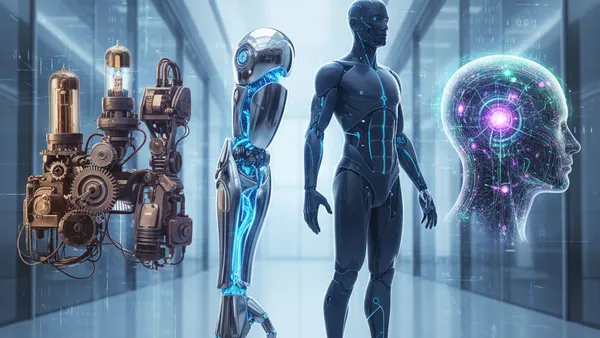
Ready to discover how we became part machine?
Prompted by NerdSip Explorer #6116
Understand the evolution of human-machine integration.
When you hear the word "cyborg", you probably picture sci-fi assassins with glowing red eyes. But the true origin of the word is firmly rooted in real-world science.
In 1960, two space scientists named Manfred Clynes and Nathan Kline were trying to solve a massive problem: how could fragile human bodies survive the harsh, unforgiving environment of deep space?
Instead of building better spaceships, they proposed altering the astronauts themselves. They envisioned humans equipped with mechanical pumps and synthetic organs that would automatically regulate their biology in a vacuum. To describe this fusion of biology and machinery, they combined the words "cybernetic" and "organism" to coin a brand new term: the cyborg.
While we haven't yet engineered astronauts with built-in oxygen pumps, this foundational idea—using technology to seamlessly adapt and enhance the human body—birthed the entire field of cyberware. We stopped looking at machines as just tools we hold, and started seeing them as parts of ourselves.
Key Takeaway
The term "cyborg" was invented in 1960 by space scientists looking to adapt the human body for extraterrestrial travel.
Test Your Knowledge
What was the original purpose behind the invention of the term "cyborg"?
While scientists in the 1960s were dreaming of cyborg astronauts, the first true piece of life-saving cyberware had already been implanted. It wasn't a glowing robotic arm—it was the implantable cardiac pacemaker.
In 1958, a Swedish engineer named Rune Elmqvist and a surgeon named Åke Senning teamed up to save a dying patient named Arne Larsson, whose heart was failing. They created a small, hockey-puck-sized device designed to deliver rhythmic electrical shocks directly to the heart muscle to keep it beating.
The very first implant failed after just three hours. Undeterred, they implanted a second one the next day. It worked. This simple piece of internal hardware paved the way for a medical revolution.
Arne Larsson ended up living to the ripe old age of 86, outliving both the engineer and the surgeon who saved him. He went through an incredible 26 different pacemakers in his lifetime, acting as living proof that machines and human biology could peacefully coexist.
Key Takeaway
The first fully implantable pacemaker was placed in 1958, paving the way for machines to keep the human heart beating.
Test Your Knowledge
What was the very first fully implantable piece of cyberware?
Fixing a heartbeat is one thing, but could a machine replace a human sense? In the 1960s and 70s, researchers set their sights on a seemingly impossible goal: curing deafness with technology.
The result was the cochlear implant. Unlike a traditional hearing aid, which simply acts like a megaphone to make sounds louder, the cochlear implant does something entirely different. It acts as an artificial ear, completely bypassing damaged acoustic hardware.
It works by using an external microphone to pick up sound, translating it into digital data, and sending it to an internal implant. This implant features a wire threaded directly into the inner ear, using electrical impulses to stimulate the auditory nerve.
Early prototypes in the 1960s could only transmit a single channel of sound, making it hard to understand speech. But by the late 1970s, multi-channel devices were successfully implanted, allowing deaf individuals to hear complex words and sentences. It was the first time in history a human sense was restored by a computer interface.
Key Takeaway
Cochlear implants bypassed damaged ears entirely, becoming the first technology to restore a human sense using direct electrical stimulation.
Test Your Knowledge
How does a cochlear implant differ from a traditional hearing aid?
While doctors were quietly implanting pacemakers and artificial ears, pop culture exploded with wild, neon-soaked visions of the future. The 1980s gave birth to the "cyberpunk" genre, which forever changed how we think about human enhancement.
Authors like William Gibson, who wrote the groundbreaking 1984 novel *Neuromancer*, painted a gritty picture of the future. His characters didn't just use computers; they plugged them directly into their brains via neural jacks. They upgraded their bodies with hidden weapons, mirrored optical implants, and synthetic muscles.
This era popularized the term "cyberware." It shifted the concept of implants away from being purely medical devices for people with disabilities, transforming them into a subculture of choice and rebellion. Cyberware became "chrome"—a status symbol, a weapon, and a fashion statement.
Though these stories were fiction, they created a powerful cultural blueprint. The engineers and biohackers of today grew up reading these novels, and many of the sleek, commercial brain interfaces currently in development are directly inspired by 1980s cyberpunk dreams.
Key Takeaway
The 1980s cyberpunk genre took the medical reality of implants and transformed it into a cultural obsession with futuristic, enhanced bodies.
Test Your Knowledge
What cultural movement in the 1980s popularized the term "cyberware"?
If we truly want to merge humans and computers, the ultimate frontier is the brain. But how do you connect a wet, squishy biological organ to a hard, digital machine? Enter the Utah Array.
Invented in 1989 by Richard Normann, the Utah Array was a monumental leap forward in Brain-Computer Interfaces (BCIs). Imagine a tiny, square bed of nails, smaller than a penny, featuring exactly 100 microscopic silicon needles.
During surgery, this tiny grid is pressed gently into the surface of the brain's cortex. Each microscopic needle acts as an antenna, eavesdropping on the electrical chatter of individual neurons.
By the early 2000s, patients paralyzed by spinal cord injuries were having Utah Arrays implanted in their motor cortex. By simply *thinking* about moving their arm, the array captured their neural signals, translated them through a computer, and allowed them to move digital cursors, type messages, and even control robotic arms. The sci-fi dream of telekinesis had become a digital reality.
Key Takeaway
The Utah Array, a tiny bed of micro-electrodes invented in 1989, became the gold standard for reading brain waves directly from the cortex.
Test Your Knowledge
What is the primary function of the Utah Array?
Controlling a robotic arm with your mind is an incredible feat, but early neuroprosthetics had a major flaw: the user couldn't *feel* what they were touching. Imagine trying to pick up a fragile egg with a metal claw while blindfolded.
To solve this, scientists realized that a true cyborg limb needs to be a two-way street. It can't just receive commands from the brain; it has to send sensory information back.
Modern bionics achieve this through advanced techniques like Targeted Muscle Reinnervation (TMR) and two-way brain implants. Sensors on the fingertips of a robotic hand detect pressure and texture. Those signals are then translated into electrical pulses and zapped directly back into the sensory cortex of the user's brain.
In a famous 2016 milestone, a paralyzed man with sensory brain implants used a robotic arm to fist-bump the President of the United States—and he reported that he could actually *feel* the physical impact of the touch. The machine had become an extension of his own nervous system.
Key Takeaway
Modern neuroprosthetics have evolved from passive replacements to two-way streets, allowing users to control robotic limbs and actually feel what they touch.
Test Your Knowledge
What makes modern neuroprosthetics a "two-way street"?
You don't need a medical degree or a multimillion-dollar lab to become a cyborg. In the early 2000s, a DIY subculture emerged called "Grinders."
Grinders are biohackers who believe in democratizing human enhancement. Instead of waiting for medical companies to commercialize cyberware, they take matters into their own hands—literally. Operating out of tattoo parlors and basement labs, they perform minor surgeries on themselves to upgrade their bodies.
One of the most common beginner upgrades is implanting an RFID or NFC microchip into the webbing between the thumb and index finger. Once healed, the user can unlock their front door, start their car, or share digital business cards just by waving their hand.
Other popular implants include tiny neodymium magnets placed in the fingertips. These magnets vibrate in the presence of electromagnetic fields, effectively granting the user a "sixth sense" to feel the invisible energy humming inside microwaves, laptops, and power outlets. It is the purest, rawest form of modern cyberware.
Key Takeaway
"Grinders" are DIY biohackers who bypass the medical system, implanting chips and magnets into their own bodies to gain new senses and abilities.
Test Your Knowledge
Who are "Grinders" in the context of cyberware?
For decades, brain implants like the Utah Array required patients to have bulky wires physically protruding from their skulls, tethering them to large computers. Neuralink, founded by Elon Musk in 2016, aimed to bring this technology out of the lab and into everyday life.
The goal of companies like Neuralink is to make Brain-Computer Interfaces totally invisible and wireless. Instead of stiff needles, their device uses ultra-thin, flexible "threads"—each thinner than a human hair.
Because these threads are so microscopic and delicate, human hands are too clumsy to insert them. To solve this, the company developed a highly advanced surgical robot that acts like a microscopic sewing machine, carefully weaving the threads into the brain while avoiding blood vessels.
Once implanted, the coin-sized device sits flush with the skull, hidden under the scalp, and transmits brain waves wirelessly via Bluetooth. While initially aimed at curing paralysis and blindness, this sleek approach represents the first major step toward commercial, mass-market cyberware.
Key Takeaway
Companies like Neuralink are working to make brain-computer interfaces wireless and commercially accessible using ultra-thin flexible threads and robotic surgery.
Test Your Knowledge
Why do companies like Neuralink use a surgical robot for their implants?
As cyberware transitions from science fiction to commercial reality, society is racing toward a massive ethical collision. The debate boils down to two concepts: Therapy vs. Enhancement.
Historically, cyberware has been strictly therapeutic. A pacemaker fixes a broken heart; a cochlear implant restores lost hearing; a bionic arm replaces a missing limb. The goal has always been to return a patient to a "baseline" of normal human health.
But what happens when the technology becomes *better* than biology? What if a synthetic eye can see infrared light and zoom in like a telescope? What if a brain chip allows you to memorize entire books in seconds?
This crosses the line into human enhancement. Ethicists worry this could create a profound societal divide. If only the wealthy can afford cognitive upgrades, we could see the emergence of a biological elite—a world where the rich aren't just financially superior, but physically and intellectually engineered to be better. The rules of fairness are about to be rewritten.
Key Takeaway
The biggest ethical debate in cyberware is the shift from therapy (healing) to enhancement (upgrading humans beyond their natural limits).
Test Your Knowledge
What is the core ethical concern behind human "enhancement"?
Where does the history of cyberware lead us? We are rapidly approaching an era that futurists call Human 2.0 or the posthuman age.
Currently, we interact with our technology through a severe bottleneck. We type with our thumbs and stare at glowing rectangles. Cyberware promises to shatter that bottleneck, merging the human mind directly with the internet and Artificial Intelligence.
In the near future, AI won't just be an app on your phone; it will be a co-processor in your mind. You could instantly access all of human knowledge, communicate telepathically by beaming thoughts to a friend, or control smart environments just by walking into a room.
The history of cyberware began with a simple ticking pacemaker in 1958, designed merely to keep a human alive. Less than a century later, we are preparing to transcend our biological limits entirely. The question is no longer *if* we will merge with machines, but what it will mean to be human when we do.
Key Takeaway
The future of cyberware points toward the total merger of biology and artificial intelligence, potentially creating a new stage of human evolution.
Test Your Knowledge
In the concept of "Human 2.0," how might Artificial Intelligence change our relationship with technology?
Track your progress, earn XP, and compete on leaderboards. Download NerdSip to start learning.