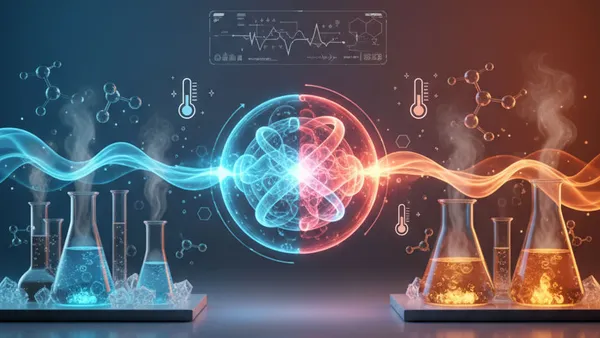
Why do instant cold packs get freezing cold?
Prompted by NerdSip Explorer #6116
Master the rules of heat in chemical reactions.
Ever wonder why burning wood keeps you warm, or why ice packs get instantly cold? Welcome to thermochemistry: the study of heat energy in chemical reactions and physical changes.
Energy is the ability to do work or produce heat. In chemistry, we are mostly concerned with thermal energy (heat) moving around. When chemical bonds break or form, heat is either absorbed or released.
Think of chemical bonds as tiny energy storage units. Breaking those units open costs energy, but forming new ones releases energy. Thermochemistry tracks this invisible energy accounting system, helping us understand everything from digesting food to launching rockets!
Key Takeaway
Thermochemistry studies the heat energy absorbed or released during chemical reactions.
Test Your Knowledge
What does thermochemistry primarily track during a chemical reaction?
To track heat accurately, thermochemists must draw an imaginary box around what they are studying. We call the specific chemical reaction we are looking at the system.
Everything else outside that box—the glass beaker, the air, the room, and even the thermometer you use—is called the surroundings. Heat is constantly flowing back and forth between the system and the surroundings.
If a chemical reaction (the system) gets incredibly hot, it's pushing heat *out* into the surroundings. By carefully defining these boundaries, scientists can measure exactly how much energy is moving and where it's going.
Key Takeaway
The 'system' is the reaction being studied, and the 'surroundings' are everything else.
Test Your Knowledge
If a beaker gets hot during a reaction, where is the heat flowing?
Reactions are categorized by the direction that heat flows. An exothermic reaction releases heat *out* into the surroundings. Think of a campfire or a disposable hand warmer: the system loses energy, and your hands (the surroundings) feel the warmth.
Conversely, an endothermic reaction absorbs heat *in* from its surroundings. A chemical cold pack is a perfect example. The reaction inside needs heat to proceed, so it steals it from your injured ankle, making the pack feel delightfully cold!
In short: "Exo" means out (like exit), and "Endo" means in. Tracking this flow is the very heartbeat of thermochemistry.
Key Takeaway
Exothermic reactions release heat outward, while endothermic reactions absorb heat inward.
Test Your Knowledge
A disposable hand warmer gets hot when squeezed. What type of reaction is this?
In chemistry, we measure the total heat content of a system using a concept called enthalpy, represented by the letter H.
We can't easily measure total enthalpy, so we look at the *change* in enthalpy, written as ΔH (Delta H). If a reaction is exothermic (releases heat), the system loses energy, so ΔH is a negative number.
If the reaction is endothermic (absorbs heat), the system gains energy, so ΔH is a positive number. Think of ΔH as a bank account balance for heat: a negative number means the system spent energy, and a positive number means it made a deposit!
Key Takeaway
Enthalpy change (ΔH) represents the heat gained or lost by a system at constant pressure.
Test Your Knowledge
What does a negative ΔH indicate about a chemical reaction?
Have you ever noticed that a match doesn't just spontaneously catch fire? It needs the friction of a strike. This initial push is called activation energy.
Activation energy is the minimum amount of extra energy required by a reacting molecule to get converted into a product. It's exactly like pushing a heavy boulder up to the top of a hill before it can roll down the other side.
Even highly exothermic reactions—ones that release a massive amount of energy—often need this initial spark to break the very first chemical bonds. Once that activation hill is conquered, the reaction takes off on its own!
Key Takeaway
Activation energy is the initial 'spark' of energy required to start a chemical reaction.
Test Your Knowledge
Why doesn't a match catch fire spontaneously while sitting in a box?
Why does the sand on a beach burn your feet, while the ocean water stays refreshingly cool under the exact same summer sun? The answer is specific heat capacity.
This is the amount of heat energy required to raise the temperature of one gram of a substance by one degree Celsius. Every material has its own unique 'stubbornness' when it comes to changing temperature.
Water has a very high specific heat capacity, meaning it can absorb a massive amount of heat before its temperature actually rises. Metals and sand have a low specific heat, so they heat up—and cool down—very quickly.
Key Takeaway
Specific heat capacity dictates how much energy is needed to change a substance's temperature.
Test Your Knowledge
Why does ocean water stay cooler than the beach sand on a sunny day?
How do we actually put a number on chemical heat? We use a clever laboratory technique called calorimetry. The device we use, a calorimeter, is basically a highly insulated container, much like a high-tech thermos.
Scientists place a reaction inside the calorimeter, usually completely surrounded by a known amount of water. As the reaction happens, it either heats up or cools down that surrounding water.
By measuring the exact temperature change of the water with a thermometer, we can calculate the exact amount of energy the reaction released or absorbed. Fun fact: This is exactly how scientists determine the calories in the food we eat!
Key Takeaway
Calorimetry measures heat change by tracking the temperature shift of the surrounding environment (usually water).
Test Your Knowledge
What is the primary purpose of a calorimeter in a lab?
Imagine climbing a mountain. You could take a steep, direct path to the summit, or a long, winding scenic route that goes up and down along the way. Either way, your total change in altitude from the base to the peak is exactly the same.
This is the core principle behind Hess's Law. It states that the total enthalpy (heat) change for a chemical reaction is the same, regardless of whether it happens in one single step or multiple steps.
Because enthalpy only cares about the starting line (reactants) and the finish line (products), the actual journey doesn't matter. This law allows chemists to calculate heat changes for incredibly complex reactions mathematically without having to run them in a lab!
Key Takeaway
Hess's Law states that total heat change is identical whether a reaction occurs in one step or many.
Test Your Knowledge
Which analogy best describes Hess's Law?
Thermochemistry isn't just about heat; it's also about order. Entropy, represented by the letter S, is a scientific measure of the disorder or randomness in a system.
The universe naturally tends toward chaos. Think of your bedroom: it takes conscious energy to keep it clean (ordered), but it naturally becomes messy (disordered) over time without you trying.
In chemistry, a solid block of ice turning into a gas represents a massive increase in entropy, because gas molecules fly around chaotically. When analyzing if a reaction will happen naturally in the real world, we must look at both heat (enthalpy) AND chaos (entropy).
Key Takeaway
Entropy (S) is a measure of the level of disorder or chaos within a chemical system.
Test Your Knowledge
Which of the following phase changes represents the largest increase in entropy?
Will a chemical reaction happen on its own without us forcing it? To answer this, thermochemists combine enthalpy (heat) and entropy (chaos) into one ultimate master equation: Gibbs Free Energy (G).
A reaction is considered spontaneous if it can occur without continuous outside intervention. If the change in Gibbs Free Energy (ΔG) is negative, the reaction gets a green light—it is spontaneous!
If ΔG is positive, the reaction gets a red light; it will not happen unless we constantly pump energy into it. Gibbs Free Energy is the ultimate decider of chemical destiny, balancing the universe's desire to release heat and increase messiness.
Key Takeaway
Gibbs Free Energy (ΔG) predicts whether a chemical reaction will happen spontaneously.
Test Your Knowledge
What does a negative ΔG (Gibbs Free Energy) mean for a chemical reaction?
Track your progress, earn XP, and compete on leaderboards. Download NerdSip to start learning.