What happens when two massive galaxies crash into each other to form a giant heart?
Prompted by A NerdSip Learner
Understand galactic collisions and the future of our universe.
Deep in the constellation Corvus, roughly 65 million light-years away, two massive spiral galaxies are locked in a spectacular "embrace." Formally known as NGC 4038 and NGC 4039, these two giants were first spotted by astronomer William Herschel in 1785. Today, they are one of the best-studied examples of a galactic collision in the entire universe.
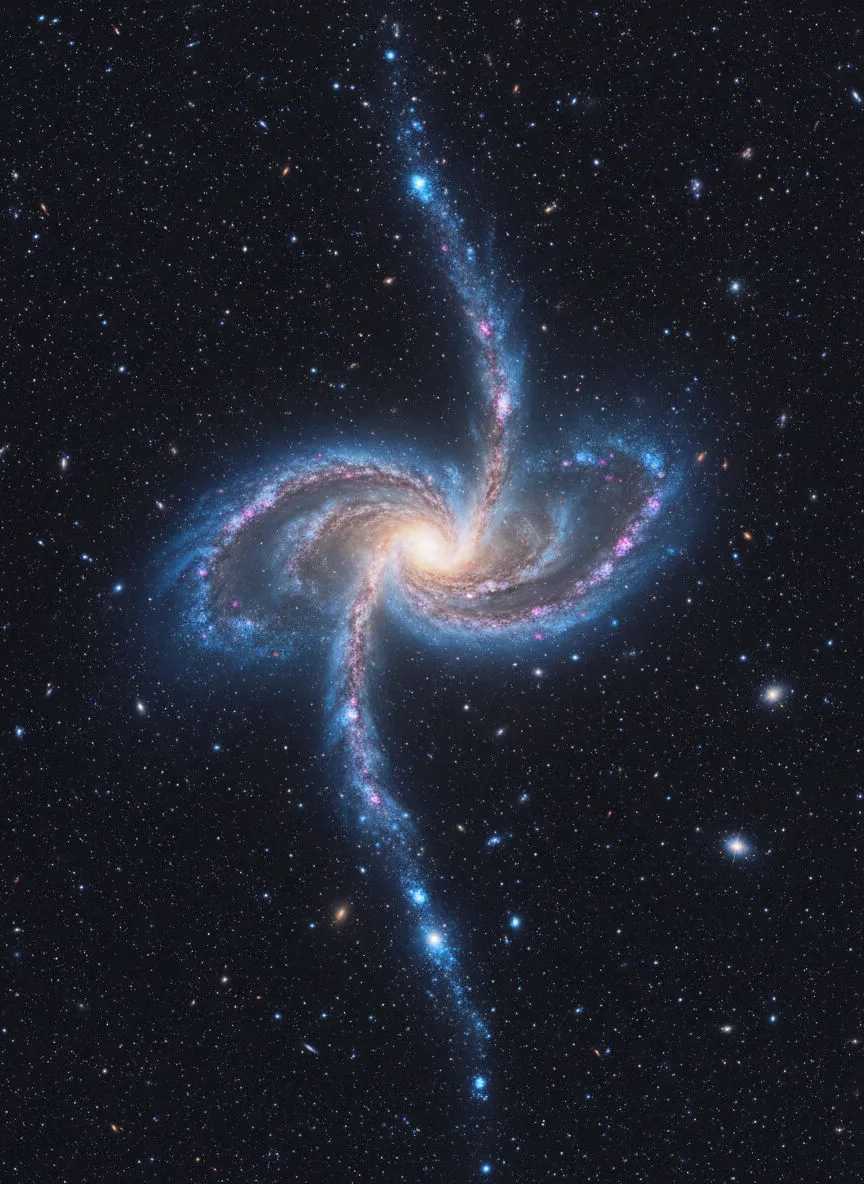
Together, they are often called the Heart-Shaped Galaxies because their bright yellow cores and dark dust lanes form a distinct heart shape when viewed at certain angles. This "heart" is actually the site of a violent intersection where the two galactic discs have begun to penetrate one another, causing massive disruption to their once-orderly spiral shapes.
This collision isn't a quick explosion; it’s a slow-motion dance that began approximately 900 million years ago. Because galaxies are mostly empty space, the individual stars themselves don't usually hit each other. Instead, their gravitational pull changes everything about how the galaxies look, dragging gas and dust into new, chaotic patterns.
Key Takeaway
The 'heart' is actually the high-energy impact zone of two colliding spiral galaxies.
Test Your Knowledge
In which constellation are these heart-shaped galaxies located?
While they may look like a heart up close, wide-field images reveal why they are more famously known as the Antennae Galaxies. Two enormous, spindly "tails" of stars and gas stretch hundreds of thousands of light-years into space. These long, curved streamers resemble the antennae of an insect, creating a silhouette that is unique in the night sky.
These features are called tidal tails. They form because of gravitational tidal forces—the same physics that causes tides in Earth's oceans. As the two galaxies swung past each other, the gravity of one pulled harder on the near side of the other, effectively "stretching" the galaxy and flinging outer stars into long, arched paths.
These tails are massive graveyards and nurseries combined. They contain billions of stars that were once part of neat spiral arms but are now drifting in intergalactic space. These "antennae" provide a visual history of the galaxies' paths over the last few hundred million years, showing exactly how they side-swiped each other during their first encounter.
Key Takeaway
The 'antennae' are tidal tails created by the gravitational pull of the galaxies on each other.
Test Your Knowledge
What physical force is responsible for creating the long 'antennae' tails?
A galactic crash might sound like total destruction, but for NGC 4038 and 4039, it’s a massive cosmic nursery. The real action happens when the giant clouds of hydrogen gas from both galaxies smash into one another. This intense pressure causes the gas to collapse, triggering a starburst—a period of incredibly rapid and frequent star formation.
NASA’s Hubble Space Telescope has captured thousands of bright, blue super star clusters within the collision zone. These clusters are like "stellar fireworks," each containing tens of thousands of young, hot stars. While many will eventually drift apart, the largest ones will survive to become permanent, spherical globular clusters that will orbit the new galaxy for billions of years.
The "heart" won't last forever. In about 400 million years, the two individual nuclei will fully merge into a single core. The beautiful spiral shapes will vanish, leaving behind one giant elliptical galaxy. This preview is essential for us: it’s exactly what is predicted to happen to our own Milky Way when it eventually collides with the Andromeda galaxy in the far future!
Key Takeaway
Galactic collisions trigger starbursts, creating thousands of new star clusters and eventually forming a single elliptical galaxy.
Test Your Knowledge
What is the final predicted shape of the two galaxies after they fully merge?
Track your progress, earn XP, and compete on leaderboards. Download NerdSip to start learning.