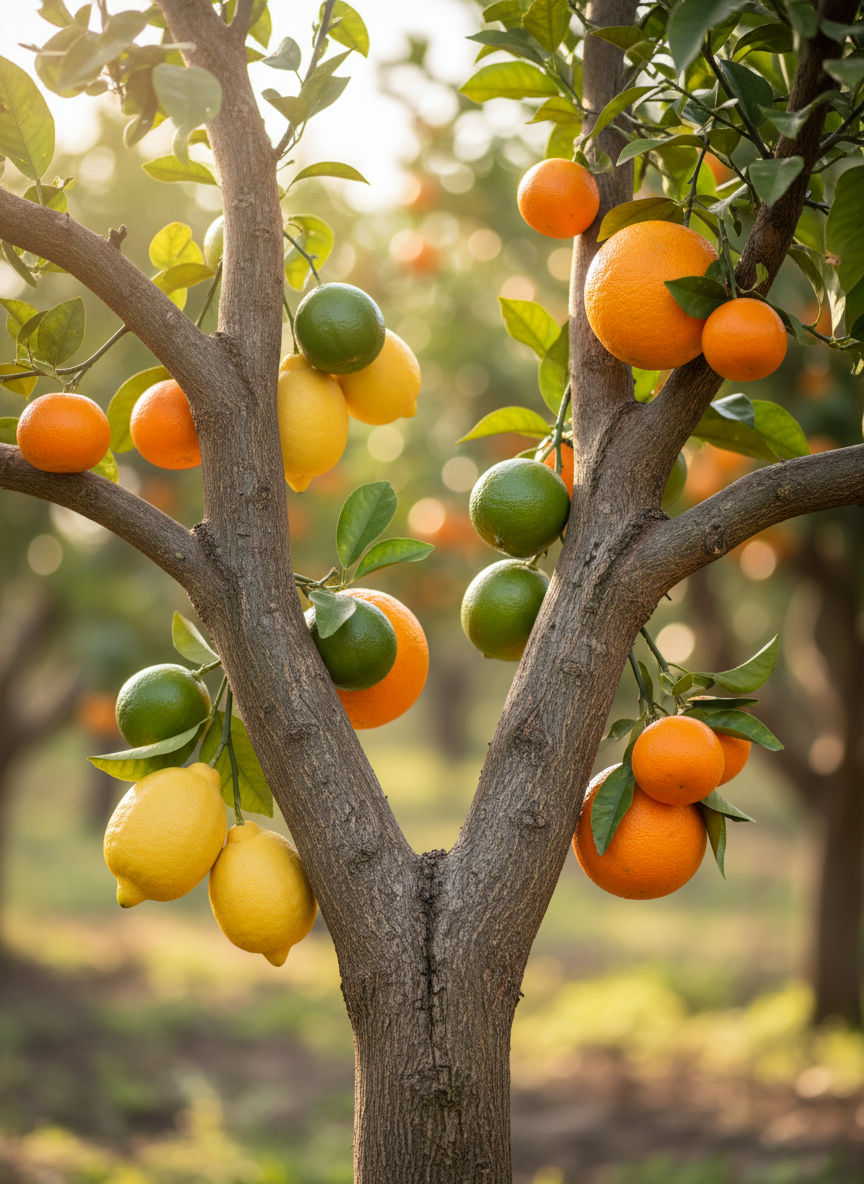
Can a single tree grow lemons, limes, oranges, and mandarins all at once?
Prompted by A NerdSip Learner
Master the secrets of multi-grafted fruit salad trees.
Ever looked at a tree and thought, "I wish you grew lemons *and* limes for my tacos, plus oranges for breakfast?" Well, nature has a remarkable loophole called multi-grafting.
Multi-grafting allows a single tree trunk to support branches from entirely different fruit varieties. The result? A single tree that produces lemons, limes, oranges, and mandarins all at the same time!
This works because these fruits share a botanical family secret. They all belong to the *Citrus* genus. Just like a human family where siblings share genetics, citrus fruits are closely related enough to share a vascular system.
If you tried to attach an apple branch to a citrus tree, the tree would reject it. But because lemons, limes, oranges, and mandarins are "cousins," their tissues recognize each other and fuse seamlessly!
Key Takeaway
Citrus fruits can grow on the same tree because they are all closely related members of the Citrus genus.
Test Your Knowledge
Why can lemons and oranges grow on the same tree but not apples and oranges?
To understand a multi-grafted citrus tree, you need to know its two main parts: the rootstock and the scion. Think of the rootstock as the foundation of a house, and the scions as the different rooms built on top.
The rootstock is the lower trunk and root system. It’s chosen for its toughness. A good rootstock is disease-resistant, tolerates poor soil, and dictates the final size of the tree (like keeping it dwarf-sized for a patio pot).
The scions are the fruit-bearing branches you attach to that base. When you want a lemon, you take a cutting (a scion) from an existing lemon tree and attach it. When you want a lime, you attach a lime scion.
In a multi-grafted tree, a single powerhouse rootstock pumps water and nutrients up to multiple different scions. It’s the ultimate botanical teamwork!
Key Takeaway
The rootstock provides a tough, disease-resistant base, while the scions are the branches that determine which fruits will grow.
Test Your Knowledge
What is the primary role of the rootstock in a grafted tree?
So, how do you actually attach a lime branch to an orange tree? It all comes down to a magical green layer inside the branch called the cambium.
The cambium is a microscopically thin layer of actively dividing cells located just underneath the bark. It’s essentially the tree’s plumbing system, responsible for transporting water and nutrients.
When grafting, a gardener makes precise cuts to expose the cambium on both the rootstock and the new scion branch. They then tape them tightly together so the two cambium layers directly touch.
Over a few weeks, the cells multiply and fuse together. The "plumbing" connects, and the rootstock begins pumping sap directly into the newly attached branch. It’s basically botanical surgery!
Key Takeaway
Successful grafting relies on perfectly aligning the cambium layers of two plants so their vascular systems can fuse.
Test Your Knowledge
What is the cambium layer?
Once your multi-grafted tree is growing, it might sound like a dream come true. But there's a catch: sibling rivalry!
Not all citrus branches grow at the same speed. Lemons and grapefruits are notoriously vigorous and aggressive growers. Mandarins and sweet oranges, on the other hand, tend to grow much slower.
If left completely alone, the lemon branch will hog all the nutrients, sunlight, and water. It will rapidly take over the entire tree, literally starving the slower-growing mandarin branch until it shrivels and dies off.
To keep a "fruit salad tree" healthy, you have to be a strict referee. This means regularly pruning back the aggressive branches to give the slower ones a fair chance to thrive. Balance is everything!
Key Takeaway
Vigorous branches like lemons must be pruned regularly so they don't outcompete slower-growing branches like mandarins.
Test Your Knowledge
What happens if you never prune a multi-grafted citrus tree?
Ready to create your own backyard citrus buffet? While you can buy pre-grafted trees, making one yourself is an incredibly rewarding project.
The best time to try grafting is during the early spring. This is when the sap is flowing vigorously, and the tree is actively waking up and growing. High sap flow helps the new cambium layers heal and fuse quickly.
You’ll need a sharp grafting knife, some stretchy grafting tape, and a bit of patience. It usually takes a few weeks to know if your graft "took" (if it stayed green and started budding).
It takes about two to three years before that new branch will produce meaningful fruit. But once it matures? You’ll be stepping onto your patio to pick fresh lemons for your water, limes for your guacamole, and mandarins for a snack—all from a single pot!
Key Takeaway
Grafting is best done in early spring, and while it requires patience, the reward is a custom, multi-fruit harvest.
Test Your Knowledge
When is the ideal time of year to attempt citrus grafting?
Track your progress, earn XP, and compete on leaderboards. Download NerdSip to start learning.