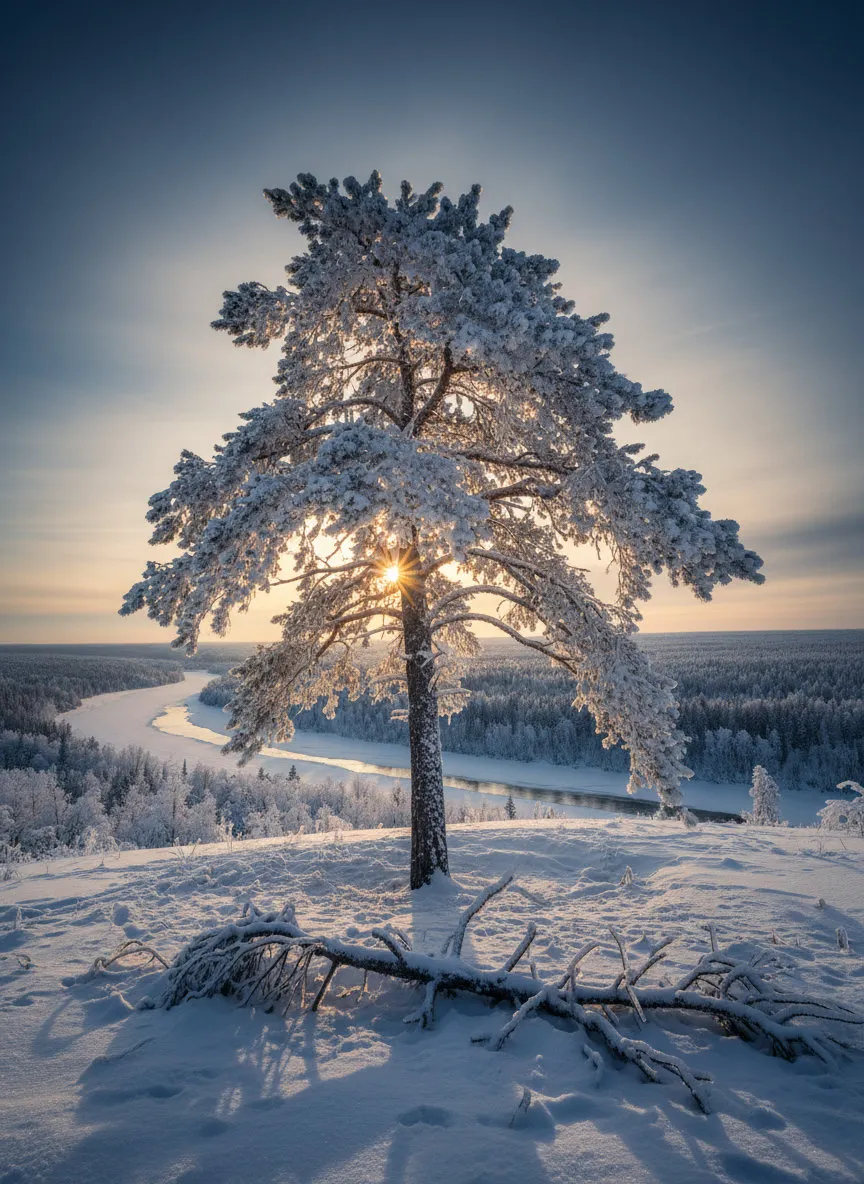
Can a pine tree survive fifty times its own weight in ice?
Prompted by A NerdSip Learner
Identify the survival mechanics of ice-covered pine trees.
Imagine walking outside in a winter jacket, but suddenly, someone dumps a bucket of wet cement on you that freezes instantly. That is exactly what ice rain feels like for a pine tree! Unlike maple or oak trees that drop their leaves, pine trees keep their needles all year round.
This is a bit of a double-edged sword. While it keeps the tree alive in winter, those needles provide a huge surface area for ice to latch onto. When supercooled rain hits the cold needles, it creates a heavy, frozen shell.
A single branch that usually weighs a few pounds can suddenly weigh ten times that amount! It is a massive structural test. The ice doesn't just sit on top; it encases every single needle, turning the fluffy branch into a heavy, solid club.
Key Takeaway
Because pines keep their needles in winter, they catch massive amounts of ice, drastically increasing the weight on their branches.
Test Your Knowledge
Why do pine trees accumulate more ice than trees like oaks or maples?
So, does the tree just give up? Not without a fight! Pine trees are classified as softwoods, which means their wood is naturally more flexible than rigid hardwoods. Think of a pine tree like a gymnast; it is designed to sway in the wind and bend under snow.
However, ice is different from snow. Snow can slide off, but ice grips. As the ice layer gets thicker, the tree begins to bow heavily. If the weight becomes too extreme, the physics of the tree will fail in one of two ways.
First, the trunk might snap like a dry twig if the angle gets too sharp. Second, if the soil is wet and soft, the entire tree might uproot and tip over because the top is just too heavy for the roots to hold. It is a dangerous game of balance!
Key Takeaway
Pines are flexible enough to bend, but extreme ice weight can cause trunks to snap or the whole tree to fall over.
Test Your Knowledge
What characteristic of pine wood helps it survive initially?
Once the sun comes out and the ice melts, the battle isn't necessarily over. Many pines demonstrate amazing resilience. Because they are young and elastic, they can often spring back to their original upright position, almost like a rubber band releasing tension.
But not all are so lucky. Some trees suffer from permanent deformation—they stay bent forever! Others might have lost their 'leader' (the very top vertical branch), which creates a weirdly shaped tree as it grows.
Even worse, when branches snap off, they leave behind open wounds. Just like a cut on your finger can get infected, these open spots on a tree invite pests like bark beetles or fungi to enter and make the tree sick. Surviving the storm is just step one; healing is the long game.
Key Takeaway
After the ice melts, pines face risks like permanent bending or bugs entering through broken branches.
Test Your Knowledge
What is a major danger to the tree AFTER the ice has melted?
Track your progress, earn XP, and compete on leaderboards. Download NerdSip to start learning.