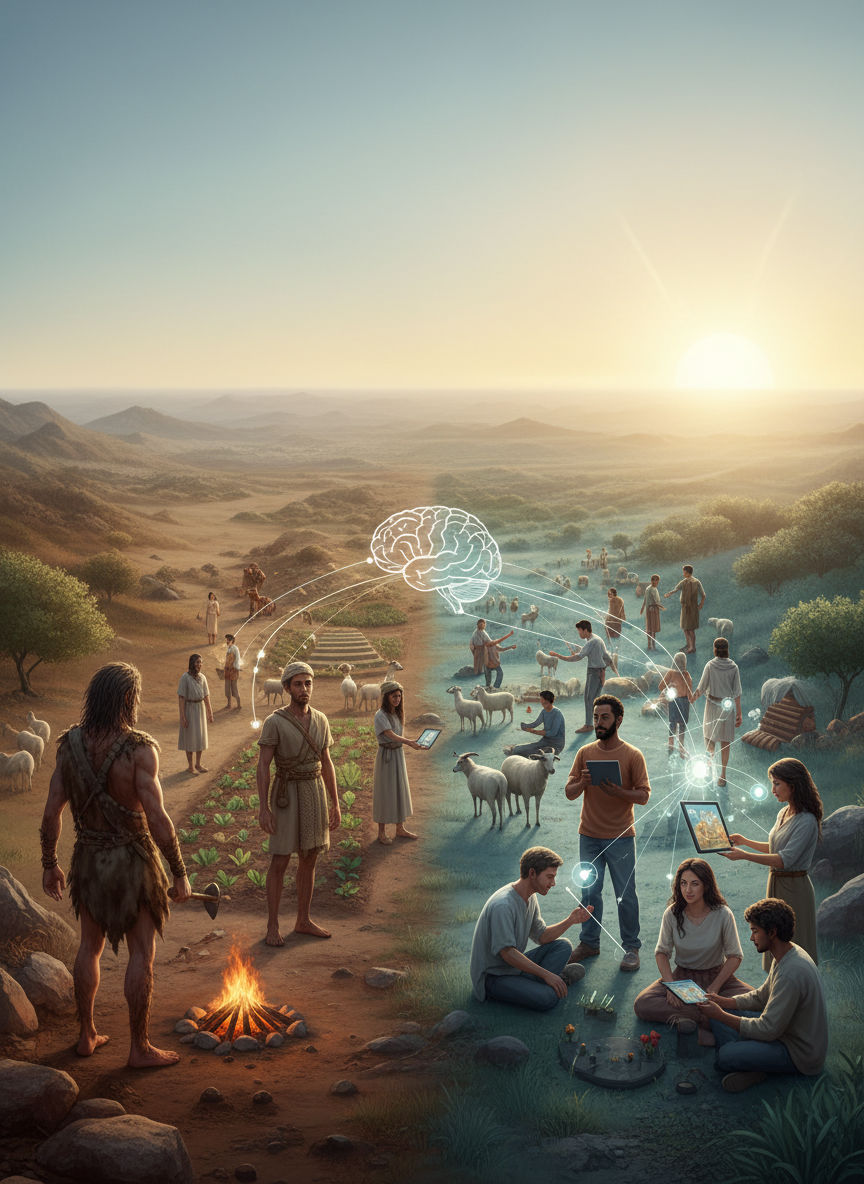
Did we accidentally breed ourselves like dogs? Discover the wild truth of human self-domestication.
Prompted by A NerdSip Learner
Understand the evolutionary superpower of human friendliness.
When we hear "survival of the fittest," we usually picture the biggest, meanest caveman winning a brutal fight for resources. Popular culture loves to show our ancestors as aggressive warriors. But evolutionary biologists suggest a radical plot twist for human history.
Current theories suggest that for our species, *Homo sapiens*, the real secret to our success was actually survival of the friendliest. Around 300,000 years ago, our ancestors slowly started favoring partners who were cooperative, empathetic, and less aggressive.
Instead of constantly fighting over territory and food, the individuals who could share, communicate, and work together thrived. Over thousands of generations, we essentially "tamed" ourselves by weeding out extreme, reactive aggression from our gene pool.
By consistently choosing mates who were easy to get along with, we accidentally launched the greatest evolutionary experiment in history—human self-domestication! Being nice wasn't just a moral choice; it was the ultimate survival strategy.
Key Takeaway
Early humans succeeded not by being the most aggressive, but by being the most cooperative and friendly.
Test Your Knowledge
What does the "survival of the friendliest" theory suggest?
To understand human evolution, think about the dramatic difference between a wild wolf and a modern golden retriever. One is highly reactive, cautious, and solitary; the other is eager to please, playful, and loves a good belly rub.
Scientists believe a very similar behavioral transformation happened to us. If you look at the primate family tree, we are, in a sense, the "golden retrievers" of the ape world!
Just as humans selectively bred the least aggressive wolves until they became highly cooperative domestic dogs, early humans unconsciously selected the least aggressive humans to live, hunt, and mate with.
We didn't do it on purpose, but the evolutionary result was exactly the same. By consistently rewarding pro-social behavior—like sharing food, caring for the sick, and helping neighbors—we evolved to be remarkably tame compared to our ancient, more aggressive relatives. This "taming" process literally reshaped our brains to crave social connection.
Key Takeaway
We unconsciously bred ourselves for friendliness, much like we bred wild wolves into domestic dogs.
Test Your Knowledge
According to the lesson, modern humans are compared to which animal?
Here is a fascinating, almost unbelievable biological quirk: when you breed mammals for friendliness, their physical bodies actually change. In biology, this strange phenomenon is known as the domestication syndrome.
You can see this clearly in tame foxes, dogs, and pigs. As they become friendlier, they often develop physical traits like floppy ears, curly tails, and shorter snouts. While humans didn't grow floppy ears or wagging tails, our bodies definitely transformed as we became friendlier.
Fossil records show that over the last 300,000 years, human faces became noticeably softer and less intimidating. We developed smaller teeth, shorter faces, and far less prominent brow ridges compared to our extinct ancestors, like the heavily-built Neanderthals.
Scientists link these specific physical changes to a dramatic drop in reactive hormones, such as testosterone, during our biological development. Put simply, our bodies physically softened as our social behavior became gentler!
Key Takeaway
Breeding for friendliness physically altered human anatomy, resulting in softer facial features and smaller teeth.
Test Your Knowledge
What is the "domestication syndrome" in humans?
Why did nature reward this newly friendly, softer-faced version of humanity? Why didn't the tougher, more aggressive hominids wipe us out? The answer lies in the incredible power of massive teamwork.
In the brutal wild, aggression can certainly be useful for winning a quick, one-on-one fight. But highly aggressive animals struggle immensely to live in large, dense groups without constantly attacking each other and fracturing the pack.
Because our ancestors developed high social tolerance, they could safely gather in much larger numbers. They weren't constantly stressed, territorial, or threatened by the mere presence of a neighbor.
This massive boost in tolerance allowed early humans to form larger, more stable tribes, share vital resources, and survive incredibly harsh climates like the Ice Ages. Our true superpower wasn't sharp claws or giant muscles; it was the unique ability to chill out in a crowd!
Key Takeaway
Reduced aggression allowed humans to safely live in larger, cooperative groups without constantly fighting.
Test Your Knowledge
How did social tolerance act as a "superpower" for early humans?
Being friendly didn't just change our faces and allow for bigger group sizes—it completely rewired our minds. This new level of social tolerance paved the way for the ultimate human superpower: complex culture.
When you live in a large, peaceful group without the constant threat of violence, you can safely observe others. This leads to shared learning. If one brilliant person figures out how to make a better spear or weave a watertight basket, the whole tribe can easily copy it.
Over time, this deep social tolerance allowed complex communication and language to flourish. We could safely gossip, share detailed stories, invent myths, and pass down crucial survival knowledge from generation to generation.
Without the process of self-domestication, we would never have built sprawling cities, written library books, or traveled to outer space. It turns out that deep-rooted kindness and cooperation were the secret engines driving human civilization all along!
Key Takeaway
Human self-domestication unlocked the ability to share knowledge, create complex language, and build civilizations.
Test Your Knowledge
What major human milestone was made possible by self-domestication?
Track your progress, earn XP, and compete on leaderboards. Download NerdSip to start learning.