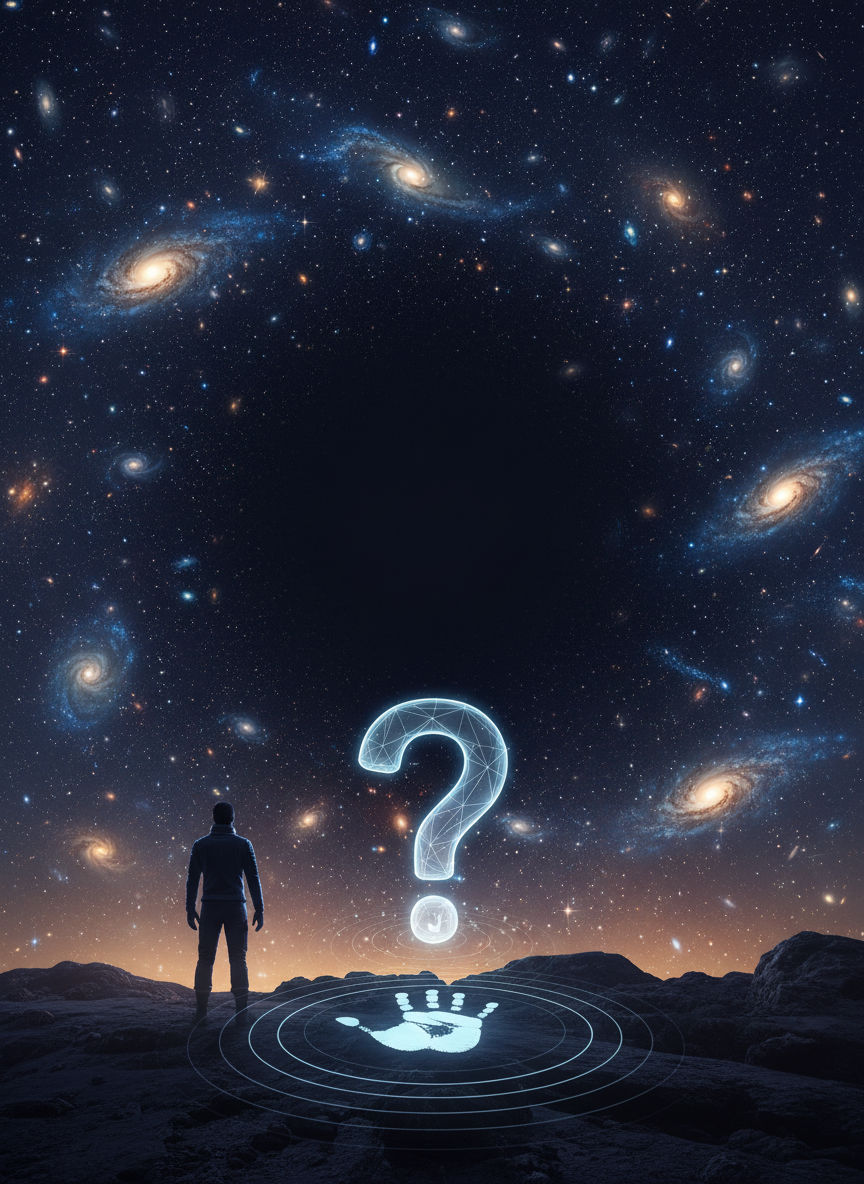
If the universe is teaming with life, why is nobody calling us back?
Prompted by A NerdSip Learner
Identify the 5 leading theories for our cosmic isolation.
In 1950, physicist Enrico Fermi sat down for lunch and asked a deceptively simple question: "Where is everybody?" He was looking at the sheer scale of the universe. With billions of stars in our galaxy and billions of years for life to evolve, it seems statistically certain that we shouldn't be alone.
This contradiction is known as the Fermi Paradox. If even one civilization decided to colonize the galaxy at a fraction of the speed of light, they could have reached every corner of the Milky Way in a few million years. In cosmic terms, that’s just a weekend trip. Yet, we see no signs of them.
We haven't found any radio signals, massive engineering projects around stars, or physical probes. This "Great Silence" forces us to reconsider our place in the cosmos. Are we truly unique, or are we just looking for the wrong clues?
Key Takeaway
The Fermi Paradox is the startling gap between the high probability of alien life and the total lack of evidence for it.
Test Your Knowledge
What is the core conflict of the Fermi Paradox?
In 1961, astronomer Frank Drake created a formula to estimate the number of active, communicative civilizations in the Milky Way. It wasn't meant to give a final answer, but to organize our ignorance. The Drake Equation breaks the big question into smaller, measurable parts.
It looks at factors like the rate of star formation, the fraction of stars with planets, and the likelihood of life developing intelligence. While we've gotten better at estimating the number of planets, values for biological evolution remain total guesswork.
Recent 2024 studies suggest we may need to add even more variables, like the presence of plate tectonics or large moons, which might be essential for complex life. Even with conservative numbers, the equation often predicts thousands of civilizations, making the silence even weirder.
Key Takeaway
The Drake Equation is a mathematical framework used to estimate how many alien civilizations might be trying to communicate with us.
Test Your Knowledge
What was the original purpose of the Drake Equation?
If life is easy to start but civilizations are rare, there must be a Great Filter. This theory, proposed by Robin Hanson, suggests there is a specific step in evolution that is almost impossible to get past. It’s like a cosmic wall that stops life from reaching a space-faring stage.
The terrifying question for humanity is: Where is the filter? If it's behind us (like the jump from single-celled to complex life), we might be the lucky ones who made it through. We could be the first civilization to ever reach this level.
However, if the filter is ahead of us, it suggests that most civilizations destroy themselves shortly after discovering technology like nuclear power or artificial intelligence. Finding simple life on Mars would actually be bad news—it would suggest the Filter is still waiting for us in our future.
Key Takeaway
The Great Filter theory posits that a highly improbable obstacle prevents most life from becoming a galactic civilization.
Test Your Knowledge
According to the Great Filter theory, why would finding simple life on Mars be 'bad news'?
Maybe the reason we haven't found anyone is because Earth is a statistical miracle. The Rare Earth Hypothesis argues that while simple microbes might be common, the conditions for complex, intelligent life are incredibly specific and rare.
Think about our setup: We have a stable sun, a massive planet like Jupiter to vacuum up dangerous asteroids, and a large Moon to stabilize our climate. Most importantly, Earth has plate tectonics, which recycles carbon and keeps our temperature habitable over billions of years.
Recent research in 2024 emphasizes that without this specific "geological engine," life might never move past the stage of simple slime. If these conditions only happen once in a billion galaxies, we aren't being ignored—we are simply the firstborn in a very lonely universe.
Key Takeaway
The Rare Earth Hypothesis suggests that the specific geological and astronomical conditions required for complex life are extremely rare.
Test Your Knowledge
Which of these is a key factor in the Rare Earth Hypothesis?
What if the aliens are there, but they are hiding? Two popular theories suggest the silence is intentional. The Zoo Hypothesis proposes that advanced civilizations are watching us from a distance, like animals in a nature preserve, waiting for us to reach a certain level of maturity before making contact.
A darker alternative is the Dark Forest Theory. Imagine the universe is a dark forest filled with armed hunters. Any civilization that reveals its location is immediately destroyed by others out of fear. In this scenario, the "smart" civilizations stay quiet to survive.
Whether they are protecting us or hiding from us, these theories suggest that our current radio broadcasts might be like shouting in a dangerous neighborhood. As we continue to listen, we must decide if we really want to be heard.
Key Takeaway
The Zoo and Dark Forest theories suggest that advanced life may be intentionally silent due to ethics or survival instincts.
Test Your Knowledge
What does the 'Dark Forest Theory' suggest about alien civilizations?
Track your progress, earn XP, and compete on leaderboards. Download NerdSip to start learning.