Could our solar system ever have two blazing suns?
Prompted by A NerdSip Learner
Understand why Jupiter is a "failed star".
Have you ever looked at Jupiter and wondered what it's made of? Unlike Earth, which is a solid rock you can stand on, Jupiter is a massive, swirling ball of gas. In fact, it is made of the exact same ingredients as our Sun!
Jupiter is composed almost entirely of hydrogen and helium. These are the lightest, simplest, and most common materials found in the universe. If you were trying to bake a brand-new star from scratch, Jupiter has the perfect ingredients sitting right there in the cosmic mixing bowl.
Because of this striking similarity, scientists and astronomers often refer to Jupiter as a "failed star." Billions of years ago, it formed from the exact same swirling cloud of dust and gas that created our Sun, scooping up all the leftover materials.
But if it has the right recipe, why isn't it shining bright in our night sky? To understand that, we have to look closely at the "oven" baking our cosmic cake: gravity and pressure.
Key Takeaway
Jupiter is made of hydrogen and helium, which are the exact same ingredients used to make stars.
Test Your Knowledge
What is Jupiter mostly made of?
So, Jupiter has the perfect ingredients to be a star. What exactly went wrong during its formation? The simple, straightforward answer is weight. Or, more accurately in space terms, mass.
For a giant ball of gas to turn into a blazing star, it needs to be incredibly heavy. When something is truly that massive, its own immense gravity pulls everything inward, creating intense, unimaginable heat and pressure right at its core.
Eventually, the core gets so hot and squeezed that the hydrogen atoms are forced to smash together and ignite. This magical scientific process is called nuclear fusion, and it is the exact engine that makes a star shine.
But Jupiter is just too light to get the fire started. It would need to be roughly 80 times heavier than it is right now to create enough core pressure to ignite. So, while Jupiter is absolutely huge compared to Earth, it is a total lightweight in the world of stars.
Key Takeaway
Jupiter lacks the massive weight required to create the extreme heat and pressure for nuclear fusion.
Test Your Knowledge
What process causes a star to ignite and shine?
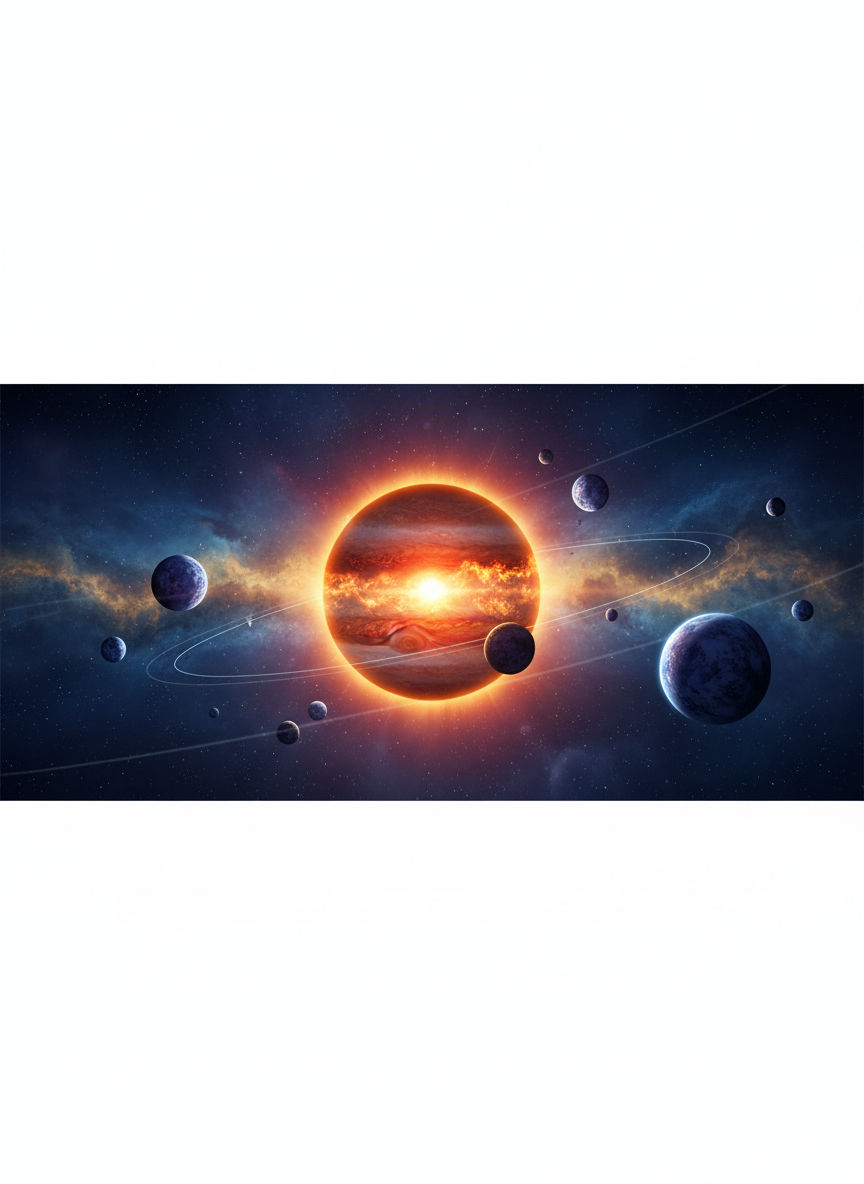
Let's play a fun game of pretend. What if, somehow, Jupiter magically gobbled up enough gas, gained 80 times its current mass, and finally ignited? Would Earth suddenly roast under the heat of two blazing suns?
Not quite! If Jupiter finally became a star, it would be the absolute smallest kind possible, which scientists call a red dwarf. It would shine with a dim, reddish glow, and would look nothing like our bright, blindingly yellow Sun.
Because Jupiter is incredibly far away from Earth—hundreds of millions of miles away—this new "second sun" wouldn't warm us up at all. In fact, it would simply look like a very bright red dot in our night sky. It might be a bit brighter than a full moon, but it definitely wouldn't bring daylight to the night.
Rest assured, there is absolutely no extra gas floating around our solar system for Jupiter to eat. It will happily remain the magnificent, stormy "failed star" we know today.
Key Takeaway
Even if Jupiter magically became a tiny star, it is too far away to significantly heat or change life on Earth.
Test Your Knowledge
If Jupiter magically gained enough mass to become a star, what kind of star would it be?
Track your progress, earn XP, and compete on leaderboards. Download NerdSip to start learning.