How does code mathematically calculate a human vibe?
Prompted by A NerdSip Learner
Master the advanced engineering secrets behind TikTok's feed.
Have you ever wondered how a brand new account with zero followers can post a video and get a million views overnight? This is TikTok's solution to the Cold Start Problem. When a system has no data on a new piece of content, it doesn't know who to show it to.
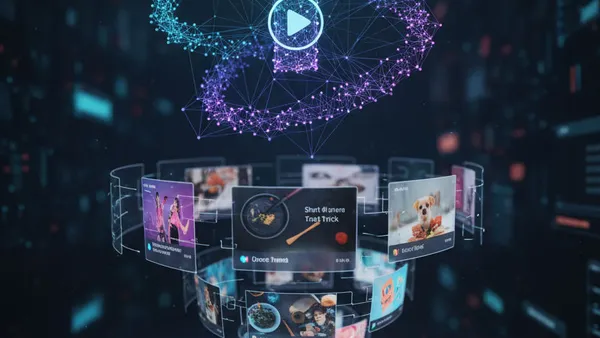
Instead of relying on a follower count, TikTok uses a Tiered Distribution system. Every single uploaded video gets dropped into an "exploration pool." It is shown to a small, randomly selected batch of roughly 200 to 500 users on their For You Page.
The algorithm watches this test group closely. It acts as a strict judge, scoring the video based on metrics like completion rate, replays, and shares. If the video passes a certain mathematical threshold, it "graduates" to a larger tier of 10,000 viewers.
This process repeats. If it succeeds at 10,000, it gets pushed to 100,000, and eventually millions. This means every video has to earn its survival at every stage, making viral fame accessible to anyone, but highly unstable.
Key Takeaway
New videos are tested on small batches of users and must hit engagement thresholds to "graduate" to larger audiences.
Test Your Knowledge
What is the primary purpose of TikTok's "exploration pool"?
Early social media platforms relied on Collaborative Filtering—recommending things because your friends liked them, or relying heavily on the hashtags the creator typed. But TikTok doesn't trust just your friends or user-generated tags.
Instead, it leans heavily on Content-Based Filtering. The algorithm acts as a digital pair of eyes and ears. Before a video even hits the feed, artificial intelligence scans the raw media file itself.
Using Computer Vision, it identifies objects in the frame—a dog, a skateboard, a specific dance move. Using Natural Language Processing, it transcribes the audio, reads the captions, and even analyzes the text pasted over the video.
By deeply "watching" the content, the algorithm clusters videos into highly specific micro-niches. This is why you can end up on "BookTok" or "CleanTok" without ever searching for those terms; the machine knows exactly what is inside the video, pixel by pixel.
Key Takeaway
TikTok's AI physically scans the video's pixels and audio to categorize it, rather than just relying on user-provided hashtags.
Test Your Knowledge
How does Content-Based Filtering differ from older recommendation methods?
If you've ever felt like TikTok adapts to your changing moods in a matter of minutes, you aren't imagining it. This speed is driven by the platform's underlying engineering architecture, a system historically known internally as Monolith.
Older social media platforms typically used Batch Training. They would collect your clicks and likes all day, and then update their recommendation models overnight in massive, computationally heavy batches. Your feed wouldn't truly adapt until the next day.
TikTok, however, utilizes Online Training. This means the model updates in real-time. Every single action you take—pausing for an extra second, hitting "Not Interested," or swiping quickly—is instantly fed back into the live system.
The machine recalculates its predictions on the fly. This aggressive, blazing-fast feedback loop is why the For You Page can pivot entirely from funny animal videos to sad emotional content in less than ten swipes. It is a live organism responding to your immediate psychological state.
Key Takeaway
TikTok's architecture uses Online Training to update its algorithm in real-time with every single swipe you make.
Test Your Knowledge
What is the main advantage of "Online Training" over "Batch Training"?
Humans easily understand complex, unspoken aesthetics. We intuitively know what a "cozy, rainy day coffee" vibe is. But how does a mathematical algorithm process a vibe? It translates it into geometry using High-Dimensional Embeddings.
In machine learning, an embedding is a way of translating a piece of data into a list of numbers, or a vector. TikTok assigns a vector to every single video, plotting it on an invisible mathematical graph containing hundreds of dimensions. These dimensions represent abstract patterns, like visual tone, pacing, and audio mood.
At the same time, TikTok assigns *you* a user vector. As you scroll, like, and watch, your user vector moves around this massive mathematical space.
When your user vector points in the exact same direction as a specific video's vector, the system registers a match. You are mathematically close to that content. This is how the code successfully predicts that you will enjoy a highly niche aesthetic you can't even put into words.
Key Takeaway
TikTok translates users and videos into mathematical coordinates called vectors to match people with specific niche aesthetics.
Test Your Knowledge
What does a "vector" represent in the context of TikTok's algorithm?
We usually think of the algorithm as a tool that passively learns from our behavior. But over time, the relationship flips. The algorithm begins to exert evolutionary pressure on the creators themselves, fundamentally changing how humans communicate.
Because the system heavily prioritizes Completion Rate (watching a video all the way to the end), creators must adapt to survive the brutal Tiered Distribution tests. If their completion rate drops, their views vanish entirely.
This is why almost all successful TikToks now feature a two-second hook—a visually jarring or loud opening meant to freeze your thumb. It's also why creators design seamless loops, where the end of the video flows perfectly into the beginning, tricking the user into watching it twice without realizing it.
The algorithm doesn't explicitly tell creators to make loopable, fast-paced videos. Instead, by ruthlessly rewarding specific metrics, it naturally selects for these traits. Ultimately, the algorithm doesn't just reflect human culture; it engineers it.
Key Takeaway
By strictly rewarding completion rate, the algorithm forces human creators to invent psychological tactics like the "two-second hook" and the seamless loop.
Test Your Knowledge
Why do many modern creators design short videos that loop seamlessly?
Track your progress, earn XP, and compete on leaderboards. Download NerdSip to start learning.