Would you upload your consciousness to a server to live forever?
Prompted by A NerdSip Learner
Debate the philosophical implications of digital immortality.
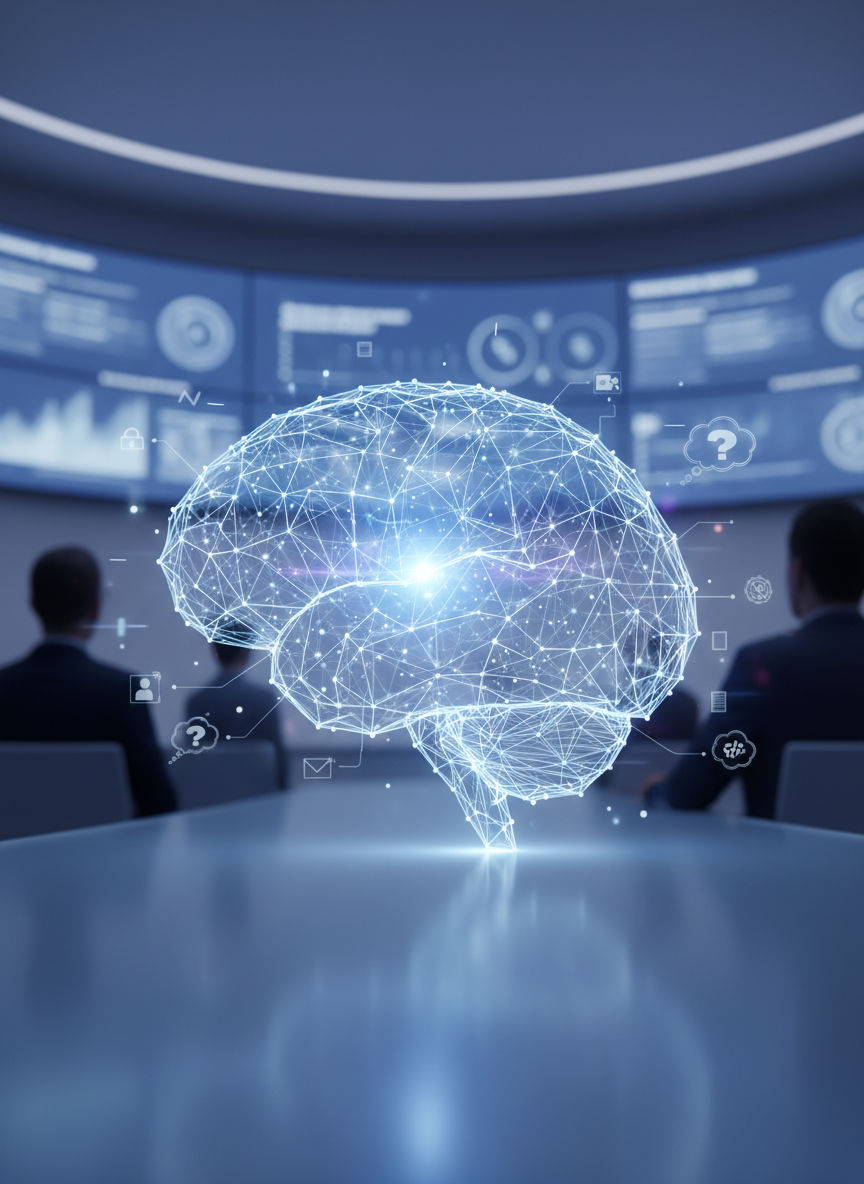
Welcome to the frontier of existence! Digital immortality, or Whole Brain Emulation (WBE), is the hypothetical process of scanning a physical brain and recreating its neural network in a digital environment. It’s not just a backup of your photos; it’s a functional map of your personality, memories, and consciousness.
Imagine escaping the limitations of biological decay. By transitioning from carbon to silicon, your 'self' could exist indefinitely on a server. This isn't just science fiction anymore; researchers are already mapping the connectomes of simpler organisms, bringing us closer to the possibility of a 'digital twin'.
But here is the big question: Is a perfect digital copy actually *you*, or just a very convincing simulation? As we embark on this journey, we must define whether the soul is tied to the biological hardware or if it is simply the software running on top of it.
Key Takeaway
Digital immortality involves mapping the brain's architecture to recreate a conscious mind within a computer system.
Test Your Knowledge
What is the technical term for scanning and recreating a brain in a digital format?
If you replace every plank on a wooden ship, is it still the same ship? This ancient Greek paradox is central to the upload debate. If we replace your neurons one by one with nanobots until you are entirely digital, at what point do you stop being you? Or do you remain the same throughout?
Some philosophers argue for 'Continuity of Identity.' They believe that as long as the stream of consciousness isn't broken, the 'self' remains intact. However, if you are scanned while asleep and a digital copy is turned on, there are now two of you. Who gets to claim your life, your bank account, and your family?
This 'branching identity' problem creates a terrifying realization: your digital ghost might wake up thinking it's you, while the biological you still faces mortality. We must decide if 'you' are a specific piece of matter or simply a pattern of information.
Key Takeaway
The transition to a digital state challenges our understanding of personal identity and whether 'the self' can be copied or moved.
Test Your Knowledge
The Ship of Theseus paradox is used in this context to illustrate problems with:
Can a computer feel the warmth of the sun or the sting of heartbreak? In philosophy, 'Qualia' refers to individual instances of subjective, conscious experience. Even if a digital ghost behaves exactly like you, it might be a 'Philosophical Zombie'—a being that acts conscious but has no inner light or actual feelings.
This leads to the 'Hard Problem of Consciousness.' We can map how neurons fire (the easy problem), but we don't yet know how those firings produce the *feeling* of being alive. If we upload a mind without capturing the essence of qualia, we might just be creating a highly advanced chat-bot that mimics your grief and joy.
Ensuring that a digital ghost is truly 'awake' is the ultimate hurdle. Without subjective experience, digital immortality might just be an empty library of memories, devoid of the person who lived them.
Key Takeaway
Functional mimicry of a human does not guarantee that the digital entity has a subjective conscious experience (Qualia).
Test Your Knowledge
What does the term 'Qualia' refer to in the study of consciousness?
Let’s talk logistics. Servers aren't free. In a world of digital immortality, your 'life' might depend on your ability to pay for server maintenance. What happens if the company hosting your consciousness goes bankrupt? Does your existence simply get deleted, or sold to a higher bidder?
This introduces a terrifying new class divide. Only the wealthy might afford 'High-Tier' servers with high processing speeds, while others might be relegated to 'Low-Bandwidth' existence where time moves slower. Digital immortality could turn the fundamental human right to life into a monthly subscription service.
Furthermore, who owns your data? If a corporation owns the server you live on, they might literally own your thoughts. The transition to digital life isn't just a philosophical shift; it's a massive economic and political transformation.
Key Takeaway
Digital immortality introduces risks of socio-economic inequality and the commodification of human existence.
Test Your Knowledge
What is a primary economic risk of living as a digital ghost?
Does a digital ghost have the right to vote? Can it own property, or is it considered the property of its creators? As we move toward digital existence, we must rewrite our legal systems. If a digital person is 'deleted,' is it murder or just a software crash?
Currently, our laws are built for biological entities. Extending 'personhood' to a line of code is a radical step. If you create ten copies of yourself, do they each get a vote? If one copy commits a crime, are you—the original—responsible for their actions?
Defining the legal status of an upload is crucial for preventing a new form of digital slavery. We must decide if the 'ghost' in the machine deserves the same protections as the body that preceded it.
Key Takeaway
The legal system must evolve to define personhood and rights for non-biological conscious entities.
Test Your Knowledge
If a digital consciousness is legally classified as 'property' rather than a 'person,' what is the main concern?
In a digital world, your environment is limited only by code. You could live in a paradise, fly through galaxies, or relive your favorite memories forever. This 'Virtual Valhalla' offers a release from physical pain and scarcity. But there is a dark side: the potential for infinite suffering.
A digital mind could be 'overclocked' to experience thousands of years of subjective time in a single second. In the wrong hands, this could lead to eternal torture or 'locked-in' states where a ghost is trapped in a glitchy or hostile simulation with no way to 'unplug.'
We must also consider the loss of the 'real.' If everything is perfect and programmable, does effort still have meaning? Without the risk of death or the limitations of physics, the human experience might become a shallow, hedonistic loop.
Key Takeaway
Digital environments offer limitless potential for both utopia and dystopia, depending on governance and design.
Test Your Knowledge
What does 'overclocking' a digital mind refer to in a philosophical context?
We’ve explored the tech, the identity crisis, the ethics, and the economics. Now, the choice is yours. Would you step into the scanner? Digital immortality offers the chance to see the end of the universe, to learn every language, and to transcend the 'meat suit.'
However, it requires us to abandon the very thing that has defined life for billions of years: biological vulnerability. Some argue that our mortality is what gives our actions meaning. Without an end, is there a point to the middle? Others argue that death is a tragedy we finally have the tools to solve.
As you ponder this, remember that the 'Digital Ghost' is more than a tech demo. It is the ultimate mirror, forcing us to ask: What is the core of being human? Is it our bodies, our memories, or something that simply cannot be captured in 1s and 0s?
Key Takeaway
The decision to pursue digital immortality rests on whether one values biological authenticity or the infinite expansion of consciousness.
Test Your Knowledge
What is the ultimate philosophical question posed by the prospect of digital immortality?
Track your progress, earn XP, and compete on leaderboards. Download NerdSip to start learning.