Why is the US military planning to build a train network on the moon?
Prompted by A NerdSip Learner
Discover the blueprint for humanity's first lunar railroad.
The Defense Advanced Research Projects Agency (DARPA) is famous for funding futuristic tech like the early internet and stealth aircraft. Now, they've set their sights on something that sounds straight out of a science fiction novel: a lunar railroad.
In early 2024, DARPA officially partnered with aerospace giant Northrop Grumman for a critical conceptual study. This ambitious project is a key pillar of DARPA’s LunA-10 study, a 10-year vision designed to build the foundational technologies for a thriving, permanent lunar economy by the year 2035.
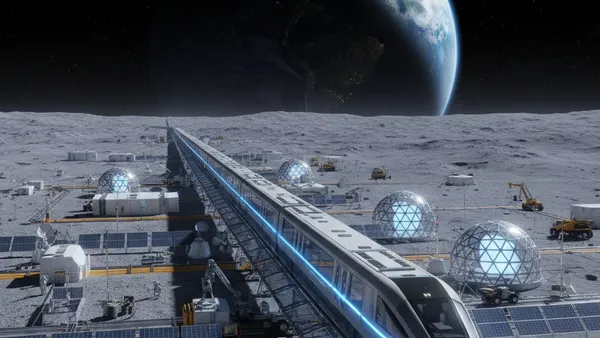
Why build a railroad in space? Just like the Transcontinental Railroad transformed the American West in the 19th century, a lunar train system would serve as the ultimate logistical backbone of the moon. It aims to efficiently transport astronauts, scientific supplies, and commercially mined resources between distant outposts.
Currently, the project is strictly in the design phase. Engineers are busy calculating foreseeable costs, technological risks, and mapping out what kind of infrastructure is required. While we won't see a locomotive chugging across the moon tomorrow, this is the first serious blueprint for establishing a permanent, bustling human presence off-Earth.
Key Takeaway
DARPA is funding the design of a lunar railroad network to transport people and resources, serving as the backbone for a future moon economy.
Test Your Knowledge
What is the primary goal of DARPA's lunar railroad concept?
You might be wondering: why bother building a massive rail network when we could just use lunar rovers or traditional moon buggies? The answer lies in one of the moon's greatest and most annoying hazards: lunar regolith, or moon dust.
Unlike dirt on Earth, which is constantly smoothed out by wind and flowing water, lunar dust is incredibly sharp, abrasive, and highly corrosive. To make matters worse, the complete lack of a lunar atmosphere means the dust is heavily charged with static electricity. It clings stubbornly to spacesuits, clogs up sensitive machinery, and severely reduces the lifespan of standard wheeled vehicles.
When rovers drive across the moon, they kick up massive clouds of this damaging dust and tear up the pristine lunar surface. Because there is no weather, those tire tracks will remain untouched for billions of years.
A tracked railway—or a magnetic levitation system—brilliantly solves these problems. By hovering or moving along a fixed track, a train minimizes direct contact with the abrasive ground. It drastically reduces the amount of kicked-up dust, protecting both the fragile lunar environment and our incredibly expensive space equipment.
Key Takeaway
A fixed railway or maglev system protects equipment from highly abrasive, statically charged moon dust while preserving the lunar surface.
Test Your Knowledge
Why is lunar dust so much more damaging to equipment than dirt on Earth?
So, how do you actually build a railroad on a celestial body with no breathable air, extreme temperature swings, and only one-sixth of Earth's gravity? You send in the robots.
The DARPA study is closely examining how autonomous robotics would grade the rough lunar surface, lay down physical foundations, and perform ongoing track maintenance. Human construction crews are simply too expensive, vulnerable, and resource-heavy for this kind of grueling manual labor.
Engineers are also looking at incredibly innovative train designs. One leading concept, heavily researched by NASA and its partners, is called FLOAT (Flexible Levitation on a Track). Instead of traditional steel rails and wheels, this system uses magnetic levitation. Autonomous, unpowered robotic carts would hover over a flexible, film-like track laid directly on the moon's dusty surface.
This track would generate the electromagnetic thrust needed to push the hovering carts forward. It's an elegant solution because it features absolutely no moving parts that could get jammed by abrasive dust. While the current focus is on logistics, concepts like maglev point toward a frictionless, futuristic train network shaping our next great frontier.
Key Takeaway
Building the lunar railroad will likely rely on autonomous robots and frictionless technology, like magnetic levitation, to overcome the harsh environment.
Test Your Knowledge
What is a major advantage of using a magnetic levitation (maglev) system on the moon?
Track your progress, earn XP, and compete on leaderboards. Download NerdSip to start learning.