Were the Appalachians and Scottish Highlands once the exact same mountain range?
Prompted by A NerdSip Learner
Discover the lost super-mountains of prehistoric Pangea.
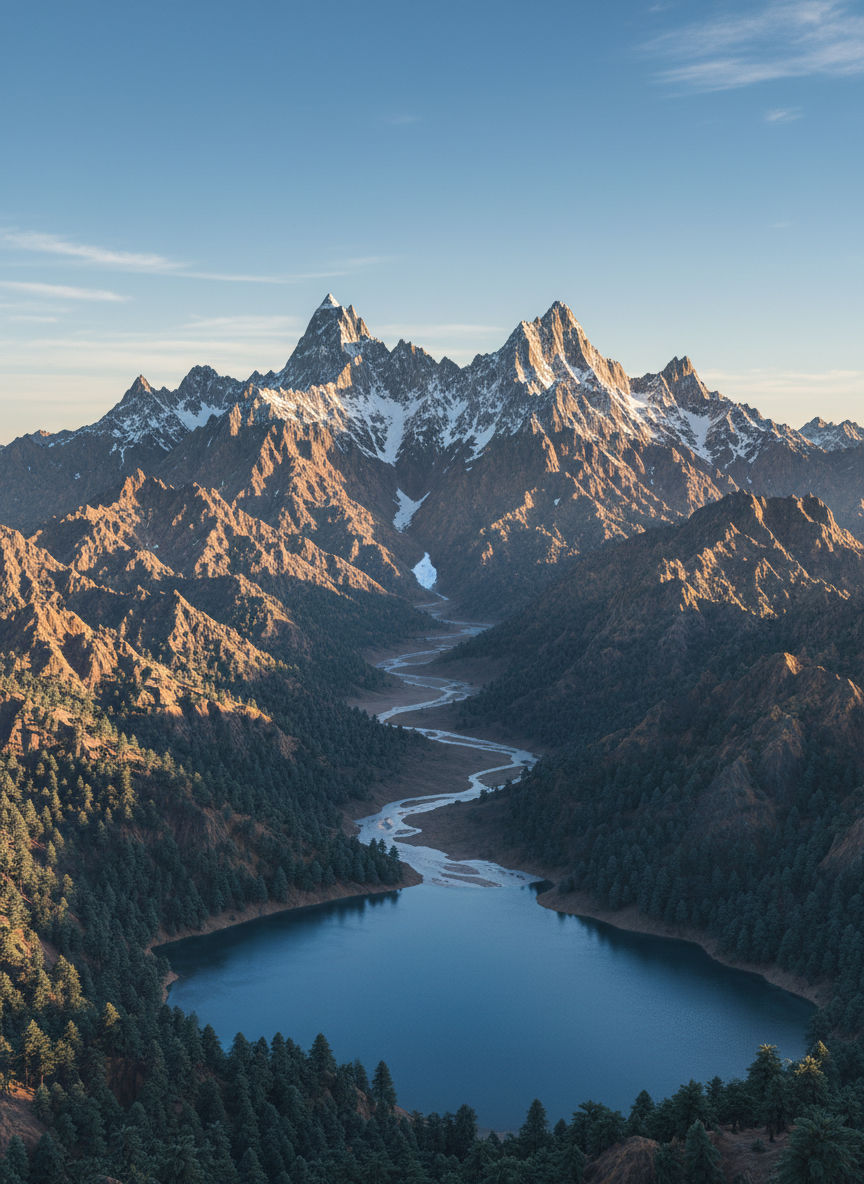
Imagine a mountain range as massive and imposing as the modern Himalayas, stretching right across the center of an ancient world. This was the Central Pangean Mountain Ridge, one of the most magnificent and sprawling geological features in Earth's 4.5-billion-year history!
Roughly 300 million years ago, our planet looked completely different than it does today. Instead of the seven isolated continents we are familiar with, almost all of Earth's landmasses were merged into a single, gigantic supercontinent known to geologists as Pangea.
Running directly through the middle of this massive landmass—situated right near the prehistoric equator—was a continuous, towering wall of rock. Because of their immense size, these peaks didn't just sit there; they actively shaped the world. At their peak, these mountains were so high that they created their own extreme weather systems.
They cast vast rain shadows over the land, fueling dense, swampy tropical forests on one side, and arid deserts on the other. This towering ridge completely altered global climate patterns and set the stage for the age of the dinosaurs!
Key Takeaway
The Central Pangean Mountains were a massive, Himalaya-sized range that ran directly through the middle of the supercontinent Pangea.
Test Your Knowledge
Which modern-day mountain range is most comparable in size to the peak height of the Central Pangean Mountains?
How exactly do you build a mountain range that spans the entire length of a supercontinent? You crash two massive, continent-sized landmasses together at slow, creeping, tectonic speeds.
The Central Pangean Mountains were born from a colossal slow-motion collision. Two ancient, sprawling landmasses—Laurussia (which included parts of modern-day North America, Europe, and Asia) and Gondwana (which included Africa, South America, Antarctica, and Australia)—smashed directly into each other.
This epic tectonic event, known by geologists as the Alleghanian and Variscan orogenies, pushed the earth's crust violently upward. The sheer force of the continents grinding together folded, crushed, and fractured the crust, thrusting jagged, rocky peaks miles into the prehistoric sky.
It took tens of millions of years for these intense geological pressures to build them to their maximum height. Once completed, this colossal ridge stood as the mighty, unbreakable backbone of Pangea, serving as a towering border between the northern and southern halves of the supercontinent.
Key Takeaway
The mountains formed from a slow-motion tectonic collision between the ancient landmasses of Laurussia and Gondwana.
Test Your Knowledge
What primary geological event caused the Central Pangean Mountains to form?
So, if this colossal mountain range was as large as the Himalayas, where did it go? As Pangea eventually began to tear apart roughly 200 million years ago, the Central Pangean Mountains were ripped right down the middle, separated by the newly forming Atlantic Ocean.
Today, the fragmented remnants of this once-unified mountain chain are scattered across the globe! Over hundreds of millions of years, relentless wind, driving rain, and advancing ice ages eroded these sharp, towering peaks down to the rolling, rounded, tree-covered hills we see today.
If you ever hike the famous Appalachian Mountains in the eastern United States, scale the rugged Scottish Highlands, or trek through the Anti-Atlas Mountains in Morocco, you are actually walking on the surviving ancient bones of the Central Pangean Mountain Ridge.
Geologically speaking, these separated ranges are pieces of the exact same prehistoric puzzle. They are a beautiful, hidden reminder that our planet's surface is constantly shifting, breaking, and remaking itself over deep time.
Key Takeaway
The Appalachians, Scottish Highlands, and Atlas Mountains are all surviving, highly eroded pieces of the exact same ancient mountain range.
Test Your Knowledge
Which of the following modern mountain ranges is a surviving remnant of the Central Pangean Mountains?
Track your progress, earn XP, and compete on leaderboards. Download NerdSip to start learning.