What happens when a giant star dies in a spectacular, winged explosion?
Prompted by A NerdSip Learner
Understand the physics behind the cosmic butterfly.
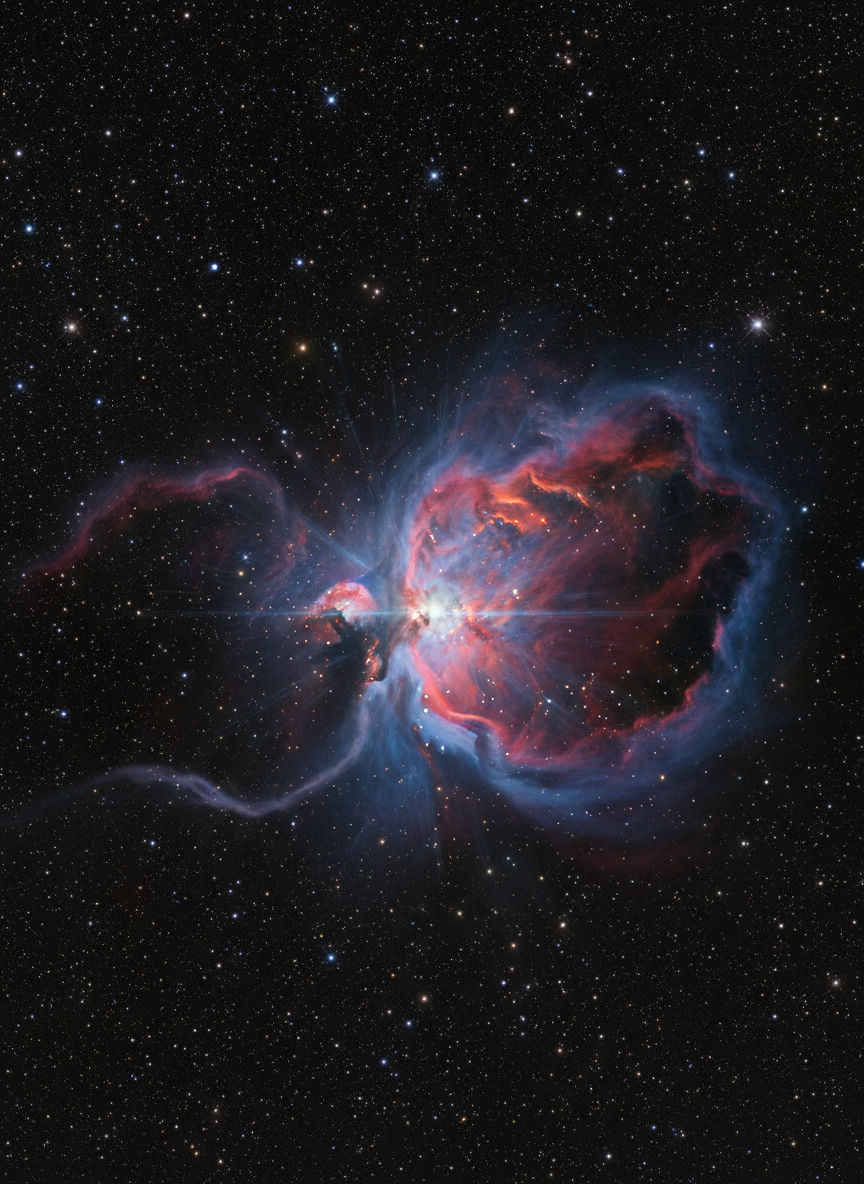
When you look at the Butterfly Nebula (officially known as NGC 6302), you might see delicate, glowing wings fluttering through deep space. But this stunning cosmic structure is actually a scene of spectacular and violent destruction.
Despite its peaceful, insect-like appearance, it is classified as a planetary nebula. This is a slightly misleading historical term coined by early astronomers—it actually has absolutely nothing to do with planets! Instead, a planetary nebula represents the glorious final act of a dying, intermediate-mass star.
Located roughly 3,400 light-years away from Earth in the constellation Scorpius, this giant cloud of glowing gas and dust spans an incredible distance. Its "wingspan" stretches about three light-years across, which is thousands of times larger than our entire solar system.
Instead of a gentle butterfly, you are witnessing the expelled outer layers of a massive stellar body, violently blown outward into the freezing vacuum of space. It is a beautiful but chaotic snapshot of stellar death.
Key Takeaway
The Butterfly Nebula is not a planet or an insect, but the massive, glowing remains of a dying star's outer layers.
Test Your Knowledge
What is a "planetary nebula"?
At the heart of every planetary nebula is a powerful stellar engine driving the cosmic light show. But if you look closely at the center of the Butterfly Nebula, you won't actually see a star. It is completely hidden behind a thick, dark band of dust shaped like a giant doughnut.
Deep inside that dusty torus lies a white dwarf—the incredibly dense, collapsed core of the original star. Although we cannot easily see it in standard visible light, advanced infrared and ultraviolet telescopes have pierced the dust to reveal its extreme nature.
This hidden core is one of the hottest stars ever discovered in our entire galaxy. Astronomers estimate its blistering surface temperature is at least 200,000 degrees Celsius (well over 400,000 degrees Fahrenheit).
This unimaginably hot stellar remnant acts like an intense ultraviolet spotlight. Its fierce radiation charges the surrounding clouds of expelled gas, causing the entire butterfly structure to fluoresce and glow brilliantly against the pitch-black backdrop of space.
Key Takeaway
The nebula is illuminated by an incredibly hot, dense white dwarf star hidden behind a thick ring of cosmic dust.
Test Your Knowledge
Why can't we easily see the star at the center of the Butterfly Nebula in visible light?
How exactly does a dying star manage to sculpt such perfect, symmetrical wings? The secret to this breathtaking shape lies in a cosmic collision between fast-moving stellar winds and the thick dust ring surrounding the star's equator.
Long before it became a collapsed white dwarf, the dying star swelled up into a massive red giant and gently shed its outer layers. This slower-moving gas gradually gathered and created the dense, doughnut-shaped disk around the star's middle.
Later in its evolution, as the star's exposed core heated up, it unleashed a much faster, more violent stream of particles known as a stellar wind. This high-speed wind slammed directly into the older, slower-moving gas.
Because the dense, dusty equator blocked the wind from expanding evenly in all directions, the fast-moving gas took the path of least resistance. It blasted outward through the star's top and bottom poles, creating the two enormous, hourglass-shaped lobes that we currently see as glowing "wings."
Key Takeaway
The butterfly shape is formed by fast stellar winds being channeled outward through the poles by a dense equatorial dust ring.
Test Your Knowledge
What forced the exploding gas into the shape of two wings?
You might naturally expect a violently dying star to be a barren, destructive wasteland, but the Butterfly Nebula is actually a massive, swirling chemistry lab. The sheer variety of elements and compounds found within its dusty wings is scientifically staggering.
Astronomers have detected abundant elements like oxygen, nitrogen, and sulfur, which mix together to give the nebula its vivid, colorful glow. But the real surprise lies in the complex molecules hiding deep within the cosmic dust.
Advanced telescope observations reveal a bizarre mixture of substances, including quartz, crystalline water ice, and silicates (the exact same stuff found in ordinary beach sand). Even more remarkably, researchers have found complex carbon-based molecules known as PAHs (polycyclic aromatic hydrocarbons).
Finding these carbon-rich organic molecules in an oxygen-rich environment is highly unusual. It suggests that the extreme shockwaves and intense radiation from the dying star are actively forging complex chemical building blocks—the same types of foundational molecules that are essential for the creation of planets and, ultimately, life itself.
Key Takeaway
The nebula contains a surprising mix of complex chemicals, including ice, quartz, and organic molecules, forged in extreme conditions.
Test Your Knowledge
Why is the chemistry of the Butterfly Nebula considered surprising?
The Butterfly Nebula isn't just a distant, beautiful curiosity; it actually acts as a stunning crystal ball for our own cosmic neighborhood. The original star that created this magnificent nebula was once very similar in size and composition to our own Sun.
In roughly 5 billion years, our Sun will finally run out of its internal nuclear fuel. When that inevitable day comes, it won't explode in a massive supernova. Instead, it will slowly swell into a massive red giant, swallowing the inner planets, before eventually shedding its outer atmospheric layers out into deep space.
Our Sun will also leave behind a glowing, super-dense white dwarf core. The expelled stellar gases will expand outward, catching the intense ultraviolet light of the dying core, and bloom into a brand new planetary nebula.
While we cannot know exactly what unique shape our solar system's final nebula will take, studying distant objects like the Butterfly Nebula helps astronomers understand the majestic, inevitable lifecycle of stars across the universe.
Key Takeaway
The Butterfly Nebula shows us the eventual fate of our own Sun, which will also shed its layers to create a glowing planetary nebula.
Test Your Knowledge
What does the Butterfly Nebula tell us about our own Sun?
Track your progress, earn XP, and compete on leaderboards. Download NerdSip to start learning.