What makes you alive? Discover the hidden rules governing every living thing.
Prompted by A NerdSip Learner
Grasp the 5 core principles driving all life.
Imagine a bustling, microscopic city. That’s a cell—the fundamental building block of all living things. Whether you are a towering redwood tree, a swimming blue whale, or the human reading this screen, you are essentially a massive collection of these tiny cities working in perfect harmony.
Inside each cell, different structures called organelles perform specific jobs, just like city departments. Some handle waste disposal, some build essential structures, and others serve as security to keep out invaders. The most famous organelle is the nucleus, which acts as the city hall, protecting the vital blueprints that tell the cell exactly what to do and when to do it.
Organisms can be as simple as a single cell (like bacteria) or as breathtakingly complex as a human being, containing an estimated 30 trillion cells! Despite their striking differences, all cells share common features, proving that at a microscopic level, all life on Earth is profoundly connected.
Key Takeaway
Cells are the basic, microscopic building blocks of all life, functioning like highly organized cities.
Test Your Knowledge
In the analogy of a cell as a city, what is an organelle?
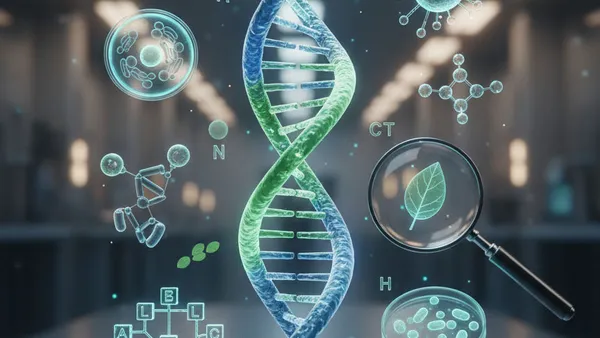
If the cell is a busy microscopic city, DNA (Deoxyribonucleic Acid) is the master blueprint securely stored in city hall. It is a long, beautifully coiled molecule shaped like a twisted ladder, famously known as a double helix.
This twisting molecule contains the precise instructions needed to build and operate you. It determines absolutely everything from your natural eye color to how your digestive system processes sugar. The "rungs" of this biological ladder are made of four chemical bases, commonly represented by the letters A, T, C, and G. The specific sequence of these four letters spells out the complex code of life.
Whenever your cells divide to help you grow or heal a scrape, they meticulously copy this DNA so the new cell knows exactly what to do. Occasionally, tiny typos happen during this copying process. These typos are called mutations, and while some do nothing at all, others can introduce brand new, fascinating traits!
Key Takeaway
DNA is a double helix molecule that carries the genetic code required to build and maintain an organism.
Test Your Knowledge
What do the letters A, T, C, and G represent in the context of DNA?
Nothing in the biological world happens without energy. To keep the cellular cities running smoothly, life requires a constant and reliable power supply. However, your cells cannot directly use a turkey sandwich or a ray of sunlight; they need a specific chemical currency called ATP.
Plants capture energy directly from the sun through the process of photosynthesis, ingeniously converting light into usable sugars. Animals, like us, have to eat plants or other organisms to acquire those essential sugars. Once consumed, a specialized organelle inside our cells called the mitochondrion—often affectionately nicknamed the "powerhouse of the cell"—gets to work.
The mitochondrion breaks down the fuel from your food and converts it into ATP. Your body then spends this chemical currency to do absolutely everything: thinking, breathing, running, and even blinking. Without this continuous energy conversion, life would instantly grind to a halt.
Key Takeaway
Mitochondria convert the fuel from your food into ATP, the universal chemical energy currency that powers cellular activity.
Test Your Knowledge
Which molecule acts as the direct energy currency for your cells?
How did planet Earth end up with millions of uniquely adapted, incredibly diverse species? The answer lies in evolution, the slow and magnificent process of biological change over vast periods of time.
The primary engine driving this continuous change is natural selection. Remember those tiny "typos" or mutations in our DNA we talked about earlier? Most are completely harmless, but sometimes a mutation gives an organism a slight advantage—like thicker fur in a freezing climate or a beak perfectly shaped to crack a particularly tough nut.
Organisms with these advantageous, environmentally-suited traits are more likely to survive, thrive, and reproduce. Over millions of years and countless generations, these small advantages accumulate, slowly transforming species and sometimes creating entirely new ones. It is life's brilliant way of constantly editing and optimizing itself to perfectly fit an ever-changing environment.
Key Takeaway
Evolution is driven by natural selection, where organisms with advantageous traits are more likely to survive and pass those traits on.
Test Your Knowledge
What is the primary mechanism that drives the process of evolution?
Imagine trying to walk a tightrope in the middle of a swirling windstorm. That is essentially what your body is doing every single second of the day. The environment outside is constantly fluctuating, but your internal environment needs to remain incredibly stable. This delicate and vital balancing act is called homeostasis.
If you get too hot on a summer day, you sweat to cool down. If your blood sugar drops, your brain makes you feel hungry. If you encounter a dangerous virus, your immune system intentionally ramps up a fever to fight it off. Your body is uniquely equipped with an intricate network of sensors and feedback loops that constantly monitor your internal state.
When something goes out of the acceptable range, your systems spring into action to seamlessly correct it. All living things—from the simplest single-celled bacteria to the most complex mammals—must continuously maintain homeostasis to survive. It is the ultimate testament to life's profound resilience.
Key Takeaway
Homeostasis is the active, continuous process by which living things maintain a stable internal environment despite external changes.
Test Your Knowledge
What happens when an organism successfully maintains homeostasis?
Track your progress, earn XP, and compete on leaderboards. Download NerdSip to start learning.