What happens when humans finally move to the Moon?
Prompted by A NerdSip Learner
Understand NASA's 2026 plan for a permanent Moon base.
For years, NASA's strategy for the Artemis program included building a mini-space station in lunar orbit called the Lunar Gateway. But space exploration moves fast!
In March 2026, NASA announced a massive strategic shift during its "Ignition" event. To accelerate our return to the Moon and establish a truly sustainable presence, the agency officially "paused" the Gateway project.
Instead, billions of dollars and major international resources are being redirected straight to the lunar surface. The new goal? Going all-in on the Artemis Base Camp. Rather than stopping at a midway orbital station, astronauts will travel directly to the Moon to build permanent infrastructure.
This bold move drastically speeds up the timeline for human habitation. The revised plan targets multiple commercial robotic landers and rapid crewed landings starting in 2028, ensuring that when humans return to the Moon, they are there to stay.
Key Takeaway
NASA shifted its focus in 2026 to prioritize a permanent surface base over an orbiting space station.
Test Your Knowledge
What major strategic change did NASA announce for the Artemis program in early 2026?
When Apollo astronauts landed on the Moon in the 1960s and 70s, they touched down near its equator. The Artemis Base Camp is targeting a much more challenging and rewarding destination: the lunar South Pole.
Why the extreme change in scenery? It all comes down to one vital resource: water.
At the lunar South Pole, the Sun hovers right at the horizon. This creates deep craters that are permanently cast in pitch-black shadow. Inside these freezing, ancient craters lies billions of years' worth of trapped water ice.
Finding water on the Moon is an absolute game-changer. Water doesn't just provide drinking supplies for astronauts—it can be broken down into oxygen for breathing and, crucially, hydrogen and oxygen for rocket fuel. By utilizing local resources instead of hauling everything from Earth, the Artemis Base Camp will become the first self-sustaining outpost in human history.
Key Takeaway
The Artemis Base Camp is located at the Moon's South Pole to harvest essential, life-sustaining water ice.
Test Your Knowledge
Why is the lunar South Pole the ideal location for the Artemis Base Camp?
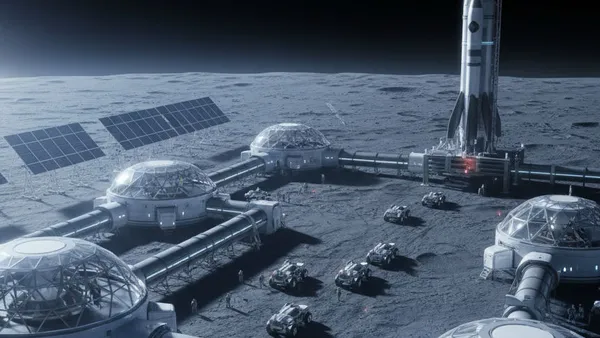
So, what will the Artemis Base Camp actually look like? It won't be a sprawling sci-fi city right away. The initial setup relies on three core pieces of cutting-edge infrastructure.
First is the Lunar Foundation Surface Habitat. This is the primary cabin where astronauts will live, work, and conduct research. It will shield them from extreme radiation and microscopic lunar dust.
Next is the Lunar Terrain Vehicle (LTV). Think of this as the classic Apollo-style "moon buggy"—an unpressurized, open-air rover that astronauts will drive while wearing their spacesuits for short scientific sprints.
Finally, there is the Habitable Mobility Platform. This is essentially a pressurized, heavily armored RV. Instead of being tethered to the main habitat, astronauts can live inside this roving home for weeks at a time, venturing hundreds of miles across the rugged lunar surface to explore uncharted craters in total comfort.
Key Takeaway
The base will feature a stationary main habitat, an open-air rover, and a pressurized mobile home for long-distance exploration.
Test Your Knowledge
What is the main purpose of the Habitable Mobility Platform?
One of the greatest challenges of living on the Moon is simply keeping the lights on. A single "day" on the Moon lasts for about 14 Earth days, followed by a punishing, freezing 14-day lunar night.
To survive this extreme environment, the Artemis Base Camp requires a massive and reliable energy grid. NASA's solution is a hybrid architecture often referred to as LunaGrid.
During the sunlit weeks, the base will rely on towering, vertically deployed solar arrays. These structures are designed to catch the low-angle sunlight at the South Pole.
But when darkness falls and temperatures plunge to roughly -280°F (-173°C), solar power isn't enough. That's why NASA is deploying nuclear fission surface reactors. These compact, incredibly efficient nuclear power plants will act as the "always-on" heartbeat of the base, ensuring astronauts stay warm and life-support systems continue running seamlessly through the long lunar night.
Key Takeaway
The Artemis Base Camp will use a hybrid system of solar arrays and nuclear fission reactors to survive the 14-day lunar night.
Test Your Knowledge
How will the Artemis Base Camp generate continuous power during the two-week-long lunar night?
The Artemis Base Camp is a monumental achievement on its own, but it serves an even larger purpose. The Moon is humanity's ultimate proving ground for a much more ambitious destination: Mars.
Earth and Mars are millions of miles apart. A mission there will take years, and a quick rescue operation is impossible. Before we send astronauts on that journey, we have to prove we can keep them safe in deep space.
By operating a permanent base on the Moon, scientists will learn how to mine extraterrestrial resources, build radiation-shielded habitats, and manage the physical and psychological toll of living on another world.
With NASA developing advanced nuclear-powered spacecraft to journey deeper into the solar system, the Artemis Base Camp acts as the critical sandbox. Every rover tested, every solar array deployed, and every drop of water mined on the Moon brings us one giant leap closer to the Red Planet.
Key Takeaway
The Artemis Base Camp is a vital practice arena to test the technologies needed for human missions to Mars.
Test Your Knowledge
What is the ultimate strategic purpose of building the Artemis Base Camp?
Track your progress, earn XP, and compete on leaderboards. Download NerdSip to start learning.