Could an ancient Greek device from 2,000 years ago actually be a super-complex computer?
Prompted by A NerdSip Learner
Identify how ancient technology predicted the future cosmos.
In 1901, sponge divers off the Greek island of Antikythera found a massive Roman shipwreck filled with treasures. Among the marble statues and jewelry, they pulled up a crusty, green lump of bronze that looked like a piece of junk.
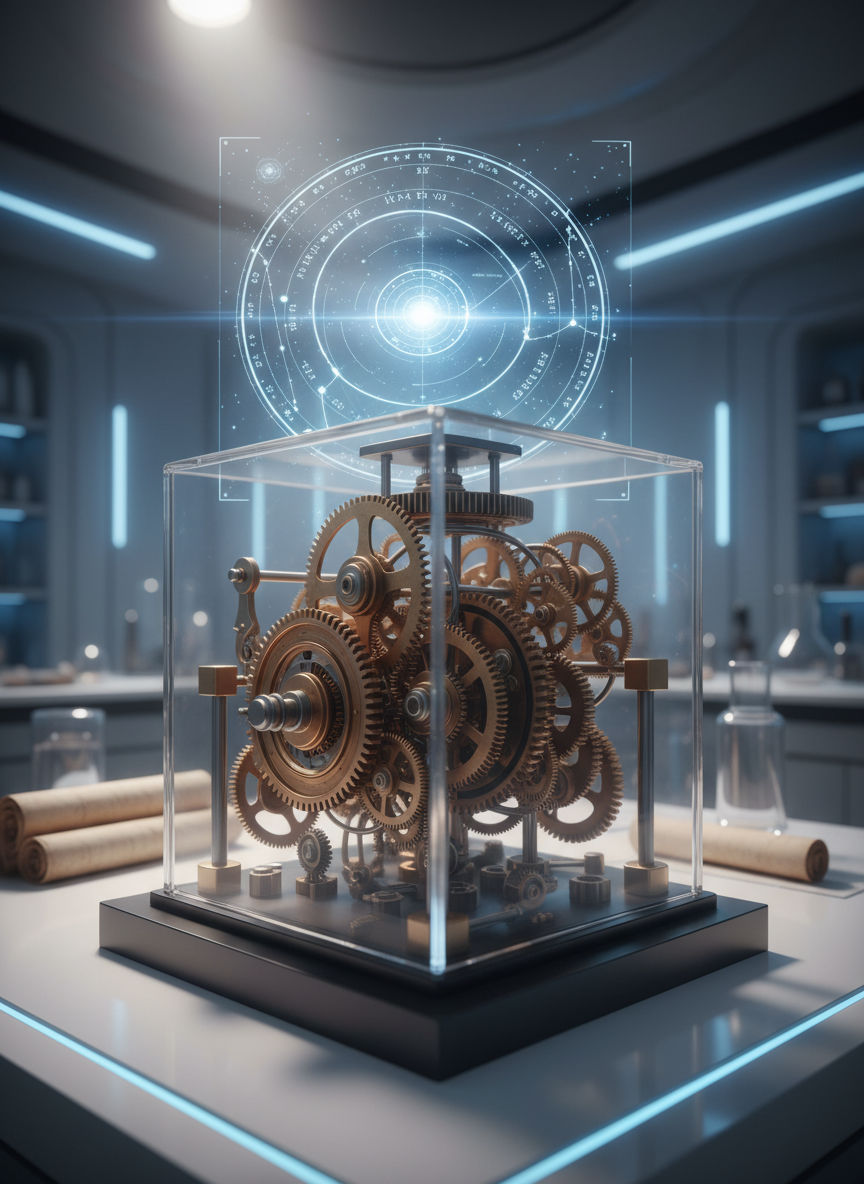
For decades, scientists ignored it while they polished the pretty statues. It wasn't until they used X-rays years later that they realized this 'rock' actually contained dozens of tiny, interlocking bronze gears.
This was a shock to historians because nothing this complex was supposed to exist for another 1,000 years. It changed everything we knew about what ancient civilizations were capable of building.
Key Takeaway
An accidental discovery in a shipwreck revealed an ancient device far more advanced than anyone thought possible.
Test Your Knowledge
Where was the 'world's first computer' found?
The Antikythera Mechanism is known as an analog computer. Unlike your phone, which uses electricity and code, this device used physical movement to solve math problems.
By turning a small hand-crank, the user could move roughly 30 bronze gears inside a wooden case. These gears were cut with incredible precision, some with teeth only a few millimeters long.
One of its most mind-blowing features was a 'pin-and-slot' mechanism. This allowed the device to mimic the way the Moon appears to speed up and slow down as it orbits Earth—a complex idea that requires serious math to calculate!
Key Takeaway
The device used interlocking gears to physically calculate the movements of space objects.
Test Your Knowledge
What type of computer is the Antikythera Mechanism?
What did this 'computer' actually compute? It was essentially a portable universe. On its front dial, pointers showed the positions of the Sun and Moon against the stars.
Recent research from 2024 suggests it used a 354-hole ring to track the Greek lunar year. It didn't just show where things were *now*; it could predict solar and lunar eclipses decades into the future.
Imagine being an ancient sailor or priest and being able to predict exactly when the Moon would turn red or the Sun would disappear, just by turning a handle! It gave the user 'god-like' knowledge of the sky.
Key Takeaway
The mechanism was a master at predicting astronomical events like eclipses and lunar phases.
Test Your Knowledge
What major astronomical event could the device predict?
The device wasn't just a machine; it was a textbook. The outside of its case was covered in tiny Greek inscriptions that acted like a user manual.
These inscriptions described the movements of the planets and even included a calendar for the Panhellenic Games, like the Olympics. It showed exactly which year the games would happen in various cities.
The text was so small (some letters are less than 2mm tall) that researchers had to use advanced CT scans to read them. These writings confirm the device was used to blend science, religion, and social life into one high-tech box.
Key Takeaway
Tiny inscriptions on the device provided instructions and a schedule for the ancient Olympic Games.
Test Your Knowledge
How did scientists eventually read the tiny writing on the device?
The biggest mystery isn't how it worked, but where it went. After the ship sank around 60 BC, the technology to build something this complex seemed to vanish from history.
We don't see gears this advanced again until the 14th century, when medieval cathedral clocks were built. That's a 1,500-year gap in human engineering!
Historians wonder if there were more of these devices or if this was a 'one-of-a-kind' masterpiece. Some believe the famous inventor Archimedes might have designed the original prototype, though we may never know for sure who the master builder was.
Key Takeaway
The technology inside the mechanism was so advanced that it wasn't matched for over a thousand years.
Test Your Knowledge
How long was the gap before humans built something as complex as this again?
Track your progress, earn XP, and compete on leaderboards. Download NerdSip to start learning.