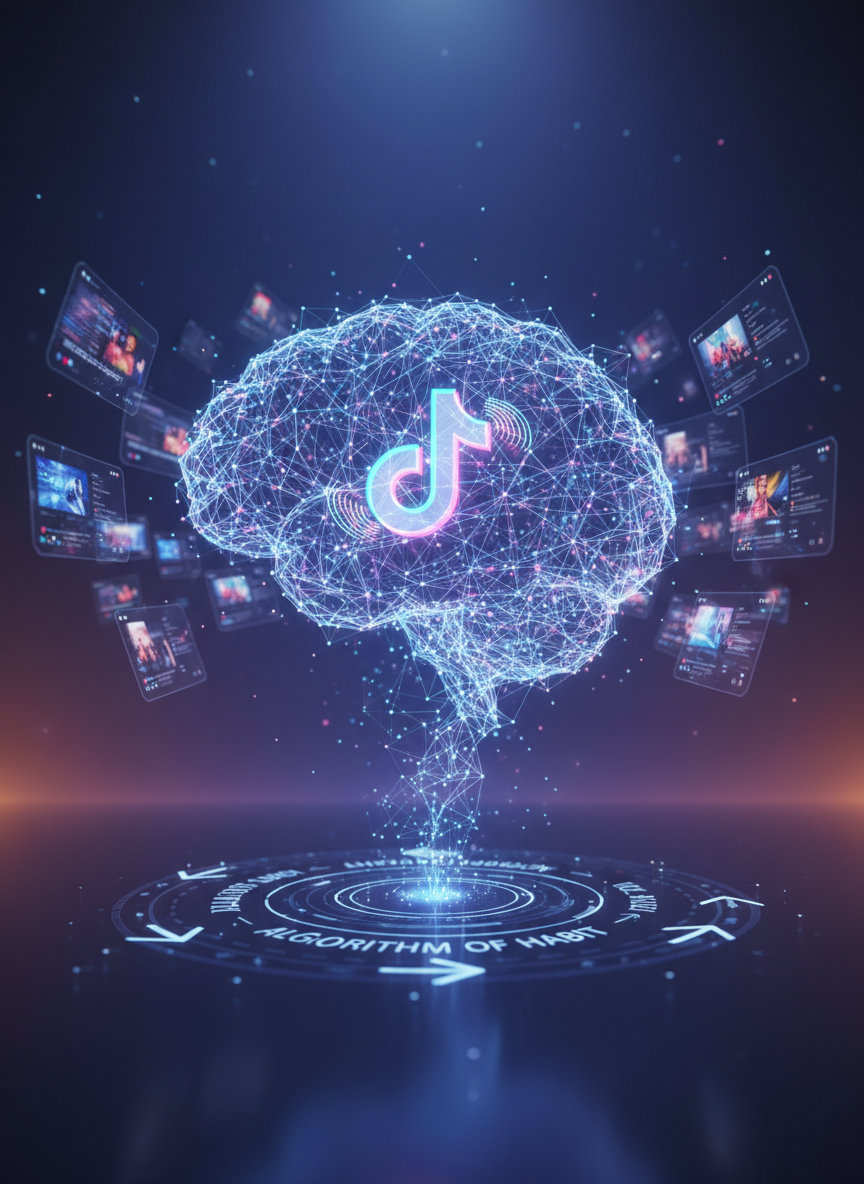
Ever wonder how TikTok knows exactly what you're thinking before you do?
Prompted by A NerdSip Learner
Decode the secret logic behind your For You Page.
Welcome to the party! Imagine you walk into a massive club with millions of songs. The DJ doesn't know you, but they are watching you closely. Every time you nod your head, they take a note. Every time you leave the dance floor, they notice. This is exactly how a Recommendation Engine works.
At its core, the algorithm isn't magic or a mind reader; it is simply a very observant robot. Its only goal is to find the next video that will keep your eyes glued to the screen. Unlike a human who might get tired, this digital DJ processes millions of options in a split second to serve you the perfect beat.
For a beginner, the most important thing to realize is that the app starts as a blank slate. It doesn't know *you* yet; it only knows patterns. You are the one training it with every single swipe, pause, and tap. You are the programmer of your own experience!
Key Takeaway
The algorithm is a reactive machine that learns entirely from your actions.
Test Your Knowledge
What is the primary goal of the recommendation algorithm?
So, how does the app know what you like? It acts like a detective looking for clues, or signals. You might think hitting the "Like" heart is the biggest clue, but that is actually just the tip of the iceberg. The algorithm cares about much subtler behaviors that are harder to fake.
The most powerful signal is Watch Time. If you watch a 15-second video all the way to the end, that is a huge thumbs up. If you watch it twice (looping), that is a gold medal! On the flip side, if you swipe away after one second, the algorithm learns you hate that topic.
It also looks at "negative signals." Did you tap "Not Interested"? Did you click on a creator's profile but leave immediately? All of these micro-actions feed a massive math equation that ranks the next video for you. It listens to what you *do*, not just what you say you like.
Key Takeaway
Your time spent watching a video is the strongest signal of interest.
Test Your Knowledge
Which action tells the algorithm you loved a video the most?
Older social media apps, like Facebook or Instagram (in the early days), were built on a Social Graph. This means they showed you stuff because your *friends* liked it. If your best friend posted a cat photo, you saw the cat photo. TikTok changed the game by using an Interest Graph instead.
An Interest Graph doesn't care who your friends are. It groups you with strangers who share your specific obsessions. Do you love oddly satisfying sand-cutting videos? The algorithm puts you in a "cluster" with other sand-cutting fans.
This is why you can go viral with zero followers. The system tests your video with a small group interested in that topic. If they engage, it pushes the video to a bigger group. It is a meritocracy of content, not a popularity contest based on how many people you know. Your feed is a reflection of your brain, not your contact list!
Key Takeaway
The algorithm connects you to content based on interests, not your friend list.
Test Your Knowledge
What determines what you see on an Interest Graph platform?
Have you ever been scrolling and suddenly saw a video that made zero sense? Maybe a video about deep-sea fishing when you usually only watch cooking clips? This isn't a mistake. This is a deliberate feature called Exploration.
If the algorithm only showed you things it *knew* you liked (Exploitation), you would eventually get bored. It needs to find out if you have developed new hobbies. So, it throws in a "Wildcard" video.
Think of it as a taste test. The algorithm is asking, "Hey, do you like fishing now?" If you swipe away instantly, it notes that down and won't show it again for a while. But if you watch it, you have just unlocked a whole new side of the internet! This balance between showing what you love and testing new things is what keeps the feed feeling fresh and endless.
Key Takeaway
Random videos are actually tests to see if your interests have changed.
Test Your Knowledge
Why does the algorithm show you random videos sometimes?
Why is it so hard to stop scrolling? It’s not just because the videos are funny. It’s because the system uses Variable Rewards. This is the exact same psychology used in slot machines at a casino.
When you pull the lever on a slot machine, you don't know if you will win. That uncertainty releases a brain chemical called Dopamine, which makes you feel excited. On TikTok, the "lever" is your thumb swiping up.
Sometimes you get a boring video (no win), sometimes you get an okay one (small win), and sometimes you find the funniest video ever (JACKPOT!). Because you don't know when the "Jackpot" video is coming, you keep swiping to chase that feeling. Understanding this biological trick is the first step to taking back control of your time and your attention span.
Key Takeaway
Unpredictable rewards release dopamine, creating a habit of continuous scrolling.
Test Your Knowledge
What psychological concept keeps you swiping?
Track your progress, earn XP, and compete on leaderboards. Download NerdSip to start learning.